
You don’t need wires in your skull to be controlled anymore. You just need a screen, a playlist, and a reason to scroll.
The best psychological operations aren’t run by governments anymore — they’re run by content teams.
Entertainment has become the smoothest delivery system for behavioral engineering in human history. And the scary part? You probably paid for your own programming.
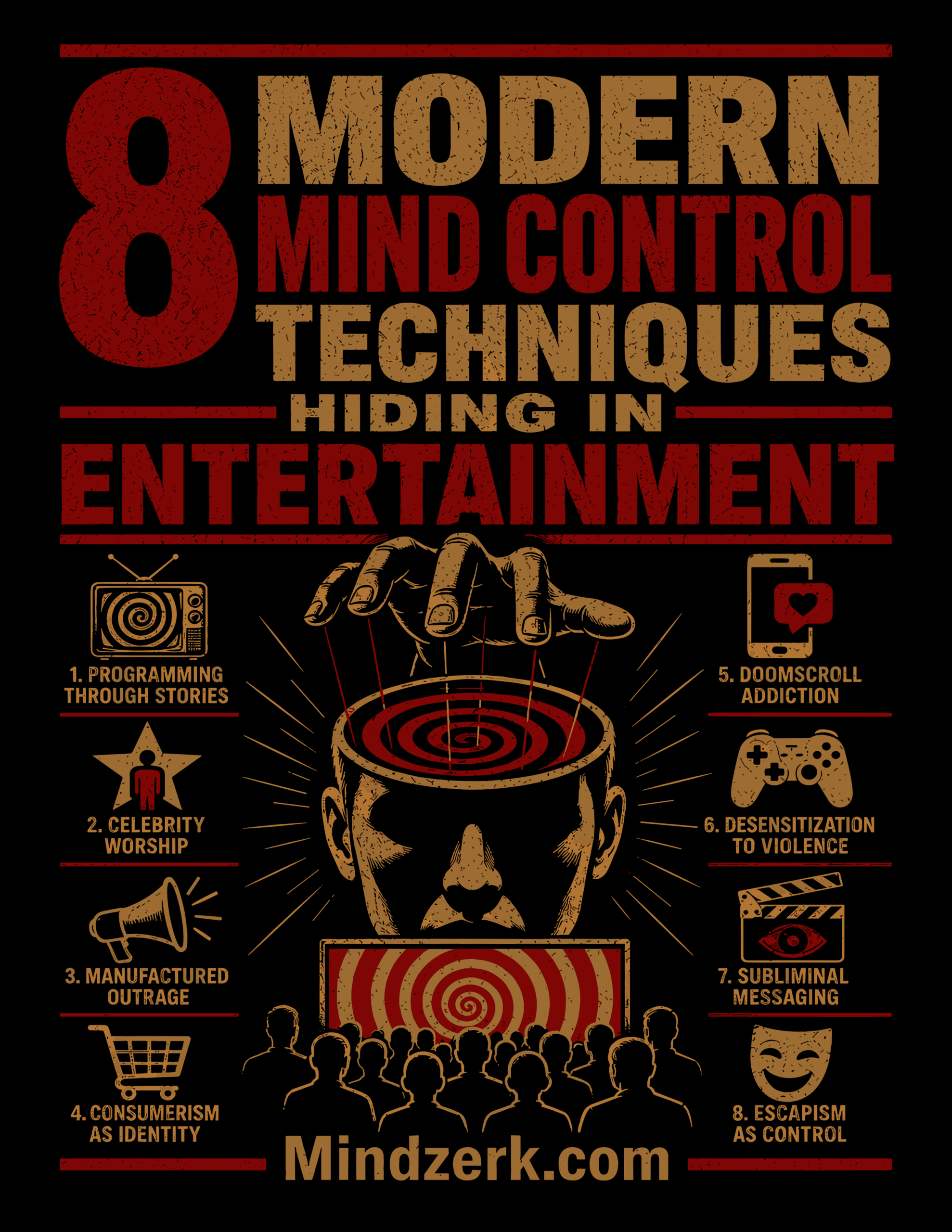
Let’s break down eight ways modern entertainment rewires your mind while pretending to “set you free.”
1. The Algorithmic Feed: The Infinite Scroll Hypnosis
The algorithm doesn’t want you informed — it wants you predictable.
Every platform you use learns your rhythm: what you like, when you’re weak, and how long it takes to keep you chasing that next dopamine drip.
TikTok, Instagram, YouTube — they’re all the same behavioral loop with different costumes. Scroll. Pause. Reward. Repeat. The system studies you better than your therapist could.
The result? You’re not “choosing” what you watch — you’re being trained what to want next. That’s not entertainment. That’s digital conditioning with a neon filter.
Mind control mechanism: Operant conditioning disguised as personalized content.
Effect: Dopamine fatigue and behavioral predictability.
2. The Nostalgia Trap: Emotional Regression as Control
Ever wonder why every reboot, remake, and retro revival hits you right in the childhood? It’s not nostalgia — it’s regression. You’re being pulled back into an emotional state where you were easiest to manipulate.
When you were a kid, you didn’t question authority. You trusted the screen. Now you’re an adult, but the screen learned how to talk to that inner child again.
This isn’t cultural recycling. It’s emotional engineering. You think you’re reconnecting with joy. You’re actually reconnecting with dependency.
Mind control mechanism: Re-triggering formative emotional imprints.
Effect: Comfort addiction, decreased critical analysis.
3. The Cult of the Celebrity Savior
Celebrities used to sell perfume and Pepsi. Now they sell ideology. Modern fame isn’t about talent — it’s about trust transfer.
When your favorite actor or pop star makes a political statement, your brain registers it with the same weight as a friend’s opinion. That’s by design.
Media corporations have merged the parasocial relationship with the political campaign. When a celebrity “takes a stand,” it’s rarely spontaneous. It’s coordinated brand engineering designed to keep your attention — and your allegiance.
The modern influencer isn’t a person. It’s an interface between the system and your subconscious.
Mind control mechanism: Parasocial manipulation.
Effect: Ideological alignment through emotional loyalty.
4. The Binge Effect: Narrative Entrapment
Streaming platforms turned storytelling into a behavioral drug. You don’t “watch” anymore — you submit.
Cliffhangers are psychological hooks designed to suspend resolution — the same method casinos use to keep gamblers spinning the wheel. You lose sleep, skip meals, and chase closure that never truly comes.
Binge culture is the illusion of control. “Next episode” feels like your choice, but it’s an engineered loop optimized to make you forget what time is.
When you wake up at 3AM halfway through season six, it’s not just exhaustion. It’s submission to serialized hypnosis.
Mind control mechanism: Variable reward cycles in narrative structure.
Effect: Sleep disruption and emotional dependency on fictional closure.
5. The Audio Weapon: Subliminal Syncing
Sound hits deeper than sight. Rhythm, frequency, and repetition bypass rational thought and slip straight into your nervous system. That’s why music and film soundtracks are potent tools of control.
Every trailer, scene, or track uses frequency manipulation — heart rate syncing, tension loops, and harmonic triggers to induce specific emotional states.
Mainstream pop music isn’t just catchy — it’s engineered addiction. Producers literally study which frequency progressions trigger limbic responses.
This is modern sorcery: waveform manipulation to induce compliance. And once your heartbeat syncs to the beat, you’re already under.
Mind control mechanism: Frequency entrainment and emotional synchronization.
Effect: Mood control through auditory triggers.
6. The Meme Weapon: Humor as Hypnosis
Memes aren’t jokes anymore. They’re micro-propaganda.
They bypass intellect and hit directly at tribal instinct. Every time you laugh, share, or caption something ironic — you reinforce a narrative framework built by someone else.
Memes are the new subliminal ad copy — short, repeatable, emotionally charged, and frictionless. They polarize, recruit, and divide faster than any manifesto could.
The CIA used to spend months designing cultural psy-ops. Now the same effect is achieved with a 12-word caption and a picture of a frog.
Mind control mechanism: Cognitive priming via humor and repetition.
Effect: Tribal reinforcement and ideological polarization.
7. The “Empowerment” Illusion
Nothing’s more profitable than selling rebellion back to the rebels. Corporations discovered that you’ll buy anything that makes you feel like you’re resisting them — even if they made it.
Every “edgy” ad, every “disruptive” brand, every “anti-establishment” message is just a marketing rebrand of the same hierarchy. They sell rebellion like a subscription. You’re not burning the system down — you’re decorating it.
That’s why “counterculture” is now a demographic. The moment rebellion can be quantified, it can be monetized — and once monetized, it’s no longer dangerous.
Mind control mechanism: Manufactured dissent.
Effect: Simulated individuality, real conformity.
8. The Virtual Ego: Identity Fragmentation
The final frontier of entertainment is you. Your online identity — the curated, filtered, exaggerated version of yourself — is the most effective self-imposed control mechanism ever created.
You willingly participate in your own surveillance. You build a character optimized for attention, not authenticity. You’re no longer living your story — you’re producing it.
The platforms reward the most performative version of you, and punish the quiet, grounded self that doesn’t engage. Your attention becomes your leash.
This isn’t mind control from above — it’s self-reinforcing hypnosis. You’ve been trained to perform your identity until the performance replaces the person.
Mind control mechanism: Self-surveillance through digital identity.
Effect: Dissociation from authentic experience.
The Entertainment Machine Is the New Church
People used to gather in cathedrals. Now they gather around screens. The rituals are the same: shared emotion, collective trance, symbolic imagery, and a charismatic high priest (or influencer) interpreting the meaning of the world for you.
The difference? The church wanted your faith. The feed wants your behavioral data.
Entertainment is the soft religion of the 21st century. It baptizes you in distraction, confirms you in consumption, and offers salvation through relevance.
The old priests warned of hell. The new ones warn of missing out.
Mind Control in Plain Sight
Mind control doesn’t look like hypnosis anymore. It looks like content. It looks like a friendly algorithm suggesting what to watch next. It looks like your favorite band releasing a “revolutionary” collab with a billion-dollar brand.
And it’s not even evil — it’s efficient. Control doesn’t require force when it can disguise itself as entertainment.
The point isn’t to scare you — it’s to remind you: awareness breaks the spell. Once you see the puppet strings, you start cutting them.
Counter-Spells for the Digital Age
- Break the rhythm. If the feed feels hypnotic, stop scrolling mid-swipe. Disrupt the loop.
- Limit nostalgia hits. Watch one old show, then do something new. Don’t let comfort be your leash.
- Mute the noise. Background sound is background programming. Choose silence sometimes.
- Laugh consciously. Every meme teaches ideology — decide which tribe you’re reinforcing.
- Stop performing. Don’t let algorithms curate your soul. Post less, live more.
- Track your dopamine. If something feels too good, it’s probably engineered that way.
- Consume backwards. Read what was banned, forgotten, or too weird for mainstream. That’s where free ideas hide.
- Make your own media. The best resistance is creation. Build your own signal.
Final Transmission
Entertainment is the new battlefield — and attention is the currency. The same tools that hypnotize can also awaken, depending on who holds the camera. So if you’re going to play in this psychic playground, do it consciously.
Make your art dangerous. Make your ideas contagious. And never forget: Mind control only works on those who stop thinking for themselves.