
Cloud storage is convenient.
That’s why almost everyone uses it.
Photos sync automatically.
Documents appear across devices.
Backups happen in the background.
It feels effortless.
But convenience and control are not the same thing.
The moment your files live on someone else’s servers, your privacy depends on:
- their policies
- their security
- their uptime
- their permissions
- their business decisions
That’s the tradeoff most people never think about.
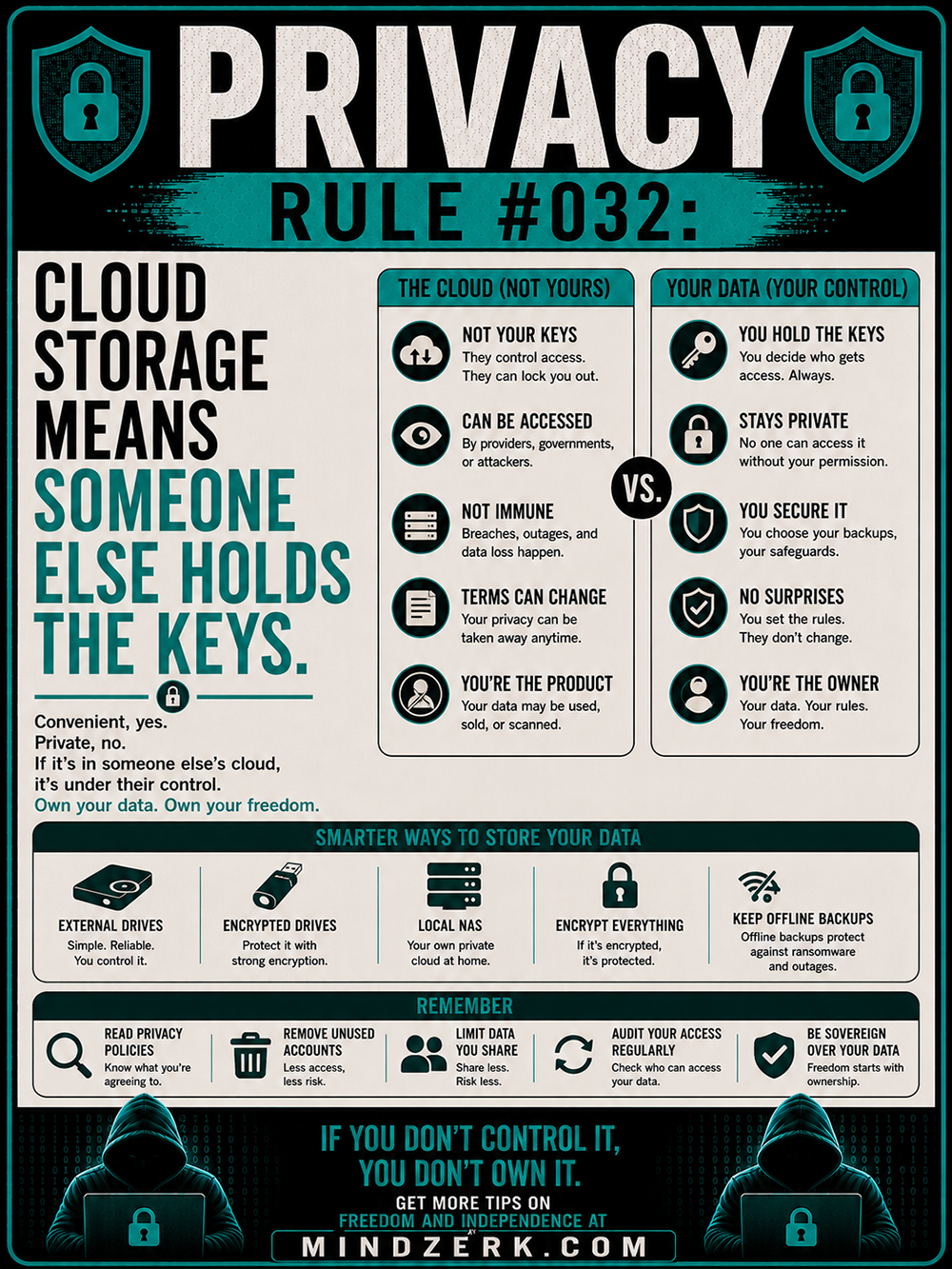
The Core Reality of Cloud Storage
If your data is stored in someone else’s cloud:
- they control the infrastructure
- they control access
- they control policy changes
- they control account recovery
- they control compliance requests
- they control what gets scanned, flagged, or removed
You may technically “own” the files.
But operationally, someone else holds the keys.
That matters.
Convenience Creates Dependence
Cloud systems are designed to become invisible.
That’s the point.
The less you think about them, the more deeply they integrate into your life:
- automatic backups
- synced passwords
- cloud photo libraries
- shared notes
- browser history
- documents
- contacts
- messages
Over time, people stop maintaining local control.
That creates dependence.
And dependence creates vulnerability.
“Not Your Keys” Applies to More Than Crypto
People often say:
“Not your keys, not your coins.”
The same principle applies to data.
If:
- someone else can lock your account
- scan your files
- remove access
- suspend your profile
- change terms overnight
Then your control is conditional.
Not absolute.
Cloud Services Can Be Accessed
People wrongly assume:
“Nobody cares about my data.”
That misses the point entirely.
Your information may still be exposed through:
- breaches
- hacked accounts
- weak passwords
- phishing attacks
- insider threats
- government requests
- third-party integrations
- automated scanning systems
Even if no human ever manually looks at your files, automated systems absolutely can.
Metadata alone reveals enormous amounts of information:
- who you talk to
- where you are
- what devices you use
- what you store
- how often you access it
Privacy is not just about file contents.
It’s also about behavioral patterns.
Terms Can Change Overnight
This is another overlooked risk.
Platforms evolve.
Policies shift.
Companies get acquired.
Features disappear.
Storage limits change.
Accounts get flagged automatically.
People build entire digital lives inside ecosystems they do not control.
Then one update changes everything.
That’s fragile infrastructure.
Smart Privacy Starts With Ownership
Privacy-focused people think differently.
Instead of asking:
“What’s easiest?”
They ask:
“What do I actually control?”
That leads toward:
- local backups
- encrypted storage
- offline archives
- private NAS systems
- external drives
- encrypted containers
- local-first workflows
Control creates resilience.
Better Ways to Store Important Data
External Drives
Simple. Reliable. Offline.
Great for:
- archives
- backups
- important documents
- photo collections
Offline storage dramatically reduces exposure.
Encrypted Drives
Encryption adds another layer between your data and outsiders.
Even if someone gains access physically, encrypted data remains protected.
Strong encryption matters.
Local NAS (Network Attached Storage)
A private cloud under your control.
You manage:
- permissions
- access
- backups
- hardware
- security
More responsibility.
Far more sovereignty.
Offline Backups
Offline copies protect against:
- ransomware
- outages
- account lockouts
- sync corruption
- accidental deletion
If everything is connected, everything can potentially be compromised.
Offline matters.
Encrypt Everything You Can
Encryption changes the equation.
Without encryption:
- providers may scan data
- attackers may read files directly
- breaches expose usable information
Encrypted data is far harder to exploit.
Even basic encryption dramatically improves security posture.
Audit Your Digital Exposure
Most people have no idea:
- what apps access their files
- which services are connected
- what old accounts still exist
- what devices sync automatically
That’s dangerous.
Review regularly:
- connected apps
- sharing permissions
- backup systems
- inactive accounts
- sync settings
- cloud integrations
Reduce unnecessary exposure.
Cloud Is a Tool — Not a Home
This is the healthiest mindset.
Cloud services can absolutely be useful.
But critical data should never exist only in someone else’s system.
Use cloud storage strategically:
- for convenience
- collaboration
- temporary syncing
- distribution
Not blind dependence.
Ownership Creates Freedom
Privacy and freedom are deeply connected.
The more your life depends entirely on systems controlled by others:
- the more vulnerable you become
- the less flexibility you have
- the easier you are to disrupt
Owning your data is part of owning your independence.
That doesn’t require paranoia.
Just awareness.
The Bottom Line
Cloud storage is easy.
But easy and private are not the same thing.
If someone else hosts your files:
- someone else controls the infrastructure
- someone else defines the rules
- someone else can change the system
That’s the reality.
Use the cloud carefully.
Encrypt what matters.
Keep local backups.
Own critical data whenever possible.
Because if you don’t control it, you don’t truly own it.