
The internet was built to connect things.
Your phone.
Your TV.
Your security cameras.
Your car.
Your bank account.
Your smart thermostat.
Your photos.
Your conversations.
Your work.
Your life.
Convenience is incredible.
But convenience has a price.
Every device you connect creates another path to your information.
That’s why:
This doesn’t mean panic.
It doesn’t mean unplugging everything and living in a cave.
It means understanding a simple reality:
If it’s online, assume someone besides you can eventually see it.
That’s the mindset that protects privacy.
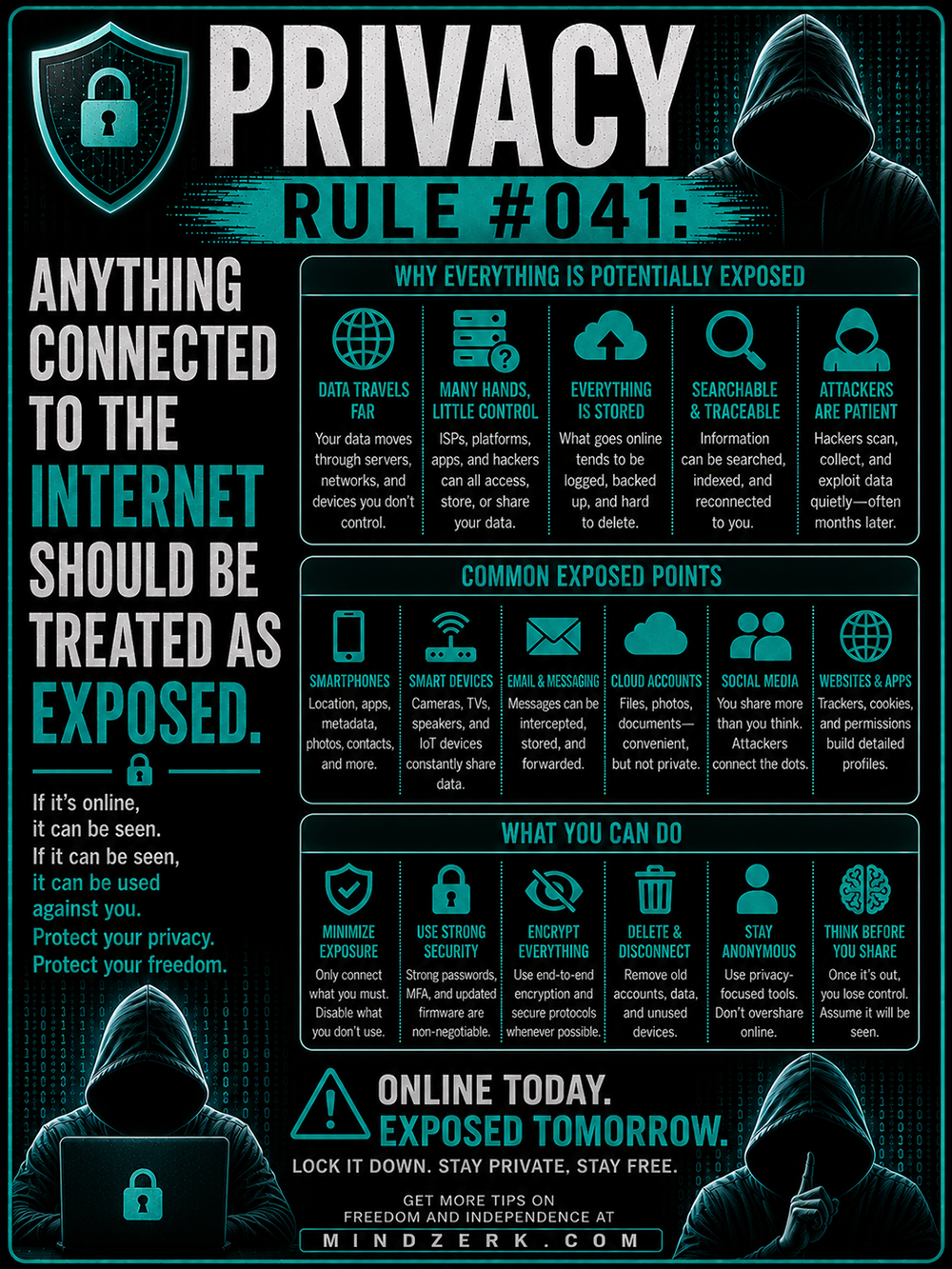
Why Everything Is Potentially Exposed
People often think privacy is about preventing hacks.
In reality, most exposure happens through ordinary technology working exactly as designed.
Apps collect data.
Services store information.
Companies build profiles.
Attackers look for opportunities.
The system doesn’t have to fail for your privacy to shrink.
Data Travels Far
When you send a message, upload a photo, or visit a website, your information doesn’t simply travel from Point A to Point B.
It passes through:
Internet providers.
Cell towers.
Cloud servers.
Content delivery networks.
Application servers.
Backup systems.
Third-party services.
Most of these systems aren’t under your control.
You trust them because modern life depends on them.
But trust isn’t ownership.
Many Hands, Little Control
Every online service adds another organization handling your data.
Social media companies.
Shopping websites.
Cloud storage providers.
Email services.
Streaming platforms.
Fitness trackers.
Smart home manufacturers.
Advertising networks.
Some protect data well.
Some don’t.
Some sell it.
Some lose it.
Once information leaves your hands, your control decreases dramatically.
Everything Gets Stored
Many people imagine the internet as temporary.
It isn’t.
Emails get archived.
Messages get backed up.
Photos get copied.
Search histories get logged.
Cloud services create duplicates.
Websites get cached.
Old information has a habit of surviving.
Deleting something doesn’t always mean it’s gone.
Searchable and Traceable
Small pieces of information seem harmless by themselves.
A photo.
A comment.
A location check-in.
A birthday.
A workplace.
A hobby.
Put enough pieces together and someone can build a surprisingly detailed picture of your life.
Privacy isn’t usually lost all at once.
It’s lost one small detail at a time.
Attackers Are Patient
Hollywood loves dramatic hacking scenes.
Reality is slower.
Attackers collect information quietly.
They monitor social media.
They study habits.
They gather email addresses.
They track usernames.
They wait for opportunities.
Sometimes weeks.
Sometimes months.
Sometimes years.
The information you share today could become useful much later.
Common Exposure Points
Many of the biggest privacy risks come from everyday devices.
Smartphones
Your phone knows almost everything.
Where you go.
Who you call.
What you search.
Who you text.
What photos you take.
What apps you use.
It’s one of the most valuable data collection devices ever created.
Treat it accordingly.
Smart Devices
Smart TVs.
Voice assistants.
Security cameras.
Doorbells.
Thermostats.
Baby monitors.
Smart appliances.
Convenience often comes with constant data sharing.
Ask yourself:
Does this device really need internet access?
Email and Messaging
People assume messages disappear.
Often they don’t.
Messages can be:
Stored.
Forwarded.
Copied.
Screenshotted.
Backed up.
Recovered.
Private conversations deserve careful thought.
Cloud Accounts
Cloud storage is incredibly useful.
It’s also someone else’s computer.
Photos.
Documents.
Financial records.
Personal files.
Backups.
Cloud services provide convenience, not absolute privacy.
Social Media
People share more than they realize.
Vacation plans.
Family relationships.
Daily routines.
Political opinions.
Workplaces.
Children.
Pets.
Birthdays.
Home renovations.
Attackers love patterns.
The more you reveal, the easier you become to understand.
Websites and Apps
Many websites track:
Clicks.
Purchases.
Searches.
Device information.
Location.
Browsing habits.
Advertising preferences.
Cookies and permissions create detailed digital profiles over time.
What You Can Do
Privacy isn’t about hiding.
It’s about being intentional.
Minimize Exposure
Ask one simple question:
Does this need to be connected?
Not every device benefits from internet access.
Disconnect what you don’t use.
Disable unnecessary features.
Reduce your digital footprint.
Use Strong Security
Strong passwords.
Password managers.
Multi-factor authentication.
Software updates.
Firmware updates.
Security patches.
Basic security habits prevent many common attacks.
Encrypt Everything
Encryption protects information while it’s moving and while it’s stored.
Use secure messaging.
Use encrypted backups.
Use encrypted storage when possible.
It won’t solve every problem, but it raises the cost of attacking you.
Delete and Disconnect
Old accounts become forgotten liabilities.
Unused apps.
Abandoned websites.
Old email addresses.
Dormant social media accounts.
Old cloud storage.
Remove what you no longer need.
The less that’s online, the less can be exposed.
Stay Anonymous When Appropriate
Not every activity requires your full identity.
Privacy-focused browsers.
Separate email addresses.
Limited personal details.
Thoughtful usernames.
Protecting privacy isn’t suspicious.
It’s practical.
Think Before You Share
This might be the most important habit of all.
Before posting, ask:
Could this identify me?
Could this reveal my location?
Could this expose my routine?
Could this embarrass me later?
Could this help someone impersonate me?
Could this affect my family?
Once information is public, control becomes difficult.
The Off-Grid Mindset for Digital Life
There’s an interesting lesson from off-grid living.
People who live off-grid often build redundancy.
Backup water.
Backup power.
Backup heating.
Backup food.
They assume systems can fail.
Privacy works the same way.
Assume technology can fail.
Assume accounts can be compromised.
Assume services can leak data.
Plan accordingly.
You don’t build stronger systems because you’re paranoid.
You build them because reality exists.
Privacy Is About Freedom
Many people think privacy means hiding something.
It doesn’t.
Privacy means choice.
The freedom to decide:
Who knows where you are.
Who knows your finances.
Who knows your relationships.
Who knows your routines.
Who knows your plans.
Every piece of information you protect gives you more control over your own life.
Online Today. Exposed Tomorrow.
Technology isn’t going away.
Neither are connected devices.
The answer isn’t to reject modern life.
The answer is to use it wisely.
Connect intentionally.
Share carefully.
Secure aggressively.
Delete regularly.
Question convenience.
Protect boundaries.
Because privacy rarely disappears overnight.
It fades through hundreds of small decisions.
A location shared here.
A photo posted there.
A new app installed.
An old account forgotten.
A smart device added to the house.
Each choice seems insignificant.
Together, they create a map of your life.
The goal isn’t perfection.
The goal is awareness.
Treat anything connected to the internet as potentially exposed.
Protect what matters.
Reduce unnecessary risk.
Build habits that favor privacy instead of convenience.
Because what goes online today may still exist tomorrow.
And freedom isn’t just the ability to connect.
It’s the ability to decide what stays yours.