
Off-grid living has a way of teaching hard lessons.
In town, a dripping faucet is annoying.
Off-grid, it’s lost water.
A loose wire isn’t just an inconvenience.
It could mean losing refrigeration, communication, or power when you need it most.
A loose hinge becomes a broken door.
A dirty solar panel becomes a dead battery.
A neglected generator becomes a very expensive lawn ornament.
The biggest off-grid disasters rarely arrive all at once.
They start small.
That’s why:
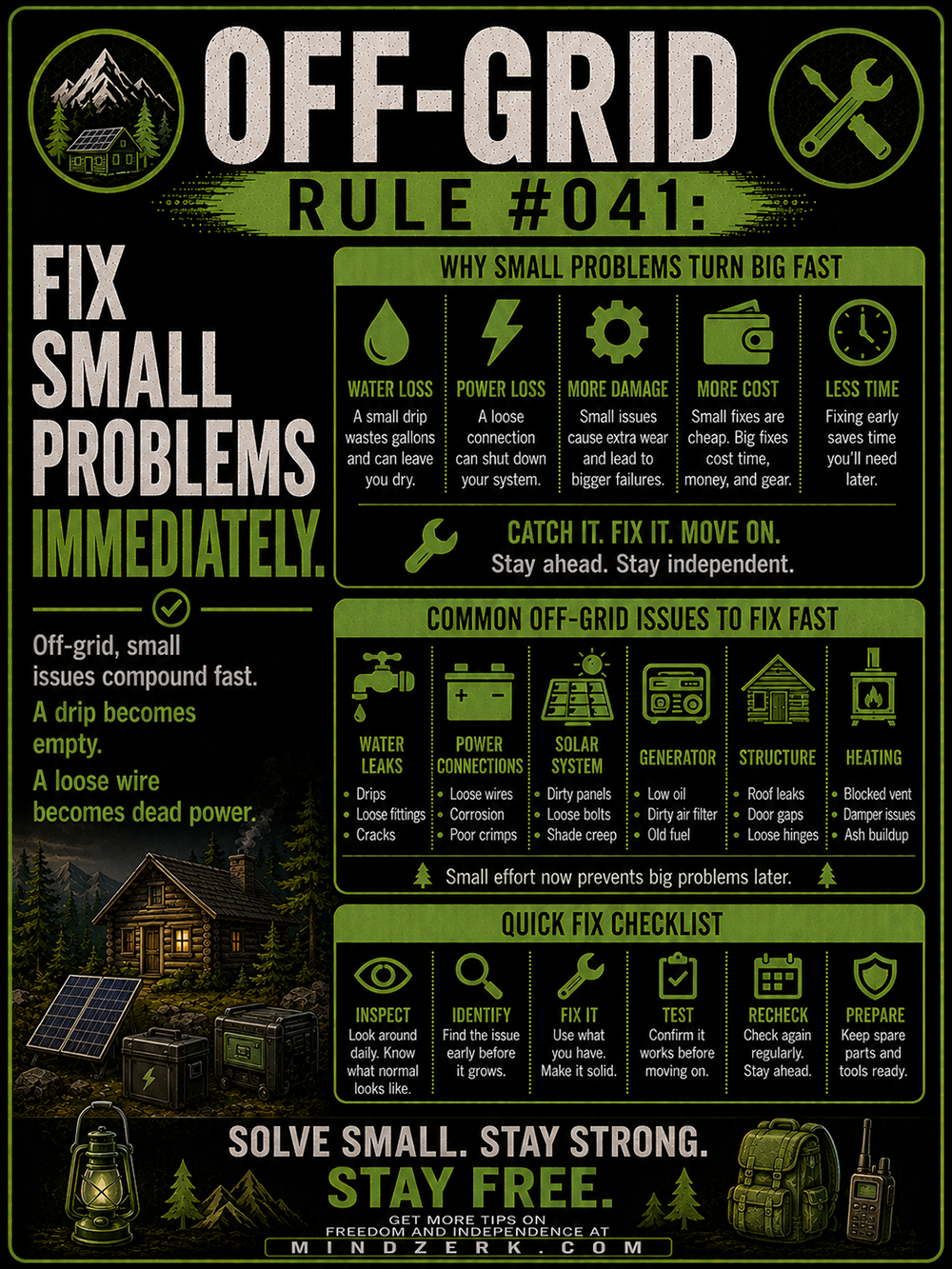
A drip becomes empty.
A loose wire becomes dead power.
Small issues compound fast.
Catch them early.
Fix them.
Move on.
Why Small Problems Become Big Problems
Modern life hides the consequences of neglect.
City water keeps flowing.
The power company fixes outages.
A plumber is one phone call away.
Off-grid systems don’t have that luxury.
You are the maintenance department.
You are quality control.
You are emergency response.
Small failures don’t stay small for long.
Water Loss
Water is life.
A tiny leak can waste hundreds of gallons over time.
Loose fittings slowly fail.
Small cracks become bursts.
Storage tanks empty when you aren’t paying attention.
The fix might cost five dollars today.
Ignoring it could cost an entire water supply tomorrow.
Power Loss
Electricity off-grid depends on dozens of small connections.
Battery terminals.
Solar wiring.
Fuse holders.
Ground connections.
Corrosion and vibration slowly loosen things.
One bad connection can shut down an entire system.
Many power failures aren’t complicated.
They’re simply neglected maintenance.
Small Damage Creates Bigger Damage
Tiny problems spread.
A roof leak damages insulation.
Then wood.
Then drywall.
Then wiring.
A loose deck board becomes structural rot.
A cracked hose destroys a garden.
A sticking latch becomes a broken gate.
Small repairs prevent chain reactions.
Early Repairs Save Money
Emergency repairs are expensive.
Preventive maintenance is cheap.
Ten-dollar clamps prevent thousand-dollar leaks.
Fresh sealant prevents major water damage.
Cleaning a solar panel costs nothing.
Replacing one because neglect destroyed it costs plenty.
The cheapest repair is almost always the one you make first.
Early Repairs Save Time
Off-grid projects already demand attention.
Adding emergencies creates chaos.
Fixing a problem while it’s small might take ten minutes.
Waiting could steal an entire weekend.
Or worse.
Fixing early means spending less time fixing later.
Common Off-Grid Problems to Watch
The best off-grid operators develop habits.
They know where systems usually fail.
They look there first.
Water Leaks
Check for:
- Drips
- Loose fittings
- Small cracks
- Wet ground
- Tank seepage
Water always wins if you let it.
Power Connections
Inspect:
- Battery terminals
- Wire crimps
- Connectors
- Corrosion
- Ground points
Electricity likes solid connections.
Loose ones become heat.
Heat becomes failure.
Solar Systems
Look for:
- Dirty panels
- Loose bolts
- Shade growth
- Frayed wiring
- Damaged mounts
Trees grow.
Panels get dusty.
Performance slowly drops until someone notices.
Don’t wait for the batteries to go flat.
Generators
Generators hate neglect.
Check:
- Oil levels
- Air filters
- Fuel quality
- Spark plugs
- Battery condition
Run them regularly.
A generator that sits unused for a year usually picks the worst possible day to fail.
Structures
Walk around your buildings.
Look for:
- Roof leaks
- Loose boards
- Door gaps
- Hinge wear
- Foundation shifts
Weather never takes a day off.
Neither should inspections.
Heating Systems
Wood stoves and heaters need attention.
Watch for:
- Blocked vents
- Damaged seals
- Excess ash
- Dirty chimneys
- Poor draft
Heat isn’t something you want to troubleshoot during a snowstorm.
The Quick Fix Checklist
Good maintenance isn’t complicated.
It follows a simple pattern.
1. Inspect
Look around every day.
Know what normal looks like.
You can’t spot change if you never look.
2. Identify
Ask:
What’s different?
What’s leaking?
What’s loose?
What’s making a strange noise?
The sooner you notice, the easier the repair.
3. Fix It
Use what you have.
Tighten the bolt.
Replace the clamp.
Patch the crack.
Clean the filter.
Don’t wait for the perfect solution.
A good repair today beats a perfect repair next month.
4. Test
Never assume.
Turn the water back on.
Start the generator.
Check the battery voltage.
Run the pump.
Make sure the repair actually worked.
5. Recheck
Problems like to return.
Inspect repaired areas regularly.
Trust, but verify.
6. Prepare
Keep supplies on hand.
Extra fittings.
Spare hose clamps.
Wire connectors.
Sealant.
Fuses.
Spare bolts.
Basic hand tools.
Preparedness turns emergencies into inconveniences.
Build a Habit of Maintenance
The most successful off-grid people aren’t always the strongest or smartest.
They’re consistent.
They notice things.
They clean tools.
Check batteries.
Walk fence lines.
Inspect roofs.
Oil hinges.
Tighten bolts.
Maintenance isn’t exciting.
It’s freedom insurance.
The Broken Window Effect of Off-Grid Living
Neglect attracts more neglect.
One messy corner becomes two.
One loose board becomes a damaged porch.
One ignored repair becomes several.
The opposite works too.
One small repair encourages another.
A clean, organized property stays that way more easily.
Momentum matters.
The Off-Grid Mindset
This rule isn’t really about leaks or wires.
It’s about discipline.
Small actions prevent big disasters.
Five minutes today saves five hours tomorrow.
A twenty-dollar repair prevents a two-thousand-dollar replacement.
A quick inspection prevents a dangerous failure.
The people who seem lucky off-grid usually aren’t lucky.
They’re observant.
They fix things while they’re still small.
Solve Small. Stay Strong. Stay Free.
Off-grid freedom doesn’t come from owning land.
Or solar panels.
Or generators.
It comes from maintaining the systems that support your independence.
Every small repair is an investment.
Every inspection buys peace of mind.
Every tightened bolt protects your future.
Don’t wait for a crisis.
Don’t hope the problem fixes itself.
Catch it.
Fix it.
Move on.
Because off-grid life rewards the people who pay attention.
A drip becomes empty.
A loose wire becomes dead power.
A tiny crack becomes a major repair.
But a five-minute fix today can prevent a week-long disaster tomorrow.
Solve small.
Stay strong.
Stay free.