
Most people think privacy starts with stronger passwords.
Or better antivirus software.
Or a VPN.
Those things help.
But they all miss the biggest truth about privacy.
You can’t steal what doesn’t exist.
You can’t leak what wasn’t stored.
You can’t sell what was never collected.
That’s why:
Every account.
Every app.
Every loyalty card.
Every survey.
Every “Accept All Cookies.”
Every free service.
Every online quiz.
They’re all asking for one thing.
Data.
And once you hand it over, you rarely get it back.
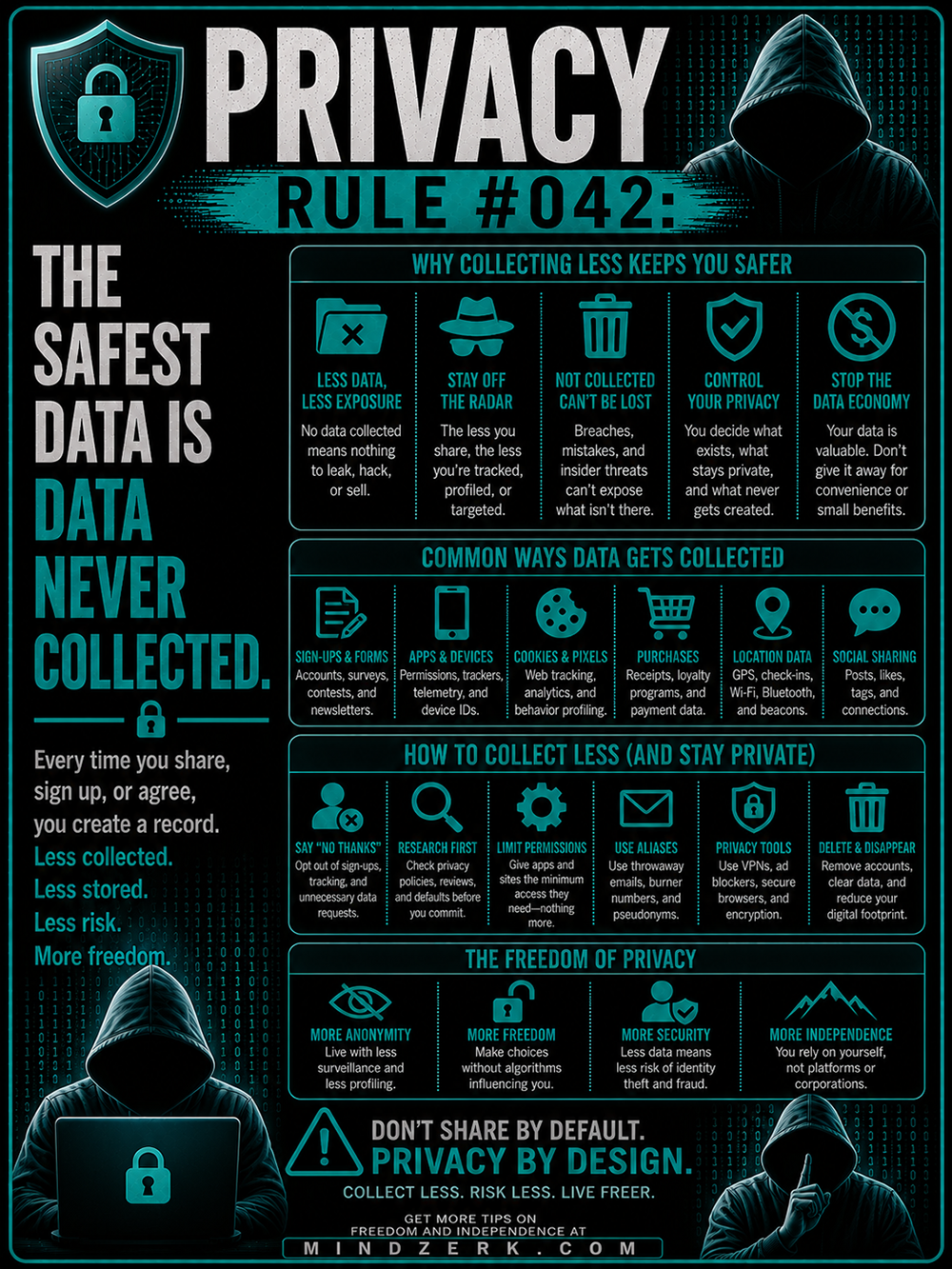
Why Collecting Less Keeps You Safer
Privacy isn’t about hiding.
It’s about reducing unnecessary risk.
The less information that exists about you, the fewer opportunities there are for mistakes, breaches, and abuse.
Think of your personal information like cash.
The less you leave lying around, the less there is to steal.
Less Data Means Less Exposure
Every piece of information creates another target.
Your email.
Phone number.
Birthday.
Address.
Shopping habits.
Political opinions.
Family members.
Travel patterns.
Each one adds another puzzle piece.
Attackers don’t need everything.
They just need enough.
The fewer pieces available, the harder the puzzle becomes.
Stay Off the Radar
Modern tracking isn’t just about advertising.
Companies build detailed profiles.
What you buy.
Where you go.
What you search.
Who you know.
What time you wake up.
What restaurants you visit.
What products you almost purchased.
The more you share, the easier you are to predict.
Privacy means becoming harder to profile.
Data That Doesn’t Exist Can’t Be Lost
Every year brings another major data breach.
Millions of accounts leak.
Passwords.
Credit cards.
Medical records.
Addresses.
Personal messages.
Companies can promise security.
They can’t promise perfection.
But information that was never collected can’t be exposed.
The safest database is the one that was never created.
You Control Your Privacy
Privacy isn’t all or nothing.
It’s a series of choices.
Every form you fill out.
Every permission you grant.
Every account you create.
Every photo you upload.
You decide what becomes permanent.
The less unnecessary information you create, the more control you keep.
Stop Feeding the Data Economy
Many online services appear free.
They’re not.
You often pay with information.
Your attention.
Your habits.
Your location.
Your relationships.
Your interests.
Your behavior becomes the product.
Before sharing information, ask:
Am I paying for convenience with my privacy?
Common Ways Data Gets Collected
Most collection happens quietly.
People often don’t notice it.
Sign-Ups and Forms
Every account requests something.
Name.
Birthday.
Phone number.
Email.
Interests.
Occupation.
Sometimes more than necessary.
Ask yourself:
Do they really need this?
Apps and Devices
Many apps request permissions unrelated to their purpose.
A flashlight app doesn’t need your contacts.
A simple game probably doesn’t need location tracking.
Many devices constantly collect:
Usage patterns.
Device identifiers.
Telemetry.
Background activity.
Read permissions before clicking Allow.
Cookies and Tracking Pixels
Websites follow visitors.
Advertising networks connect activity across multiple sites.
Tiny bits of code can create detailed profiles of your interests.
Clearing cookies helps.
Blocking trackers helps even more.
Purchases
Stores collect:
Purchase history.
Payment methods.
Loyalty memberships.
Shopping preferences.
Returns.
Browsing habits.
Over time, your spending creates a surprisingly detailed biography.
Location Data
Phones reveal:
GPS locations.
Wi-Fi networks.
Bluetooth signals.
Check-ins.
Travel routes.
Daily routines.
Location history can expose where you live, work, and spend time.
Social Sharing
Photos.
Comments.
Likes.
Tags.
Friend lists.
Group memberships.
Vacation pictures.
Celebration posts.
Small details combine into a larger picture than most people realize.
How to Collect Less
Privacy isn’t about disappearing.
It’s about being intentional.
Learn to Say No
You don’t need every account.
Every newsletter.
Every rewards program.
Every online contest.
Every optional survey.
Sometimes the best privacy tool is declining.
Research Before You Commit
Read privacy policies.
Look at reviews.
Check what permissions apps request.
See what information companies collect.
A few minutes of research can prevent years of exposure.
Limit Permissions
Many apps ask for more access than they need.
Disable:
Location tracking.
Microphone access.
Camera access.
Contacts.
Background activity.
Grant only what’s necessary.
Use Aliases
Separate identities reduce risk.
Use:
Dedicated email addresses.
Burner phone numbers.
Pseudonyms where appropriate.
Separate accounts for different purposes.
One breach won’t expose everything.
Use Privacy Tools
Simple tools make a difference.
VPNs.
Secure browsers.
Ad blockers.
Password managers.
Encrypted messaging.
Two-factor authentication.
None are perfect.
Together they reduce risk.
Delete and Disconnect
Old accounts don’t disappear by themselves.
Unused apps.
Forgotten forums.
Old cloud storage.
Unused subscriptions.
Delete what you no longer need.
Reduce your digital footprint over time.
The Freedom of Privacy
Privacy isn’t just about security.
It’s about independence.
More Anonymity
Less sharing means less profiling.
Less profiling means fewer assumptions about who you are.
More Freedom
Algorithms influence decisions.
Recommendations.
News feeds.
Advertising.
Purchases.
The less data they collect, the less influence they have.
More Security
Identity theft.
Fraud.
Scams.
Social engineering.
Many attacks depend on personal information.
Less data means fewer attack opportunities.
More Independence
The less you rely on platforms storing your life, the more control you maintain.
Privacy supports self-reliance.
Convenience Has a Cost
Many privacy sacrifices seem harmless.
One app.
One account.
One loyalty program.
One quiz.
One free download.
One social media post.
One location check-in.
None seem important alone.
Together they create a permanent record.
Privacy usually isn’t lost in one dramatic event.
It’s surrendered one convenience at a time.
Practice Privacy by Design
The best privacy strategy isn’t reacting after a breach.
It’s planning ahead.
Before sharing, ask:
Do they really need this?
Could I leave this blank?
Can I use an alias?
Will I care if this exists ten years from now?
What happens if this database gets hacked?
Small questions prevent big problems.
The Privacy Mindset
You don’t have to disappear.
You don’t have to avoid technology.
You don’t have to live off the grid.
You simply need to become intentional.
Collect less.
Share less.
Store less.
Trust less by default.
Protect what matters.
Because the strongest firewall isn’t software.
It’s deciding what information never gets created in the first place.
Don’t Share by Default. Privacy by Design.
Every piece of data has a lifecycle.
It’s collected.
Stored.
Copied.
Shared.
Sold.
Backed up.
Analyzed.
Sometimes leaked.
Sometimes stolen.
Sometimes forgotten by you but remembered by the internet forever.
The safest information isn’t encrypted information.
It isn’t hidden information.
It isn’t password-protected information.
It’s information that never existed in someone else’s database.
Collect less.
Store less.
Risk less.
Live freer.
Because the safest data is, and always will be, data never collected.