
Most people think productivity breakthroughs come from giant changes.
A new AI tool.
A new software platform.
A complete business overhaul.
A massive automation project.
Sometimes those things help.
But most long-term gains come from something much smaller.
A better email template.
A faster content process.
A cleaner workflow.
A shortcut that saves two minutes.
A checklist that prevents mistakes.
Tiny improvements don’t look impressive on day one.
They become impressive after day 365.
That’s why:
The goal isn’t finding one magical productivity hack.
The goal is becoming slightly better every day.
Why Small Improvements Matter
People often underestimate compounding because they focus on immediate results.
Saving three minutes doesn’t feel life-changing.
Neither does reducing one mistake.
Or improving one workflow step.
But business isn’t built on single actions.
It’s built on repeated actions.
Anything repeated hundreds or thousands of times deserves optimization.
That’s where AI becomes powerful.
Not because it replaces everything.
Because it improves everything.
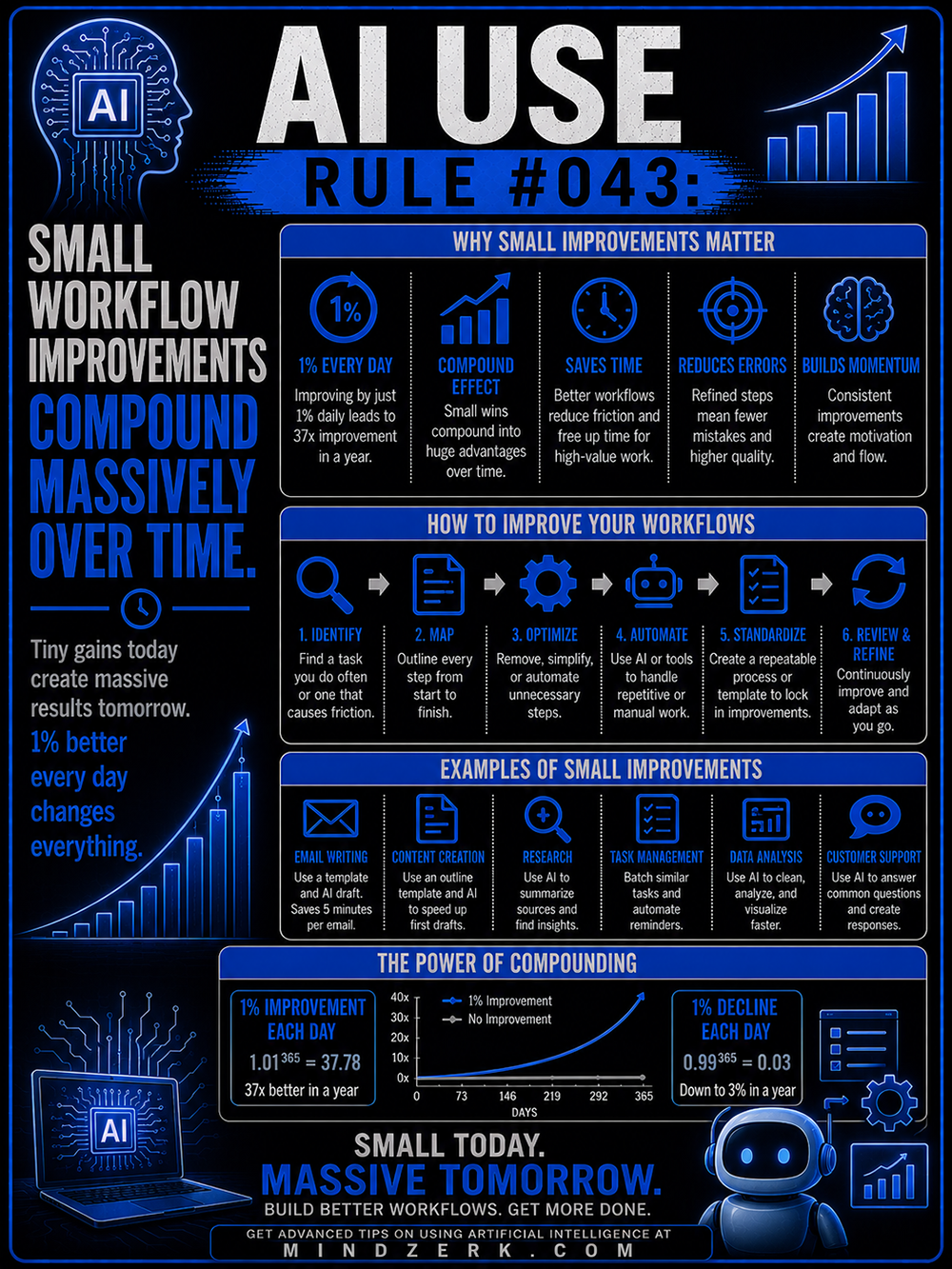
The 1% Rule
Imagine improving a workflow by just 1%.
Almost nobody gets excited about that.
Yet small improvements stack.
The famous compounding example shows:
1.01 raised to the power of 365 equals roughly 37.
That means getting 1% better every day doesn’t make you slightly better.
It makes you dramatically better.
The opposite is also true.
Tiny inefficiencies compound into major problems.
Small delays become lost days.
Minor mistakes become expensive failures.
Workflow improvement works in both directions.
Better Workflows Save Time
Most people don’t realize how much time leaks from their day.
Searching for files.
Rewriting the same emails.
Repeating research.
Formatting documents.
Switching between tools.
Answering the same questions.
Making the same decisions.
None of these feel expensive.
Together they consume hours.
AI helps eliminate those leaks.
And recovered time becomes available for higher-value work.
Better Workflows Reduce Errors
Humans make mistakes.
Especially during repetitive tasks.
The hundredth copy-and-paste is usually where the error happens.
The fiftieth customer response.
The twentieth spreadsheet update.
The tenth report.
AI systems can reduce those repetitive mistakes when properly designed and supervised.
Fewer errors means less rework.
Less rework means faster progress.
Better Workflows Build Momentum
Momentum is one of the most underrated forces in business.
People often lose momentum because work feels harder than it should.
Too many steps.
Too much friction.
Too much confusion.
Every workflow improvement removes resistance.
And when work becomes easier to start, it becomes easier to continue.
How to Improve Your Workflows
Improvement doesn’t start with automation.
It starts with observation.
Step 1: Identify Friction
Pay attention to tasks that annoy you.
Tasks you procrastinate.
Tasks you repeat.
Tasks that consume more time than they should.
Those are improvement opportunities.
The biggest workflow upgrades often start with irritation.
Step 2: Map the Process
Write down every step.
Start to finish.
Don’t assume you know the workflow.
Document it.
Most people discover unnecessary complexity the moment they see their process on paper.
Step 3: Optimize First
Don’t automate bad processes.
Fix them first.
Remove unnecessary steps.
Combine actions.
Simplify decisions.
Create clarity.
Automation should accelerate a good workflow, not a broken one.
Step 4: Automate Repetition
Now bring AI into the process.
Look for:
- Data entry
- Categorization
- Research summaries
- Draft creation
- Email responses
- Scheduling
- Reporting
- Content repurposing
If a task follows rules and repeats often, AI can probably help.
Step 5: Standardize
The best workflow is repeatable.
Create templates.
Checklists.
Standard operating procedures.
Prompt libraries.
Reusable systems.
Consistency creates scale.
Step 6: Review and Refine
No workflow stays perfect forever.
Tools change.
Markets change.
Businesses change.
Review systems regularly.
Ask:
- What’s slowing me down?
- What’s still manual?
- What’s creating mistakes?
- What could be simplified?
Small improvements continue indefinitely.
Examples of Small AI Improvements
Most productivity gains aren’t dramatic.
They’re practical.
Email Writing
Instead of writing every email from scratch:
- Create response templates
- Use AI for first drafts
- Standardize common replies
Saving five minutes per email adds up quickly.
Content Creation
Many creators waste hours staring at blank pages.
Use AI to:
- Generate outlines
- Create first drafts
- Expand bullet points
- Repurpose content
The goal isn’t replacing creativity.
It’s accelerating execution.
Research
Research can consume huge amounts of time.
AI can:
- Summarize articles
- Extract key points
- Compare information
- Organize findings
You spend less time gathering information and more time using it.
Task Management
Small automations reduce mental clutter.
Examples:
- Automatic reminders
- Follow-up triggers
- Status updates
- Project checklists
Less remembering.
More doing.
Data Analysis
Instead of manually reviewing spreadsheets:
- Summarize trends
- Flag anomalies
- Generate reports
- Visualize data
AI turns information into insight faster.
Customer Support
Many customer questions repeat.
Use AI to:
- Draft responses
- Build FAQ systems
- Categorize requests
- Escalate complex cases
Customers get faster answers.
You save time.
The Power of Compounding
Most people chase dramatic improvements.
The real winners chase consistent ones.
A workflow that saves:
- 2 minutes per task
- 5 minutes per email
- 10 minutes per report
- 15 minutes per project
May not seem impressive.
But multiplied across months and years, those gains become enormous.
Small improvements become large advantages.
Large advantages become competitive moats.
AI Is a Workflow Multiplier
The biggest mistake people make with AI is looking for complete replacement.
The better approach is continuous improvement.
Ask:
- What can be faster?
- What can be simpler?
- What can be automated?
- What can be standardized?
- What can be eliminated?
Then improve one thing.
Not everything.
One thing.
Then another.
Then another.
Small Today. Massive Tomorrow.
The most productive people rarely work harder forever.
They build systems that improve forever.
Every workflow contains hidden opportunities.
A few saved minutes.
A few fewer mistakes.
A few smarter automations.
A few better templates.
Each one seems insignificant alone.
Together they transform how much you can accomplish.
That’s the power of compounding.
Not giant breakthroughs.
Tiny improvements repeated consistently.
So don’t ask:
“How can I completely transform my business today?”
Ask:
“What’s one workflow I can improve by 1%?”
Then do it again tomorrow.
And the day after that.
Because the future belongs to people who compound.
Small today. Massive tomorrow.
Build better workflows. Get more done.