
Most privacy problems don’t begin with hackers.
They begin with convenience.
A coworker needs access to a folder.
A contractor needs temporary credentials.
A third-party app wants permission to connect.
A friend borrows an account.
A service asks for access “just this once.”
The request seems harmless.
The access is granted.
Then everyone forgets about it.
Weeks become months.
Months become years.
And suddenly a temporary exception has become a permanent vulnerability.
That’s why:
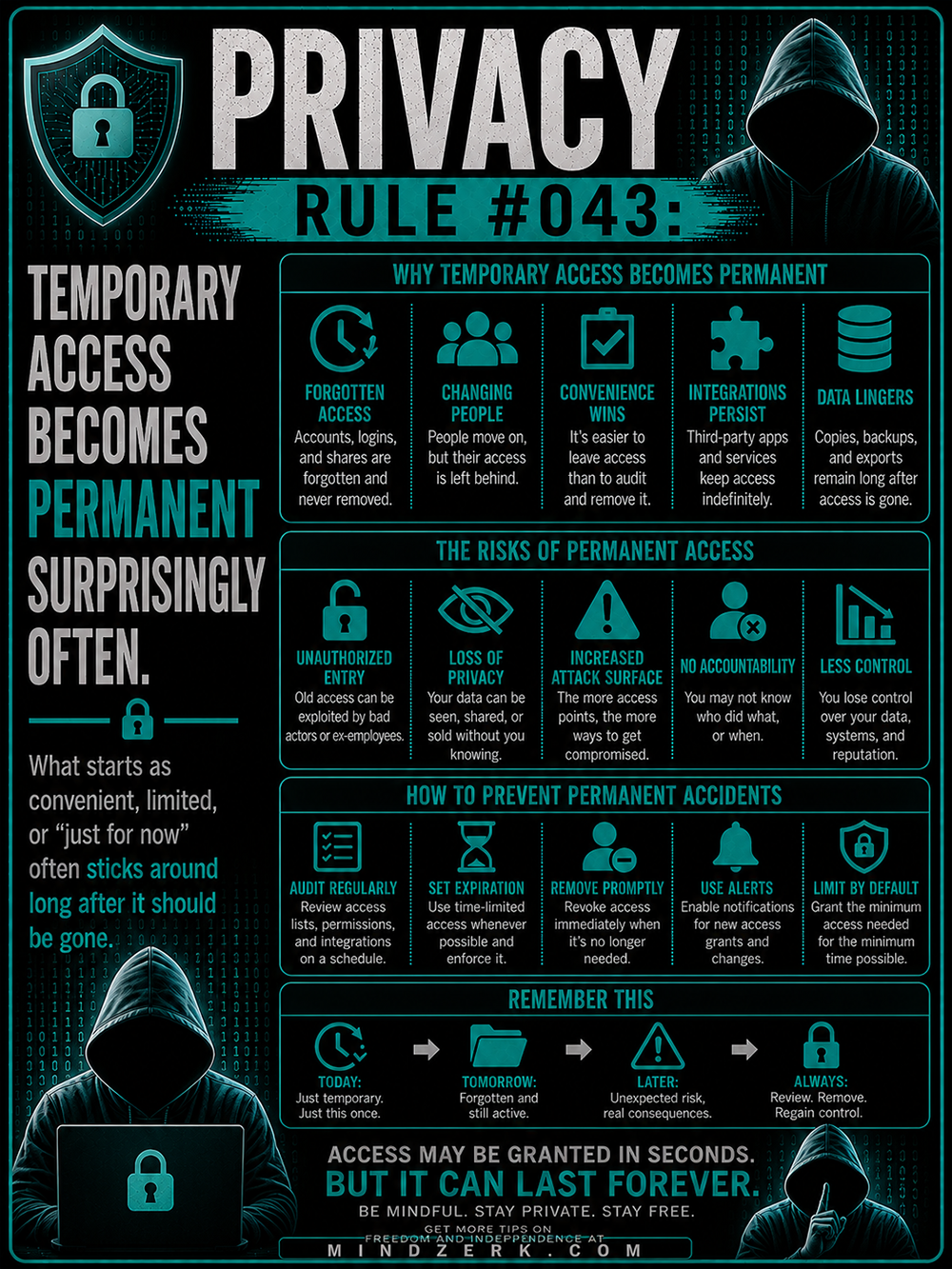
What starts as convenience often outlives its purpose.
The safest access is the access that no longer exists.
Why Temporary Access Sticks Around
Most people assume that temporary access eventually disappears.
It usually doesn’t.
Systems don’t clean themselves up.
Permissions don’t revoke themselves.
Integrations don’t uninstall themselves.
People move on.
Projects end.
Employees leave.
Vendors change.
But access often remains.
This creates hidden exposure that grows quietly over time.
Forgotten Access Is Everywhere
The biggest privacy risks are often the ones nobody remembers.
Old cloud shares.
Unused logins.
Former employees.
Expired contractors.
Test accounts.
Third-party integrations.
Legacy applications.
Shared passwords.
The problem isn’t that these things were created.
The problem is that they were never removed.
Every forgotten permission is another possible entry point.
People Change Faster Than Permissions
One of the biggest assumptions we make is that trust stays permanent.
It doesn’t.
People change jobs.
Relationships end.
Companies get acquired.
Partners become competitors.
Employees move on.
Contractors disappear.
The access you granted to a trustworthy person three years ago may now belong to someone you barely know.
Access should never be granted permanently based on temporary circumstances.
Convenience Is the Enemy of Cleanup
Most security failures aren’t caused by laziness.
They’re caused by convenience.
Removing access takes effort.
Reviewing permissions takes time.
Auditing systems isn’t exciting.
So people postpone it.
Then forget it.
The result is digital clutter filled with unnecessary permissions and lingering access.
Convenience creates exposure one unchecked box at a time.
Third-Party Integrations Never Sleep
Modern life runs on connected services.
Email tools.
Calendar apps.
Social media schedulers.
Cloud storage.
AI assistants.
Payment processors.
Marketing platforms.
Each integration creates another path into your data.
Many of these connections remain active indefinitely.
Even when you stop using the service.
Even when you forget it exists.
Every connected account deserves regular review.
Data Often Remains After Access Is Gone
Revoking access doesn’t always remove copies.
Files may have been downloaded.
Exports may have been created.
Backups may still exist.
Data may have been synchronized to another platform.
This is why privacy isn’t just about granting access carefully.
It’s about minimizing what gets shared in the first place.
The less data exposed, the less data remains behind.
The Risks of Permanent Access
The danger isn’t always immediate.
It’s cumulative.
Unauthorized Entry
Old permissions create unexpected ways into systems.
An abandoned account can become an attack path.
A forgotten integration can become an exposure point.
The longer access remains, the greater the risk.
Loss of Privacy
Data may be viewed, copied, shared, or analyzed long after the original purpose is gone.
Many privacy breaches begin with information that was technically authorized years earlier.
Larger Attack Surface
Every account.
Every permission.
Every integration.
Every connected service.
Adds another potential weakness.
Security is often less about building walls and more about reducing doors.
Reduced Accountability
If ten people have access, who changed the file?
Who downloaded the report?
Who modified the settings?
The more unnecessary access exists, the harder accountability becomes.
Less Control
Control over your information decreases as access expands.
Privacy is largely a game of minimizing unnecessary exposure.
The fewer hands involved, the easier it is to maintain control.
How to Prevent Permanent Access Accidents
Good privacy habits are simple.
Most people just don’t practice them consistently.
Audit Regularly
Schedule recurring reviews.
Check:
- User accounts
- Shared folders
- Cloud permissions
- Connected apps
- API keys
- Team access lists
Review access like you review finances.
Regularly.
Not after a problem appears.
Use Expiration Dates
Whenever possible, create temporary permissions.
Grant access for:
- One day
- One week
- One project
- One contract
Then require renewal.
If the access is still needed, it can be granted again.
If not, it disappears automatically.
Remove Access Immediately
Projects end.
Contracts finish.
Employees leave.
The access should end at the same time.
Not next week.
Not next month.
Immediately.
Enable Alerts
Many platforms allow notifications when:
- New users are added
- Permissions change
- Integrations connect
- Accounts log in
Visibility creates awareness.
Awareness prevents surprises.
Grant the Minimum Necessary
This principle is known as least privilege.
Give people access only to what they need.
Only for as long as they need it.
The less access granted, the less risk created.
A Simple Privacy Habit
Once every quarter, ask:
Who can access my data?
Then ask:
Who still needs to?
Most people are surprised by what they find.
Old services.
Unused tools.
Former collaborators.
Forgotten shares.
Stale permissions.
Removing them often takes minutes.
The protection can last years.
Temporary Should Mean Temporary
The most dangerous access is rarely the newest.
It’s the oldest.
The permission nobody remembers.
The integration nobody uses.
The account nobody reviews.
The share link nobody revoked.
Privacy is not only about blocking threats.
It’s about cleaning up leftovers.
Because today’s convenience can become tomorrow’s vulnerability.
And tomorrow’s forgotten access can become next year’s security incident.
So remember:
Grant access carefully.
Review it regularly.
Remove it aggressively.
Because access may be granted in seconds—
but it can last forever.
Stay mindful. Stay private. Stay free.