
Most people try to make more money by working harder.
More hours.
More effort.
More tasks.
More hustle.
For a while, that works.
Then reality shows up.
There are only 24 hours in a day.
Your energy has limits.
Your attention has limits.
Your time has limits.
At some point, working harder stops creating meaningful growth.
That’s when leverage becomes the answer.
That’s why:
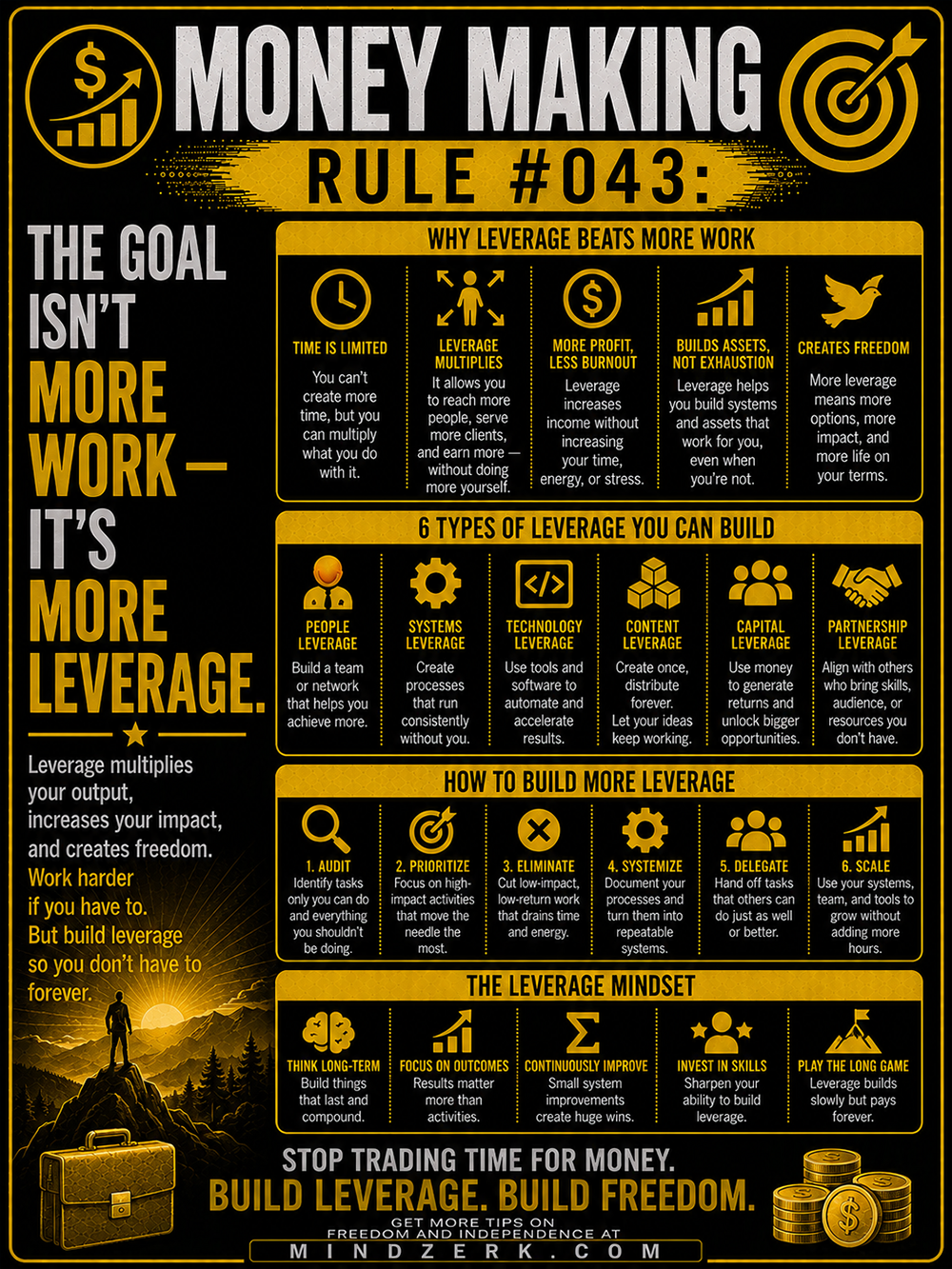
Work hard if you must.
But build leverage so you don’t have to forever.
Why Leverage Beats More Work
Most people understand effort.
Few people understand multiplication.
Leverage is the ability to create more results without personally doing more work every time.
It’s the difference between:
- Carrying water by hand
- Building a pump
The pump still requires work.
But once it’s built, the output becomes larger than the effort.
The same principle applies to money.
The people who create lasting wealth usually aren’t doing more tasks.
They’re building systems that multiply the value of their effort.
Time Is Your Most Limited Resource
Money can be earned again.
Energy can be recovered.
Skills can be learned.
Time only moves one direction.
Every income strategy based entirely on your personal labor has a ceiling.
You can only work so many hours.
You can only serve so many clients.
You can only take so many calls.
You can only handle so many projects.
Leverage breaks that limitation.
Instead of selling hours, you start building assets.
More Profit, Less Burnout
Working harder often creates a hidden problem.
Burnout.
More clients.
More responsibilities.
More stress.
More complexity.
Leverage allows income to grow without requiring the same increase in effort.
A well-designed system can serve:
- 10 customers
- 100 customers
- 1,000 customers
Without increasing your workload at the same rate.
That’s how sustainable growth happens.
Build Assets, Not Exhaustion
Many people accidentally spend years building jobs for themselves.
They’re always working.
Always producing.
Always chasing the next paycheck.
The alternative is building assets.
Assets continue creating value after the initial work is done.
Examples include:
- Websites
- Digital products
- Intellectual property
- Content libraries
- Automated systems
- Email lists
- Software
- Investments
An asset works when you’re working.
Sometimes it works when you’re sleeping.
That’s leverage.
Six Types of Leverage You Can Build
Leverage comes in many forms.
The smartest businesses often combine several.
1. People Leverage
A team multiplies your capabilities.
One person can only do so much.
A coordinated group can accomplish far more.
Employees.
Contractors.
Partners.
Specialists.
Communities.
Every person adds capacity beyond your individual limits.
2. Systems Leverage
Systems create consistency.
A documented process removes guesswork.
Checklists.
Workflows.
Templates.
Standard operating procedures.
Systems allow work to happen predictably and repeatedly.
3. Technology Leverage
Technology amplifies output.
Automation.
Software.
Artificial intelligence.
Digital tools.
Technology allows a single person to accomplish what once required entire teams.
4. Content Leverage
Create once.
Benefit repeatedly.
A blog post.
A video.
A guide.
A course.
A podcast.
Content continues attracting attention, generating leads, and building trust long after it’s published.
5. Capital Leverage
Money can work too.
Investments.
Dividend-producing assets.
Revenue-generating properties.
Business ownership.
Capital allows resources to create additional resources.
6. Partnership Leverage
You don’t need to build everything yourself.
Strategic partnerships combine strengths.
One person has an audience.
Another has expertise.
Another has systems.
Together they create outcomes neither could achieve alone.
How to Build More Leverage
Leverage isn’t built by accident.
It requires intentional design.
Step 1: Audit Your Work
Look at everything you do.
Ask:
- What only I can do?
- What anyone could do?
- What shouldn’t be done at all?
Most people spend too much time on low-value tasks.
Step 2: Prioritize High-Impact Activities
Not all work matters equally.
Focus on activities that:
- Generate revenue
- Build assets
- Create opportunities
- Strengthen relationships
- Increase future leverage
Busy and productive are not the same thing.
Step 3: Eliminate Low-Return Work
Some tasks simply aren’t worth doing.
Remove them.
Simplify them.
Automate them.
Ignore them.
Every unnecessary task steals time from building leverage.
Step 4: Systemize Everything
Whenever you repeat something twice, ask:
“Can this become a system?”
Document the process.
Create a checklist.
Build a template.
Establish a workflow.
Repeatability is the foundation of leverage.
Step 5: Delegate
Many entrepreneurs become bottlenecks.
Not because they’re lazy.
Because they refuse to let go.
If someone else can perform a task at 80-90% of your level, it may be time to delegate.
Your goal isn’t doing everything.
Your goal is building something bigger than yourself.
Step 6: Scale What Works
Once a system produces results:
Expand it.
Replicate it.
Improve it.
Leverage grows when successful systems reach more people without requiring proportionally more effort.
The Leverage Mindset
Building leverage requires a different way of thinking.
Think Long-Term
Leverage grows slowly.
At first.
The early stages often feel frustrating because results lag behind effort.
But leverage compounds.
Patience matters.
Focus on Outcomes
Many people measure activity.
Successful people measure results.
The market doesn’t reward effort.
It rewards value.
Always ask:
“What outcome am I creating?”
Continuously Improve
Small system improvements create massive gains over time.
A better workflow.
A stronger process.
A smarter automation.
Tiny upgrades compound into enormous advantages.
Invest in Skills
The ability to create leverage is itself a valuable skill.
Learn:
- Communication
- Marketing
- Sales
- Systems thinking
- Technology
- Leadership
These skills multiply everything else.
Play the Long Game
Leverage often feels slow.
Until suddenly it isn’t.
Most overnight successes are years of leverage finally paying off.
Stop Trading Time for Money
There is nothing wrong with hard work.
Hard work is often necessary.
But hard work alone has limits.
Leverage changes the equation.
Instead of constantly asking:
“How can I work more?”
Ask:
“How can I make this work without me?”
That’s the question that creates freedom.
Because wealth isn’t built by doing more forever.
It’s built by creating systems, assets, and opportunities that continue producing value long after the original effort is complete.
The ultimate goal isn’t a bigger workload.
It’s a bigger impact.
More options.
More control.
More freedom.
Stop trading time for money.
Build leverage. Build freedom.