
Optimism is useful.
It helps you start projects, solve problems, and push through difficult days.
But optimism alone won’t keep the lights on during a week-long power outage.
It won’t provide clean water when a pump fails.
It won’t cook dinner when your only fuel source runs dry.
Off-grid living rewards preparation, not assumptions.
That’s why:
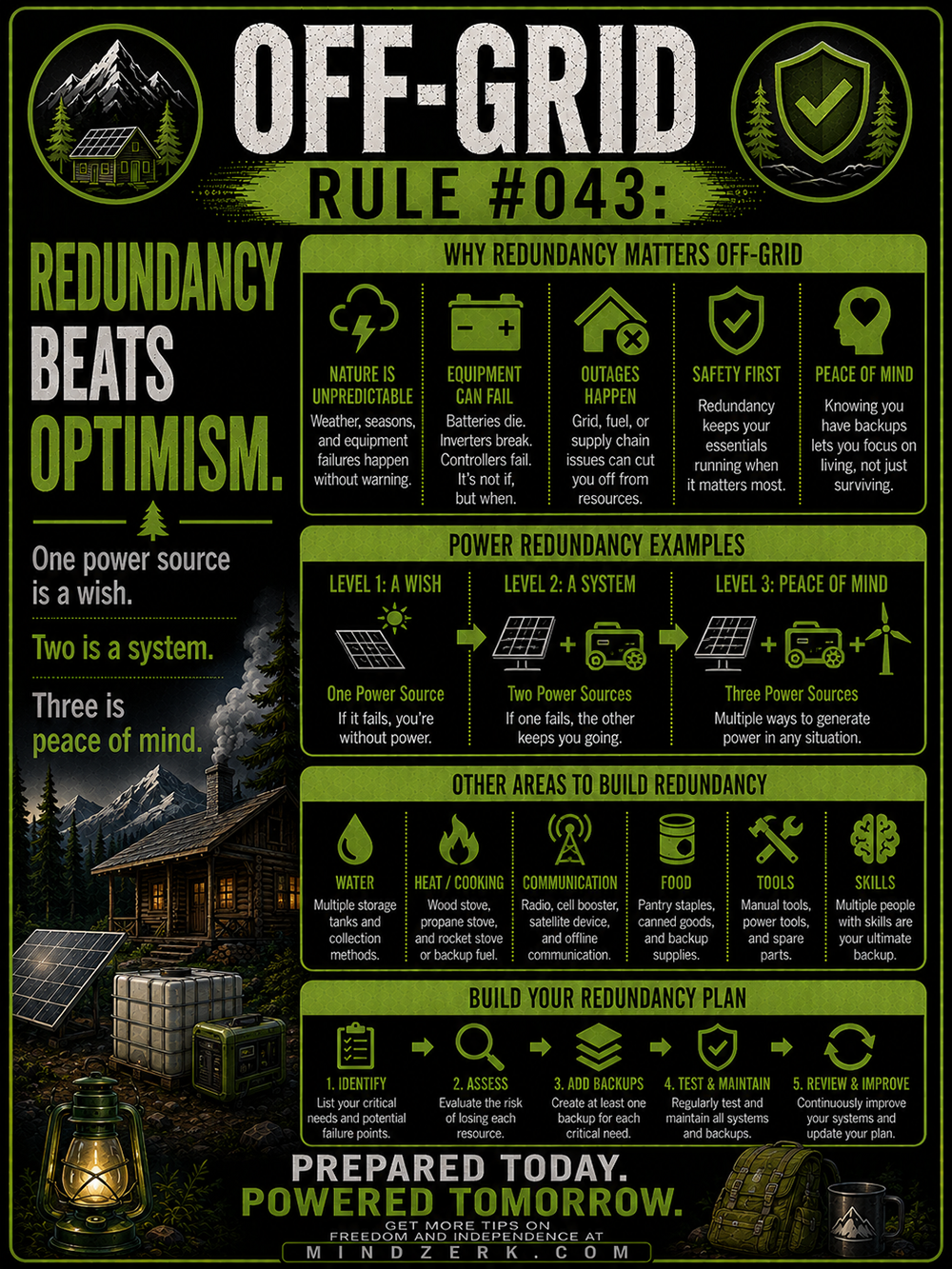
One power source is a wish.
Two is a system.
Three is peace of mind.
Why Redundancy Matters
Every system eventually fails.
Not because you did something wrong.
Because everything wears out.
Batteries lose capacity.
Solar panels get damaged.
Generators refuse to start.
Water pumps break.
Weather changes.
Supply chains stall.
The question isn’t whether something will fail.
The question is whether you’ll still have options when it does.
Redundancy gives you those options.
Nature Doesn’t Care About Your Plans
Off-grid life is closely connected to nature.
That’s one of its greatest rewards.
It’s also one of its greatest challenges.
Storms arrive without warning.
Wildfires force evacuations.
Snow blocks roads.
Heat waves increase water use.
Long stretches of cloudy weather reduce solar production.
No amount of positive thinking changes the forecast.
Building backup systems accepts reality instead of hoping reality changes.
Equipment Always Fails Eventually
Every piece of equipment has a lifespan.
Controllers fail.
Inverters fail.
Pressure switches fail.
Belts snap.
Bearings wear out.
Plastic cracks from UV exposure.
Even the best equipment will eventually need repair or replacement.
Redundancy means one failure becomes an inconvenience instead of an emergency.
Outages Happen
Many people move off-grid believing independence means they no longer rely on outside systems.
In reality, everyone depends on something.
Fuel deliveries.
Replacement parts.
Medical supplies.
Internet service.
Road access.
The electrical grid may disappear from your life, but other dependencies remain.
Backup systems give you time to adapt instead of forcing rushed decisions.
Safety Comes First
Redundancy isn’t about comfort.
It’s about safety.
Losing power during freezing temperatures isn’t merely inconvenient.
Running out of water during wildfire season isn’t just frustrating.
Communication failures during emergencies can become life-threatening.
Every backup system increases your safety margin.
That’s what preparedness is really about.
Peace of Mind Is Worth Building
Perhaps the greatest benefit of redundancy isn’t physical.
It’s mental.
Knowing you have options changes how you respond to problems.
Instead of panic, you troubleshoot.
Instead of desperation, you work through the issue.
Prepared people solve problems more effectively because they’re not forced into immediate survival mode.
Confidence grows from preparation.
Power Redundancy: The Three Levels
Power is one of the easiest places to understand redundancy.
Level 1: A Wish
One solar array.
One battery bank.
One inverter.
If any single component fails, your system goes down.
This setup works—until it doesn’t.
Level 2: A System
Now add another power source.
Solar plus generator.
Generator plus battery.
Battery plus shore power.
If one source disappears, another keeps critical systems running.
This is where resilience begins.
Level 3: Peace of Mind
Three independent power sources create true flexibility.
For example:
- Solar panels
- Generator
- Wind turbine or portable power station
No single failure leaves you without electricity.
That’s real resilience.
Build Redundancy Everywhere
Power isn’t the only system worth protecting.
Water
Store water in multiple containers.
Collect rainwater.
Maintain access to wells or natural sources.
One tank should never be your entire water plan.
Heat and Cooking
A wood stove.
A propane stove.
Rocket stove.
Outdoor cooking setup.
Backup fuel.
Different methods give you flexibility under changing conditions.
Communication
Have multiple ways to reach the outside world.
Examples include:
- Cell phone
- GMRS or HAM radio
- Satellite communicator
- Shortwave radio
Communication failures become less likely when you diversify.
Food
A stocked pantry.
Canned goods.
Freeze-dried meals.
Garden harvests.
Freezer storage.
Stored grain.
If one source disappears, another fills the gap.
Tools
Power tools are convenient.
Hand tools are dependable.
Maintain both.
Extra fasteners.
Spare blades.
Replacement belts.
Small backup parts often prevent large interruptions.
Skills
Perhaps the greatest redundancy isn’t equipment.
It’s knowledge.
Learn:
- Basic electrical repair
- Plumbing
- Gardening
- Food preservation
- First aid
- Mechanical troubleshooting
Skills can’t run out of fuel.
They can’t be stolen by a power outage.
They travel with you everywhere.
Build Your Redundancy Plan
Preparedness doesn’t happen by accident.
Use a simple process.
1. Identify Critical Systems
List everything you rely on every day.
Power.
Water.
Food.
Heat.
Communication.
Transportation.
Medical supplies.
2. Assess Failure Points
Ask yourself:
“What happens if this stops working tomorrow?”
Could you manage for:
- One day?
- One week?
- One month?
Your answers reveal where redundancy is needed most.
3. Add Backups
Start with your weakest areas.
You don’t need duplicates of everything overnight.
Build gradually.
One extra battery.
One spare water filter.
One backup radio.
One extra fuel source.
Small improvements compound into real resilience.
4. Test Everything
A backup that doesn’t work isn’t a backup.
Run your generator.
Inspect stored fuel.
Rotate water.
Charge batteries.
Use your backup cooking equipment before an emergency forces you to.
Testing builds confidence and exposes problems early.
5. Review and Improve
Preparedness isn’t a destination.
It’s maintenance.
Every season brings new lessons.
Every repair teaches something.
Every storm highlights strengths and weaknesses.
Treat your systems like living projects.
Keep improving them.
Redundancy Is an Investment in Freedom
Some people look at backup systems and see unnecessary expense.
Prepared people see insurance.
They see flexibility.
They see resilience.
Most importantly, they see freedom.
Freedom isn’t having one perfect system.
Freedom is having options when imperfect things happen.
Because eventually, something will fail.
When it does, optimism alone won’t keep your home running.
Preparation will.
Build the backups.
Test them often.
Improve them over time.
Prepared today. Powered tomorrow.