
Complexity feels productive.
More tools.
More prompts.
More automations.
More dashboards.
More workflows.
It can look impressive.
But complexity usually creates friction, not results.
The best AI systems aren’t the ones with the most moving parts.
They’re the ones people actually use every day.
That’s why:
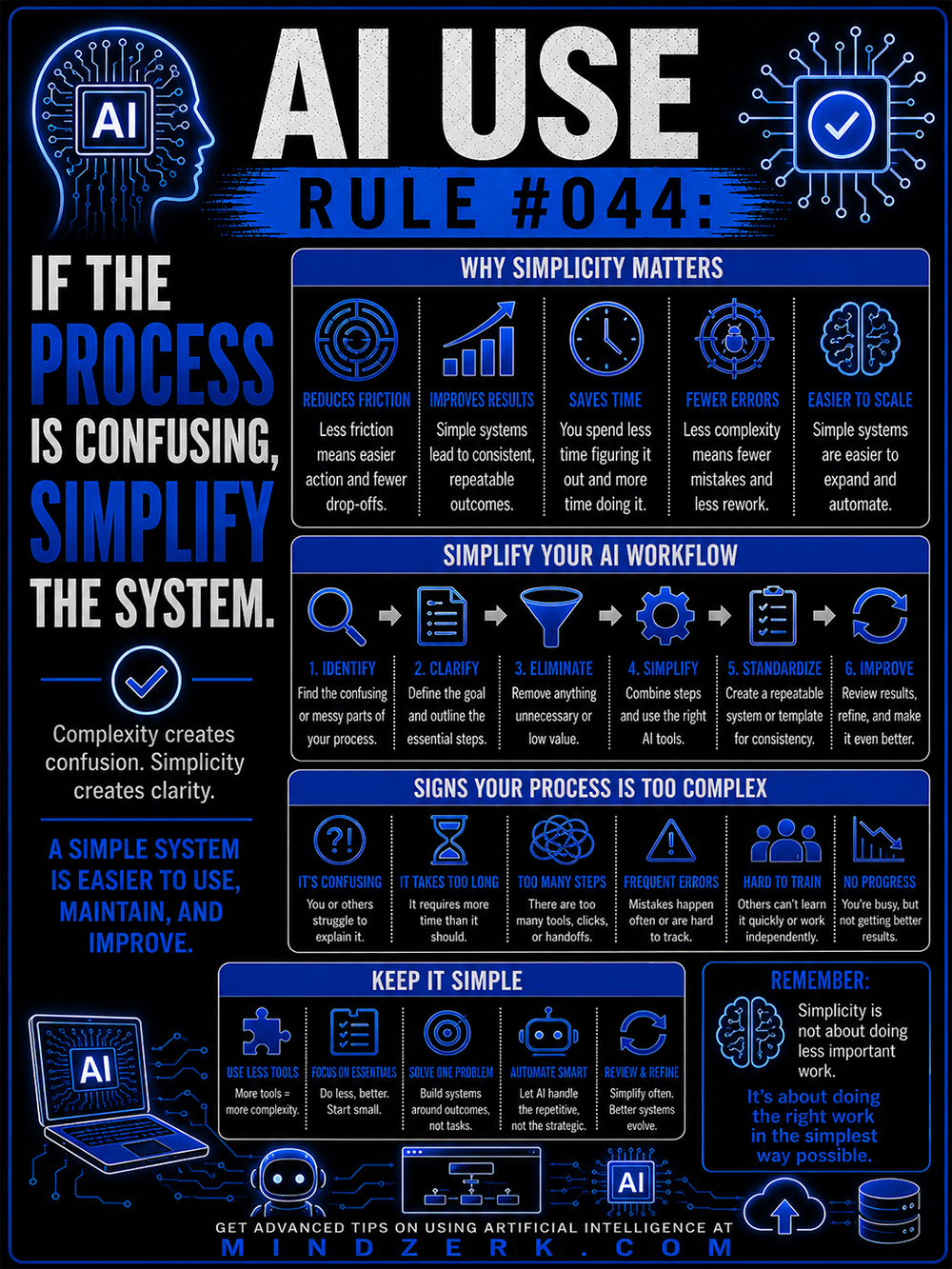
Complexity creates confusion.
Simplicity creates clarity.
A simple system is easier to use, maintain, and improve.
Why Simplicity Matters
Every unnecessary step costs something.
A few extra clicks.
Another app to log into.
Another prompt to remember.
Another decision to make.
Individually, they don’t seem like much.
Together, they become the reason the system gets abandoned.
The goal isn’t to build the most advanced workflow.
The goal is to build one that consistently gets used.
Less Friction Means More Action
People naturally avoid complicated processes.
If using AI feels like work before the work even begins, you’ll use it less.
Simple systems remove resistance.
Instead of wondering what to do next, you already know.
Instead of searching through dozens of prompts, you open one template.
Instead of managing six different tools, two handle almost everything.
Removing friction increases execution.
And execution beats perfection every time.
Simplicity Improves Results
Many people assume adding more tools produces better output.
Usually the opposite happens.
Complex workflows introduce:
- More opportunities for mistakes
- More inconsistent outputs
- More duplicated work
- More maintenance
- More troubleshooting
Simple systems are predictable.
Predictable systems are easier to improve.
Save Your Time for Real Work
Every minute spent organizing software is a minute not spent creating.
AI should reduce work.
It shouldn’t create another job managing AI.
A streamlined workflow lets you spend your time writing, designing, researching, building, or serving customers instead of constantly tweaking your process.
Fewer Moving Parts Means Fewer Errors
Every handoff creates another opportunity for something to break.
Copying text between multiple applications.
Uploading the same file repeatedly.
Running prompts through unnecessary tools.
Managing dozens of browser tabs.
Complex systems fail more often because there are simply more places for failure to occur.
Simplicity reduces those failure points.
Simple Systems Scale Better
Scaling isn’t adding complexity.
It’s repeating what already works.
When your workflow is simple:
- New team members learn it faster.
- Automation becomes easier.
- Documentation is shorter.
- Improvements happen more quickly.
The easier your process is to explain, the easier it is to grow.
Simplify Your AI Workflow
Whenever a workflow starts feeling messy, step back and simplify.
1. Identify the Confusing Parts
Ask yourself:
- Which steps slow me down?
- Where do I hesitate?
- What do I forget?
- Which parts require constant explanation?
Those are usually the first candidates for improvement.
2. Clarify the Goal
Many complicated workflows exist because no one defined the desired outcome.
Instead of asking:
“I need an AI workflow.”
Ask:
“I need a newsletter every Friday.”
“I need ten product descriptions.”
“I need blog posts optimized for SEO.”
A clear goal removes unnecessary steps.
3. Eliminate Low-Value Work
Not every step deserves to survive.
Ask:
- Does this actually improve the result?
- Could AI handle this automatically?
- Am I doing this because it’s useful or because it’s familiar?
If a step doesn’t create value, remove it.
4. Simplify Before Automating
Automation amplifies whatever process already exists.
Automating a bad workflow simply creates bad results faster.
Always simplify first.
Then automate.
5. Standardize the Process
Once something works consistently, capture it.
Create:
- Prompt templates
- Checklists
- Standard operating procedures (SOPs)
- Folder structures
- Naming conventions
Consistency reduces future decisions.
6. Keep Improving
No workflow is ever finished.
Every few weeks ask:
- Can this step disappear?
- Can two steps become one?
- Can one tool replace three?
Small improvements compound over time.
Signs Your Process Is Too Complex
Your workflow probably needs simplifying if:
You struggle to explain it.
If someone can’t understand it in a few minutes, it’s probably too complicated.
Everything takes longer than expected.
More tools rarely equal more speed.
Often they create bottlenecks.
You have too many steps.
If a simple task requires ten applications and twenty clicks, something needs to change.
Errors happen frequently.
Complicated systems create confusion.
Confusion creates mistakes.
Nobody Else Can Use It
If your system only works because you remember dozens of tiny details, it isn’t a system.
It’s a dependency.
Good systems work without relying on perfect memory.
You’re Busy But Not Improving
Activity isn’t progress.
Sometimes simplifying one workflow creates more value than adding five new automations.
Keep It Simple
Simple systems aren’t boring.
They’re effective.
Some practical habits include:
Use fewer tools.
Every additional application adds maintenance.
Master a handful instead of constantly chasing new software.
Focus on the essentials.
Most AI work boils down to:
- Writing
- Research
- Analysis
- Organization
- Automation
Solve those well before expanding.
Solve one problem at a time.
Avoid building giant “everything” workflows.
Create small systems with clear purposes.
One workflow for blog writing.
Another for customer support.
Another for research.
Smaller systems are easier to improve.
Automate the repetitive work.
AI excels at repetition.
Let it handle formatting, summaries, categorization, and repetitive drafting.
Keep human attention focused on strategy and creativity.
Review and Refine
The best workflows aren’t created in one afternoon.
They’re improved over months.
Every time you remove one unnecessary step, the system becomes faster, more reliable, and easier to use.
Simplicity Is a Competitive Advantage
People often assume sophistication wins.
In reality, clarity wins.
The companies that scale usually don’t have the most complicated systems.
They have the clearest ones.
The creators who publish consistently aren’t using dozens of disconnected workflows.
They’re using a handful of simple systems they trust.
The same principle applies to AI.
Don’t measure your workflow by how impressive it looks.
Measure it by how often it helps you finish meaningful work.
If the process feels confusing, don’t add another tool.
Simplify the system.
Because the best AI workflow isn’t the most complicated one.
It’s the one you’ll still be using a year from now.