
Off-grid living has a way of exposing bad design.
A system may look impressive when the weather is calm, the batteries are full, every tool is available, and nothing has broken yet.
The real test comes later.
A freezing night.
A failed pump.
A loose connection.
A dead controller.
A missing replacement part.
That is when complexity stops looking advanced and starts looking fragile.
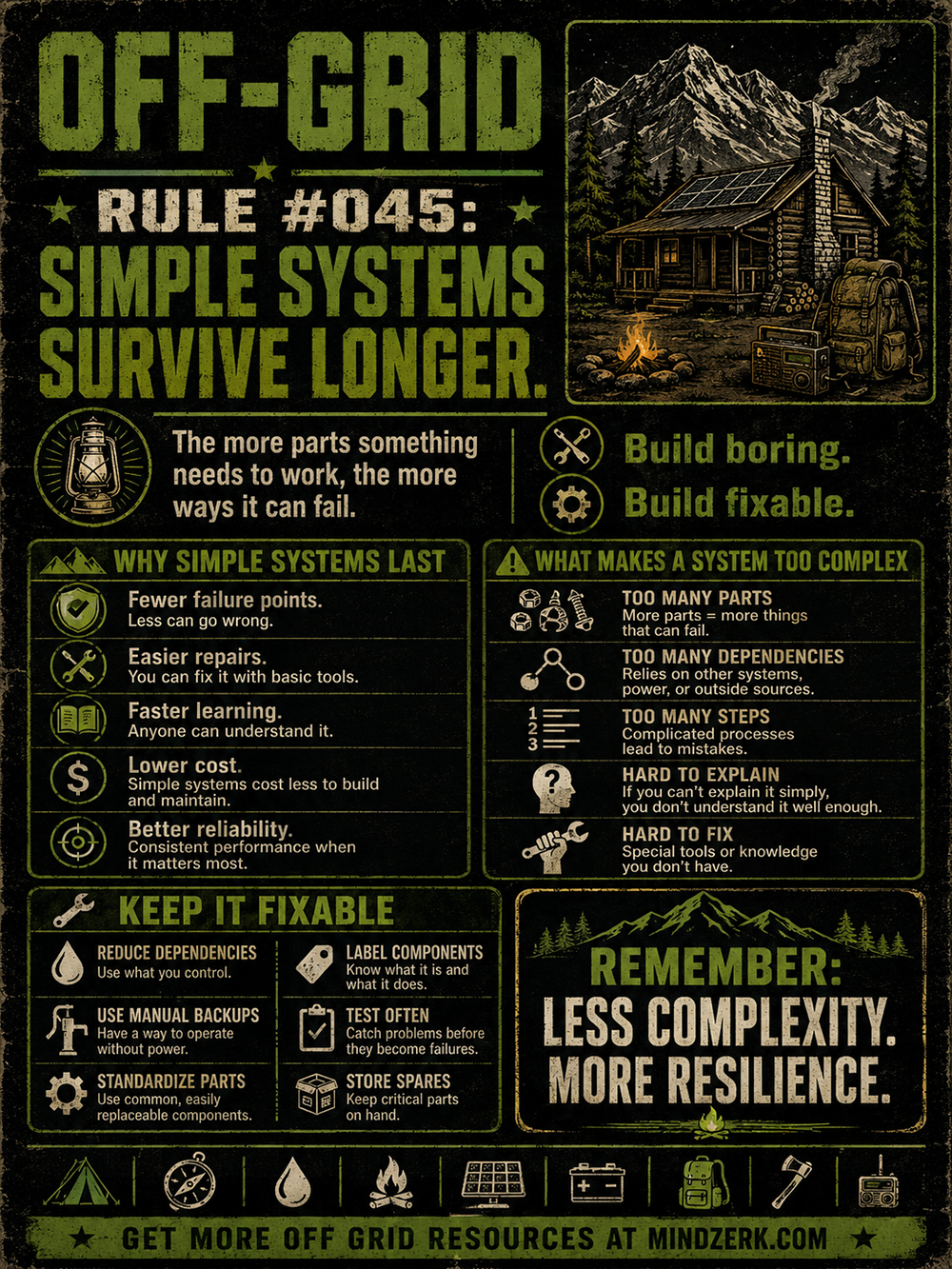
That is why the more parts something needs to work, the more ways it can fail.
Build boring.
Build fixable.
A simple system may not impress visitors. It may not have the most features or the newest technology. But when conditions get rough, simple systems are usually the ones still working.
Complexity Creates Failure Points
Every component adds another possible weakness.
Another fitting can leak.
Another wire can corrode.
Another controller can malfunction.
Another software layer can freeze.
Another specialty part can become impossible to replace.
A system with ten essential components has more failure points than one with four.
That does not mean all complexity is bad. Some systems genuinely require multiple parts.
The danger begins when extra parts are added without adding meaningful resilience.
Off-grid design should not ask:
“How advanced can we make this?”
It should ask:
“How little does this need in order to work reliably?”
Simple Systems Are Easier to Understand
A system you do not understand is not fully yours.
You may own the equipment, but you remain dependent on someone else to diagnose it, repair it, or explain what went wrong.
Simple systems are easier to learn.
You can trace the water line.
Follow the wiring.
Recognize the controls.
Understand where power enters and where it goes.
That knowledge matters when professional help is far away or unavailable.
If another capable person can look at your setup and understand it quickly, you have built something useful.
If only one specialist can operate it, you have built a dependency.
Fewer Parts Mean Fewer Failures
One of the strongest arguments for simplicity is basic probability.
Every moving part, connector, sensor, valve, relay, switch, and controller creates another opportunity for failure.
A gravity-fed water system may not be glamorous, but it keeps working without a pump.
A manual valve may lack automation, but it does not need software.
A basic wood stove may require effort, but it does not stop functioning because a circuit board failed.
Simple systems often trade convenience for reliability.
Off-grid, that is usually a good trade.
Repairs Become Easier
When something breaks, time matters.
You do not want to spend three hours locating a hidden electronic fault during a storm.
You want to identify the problem, reach the part, and repair it with tools you already own.
Simple systems are easier to:
- Inspect
- Diagnose
- Disassemble
- Repair
- Rebuild
The best off-grid systems use common parts and obvious connections.
You should not need proprietary software or a rare replacement component for every basic repair.
A wrench, screwdriver, multimeter, hose clamp, and a few spare fittings should solve a surprising number of problems.
Simplicity Lowers Costs
Complex systems are usually expensive twice.
They cost more to build.
Then they cost more to maintain.
Specialty components.
Professional service.
Replacement modules.
Software subscriptions.
Custom parts.
Even small failures can become expensive when the system is difficult to access or understand.
Simple systems often use fewer materials, common components, and repairs you can complete yourself.
That creates savings over the entire life of the system, not just on installation day.
Simple Systems Are Easier to Teach
A resilient setup should not depend on one person remembering everything.
What happens if you are sick?
Injured?
Away from the property?
Too exhausted to troubleshoot?
Someone else should be able to operate the essentials.
A simple water system can be explained.
A basic battery routine can be written down.
A labeled transfer switch can be understood.
A manual backup can be demonstrated.
If a system is too complicated to teach, it is too complicated to trust during an emergency.
Signs a System Has Become Too Complex
Sometimes complexity grows so gradually that you stop noticing it.
One new device.
One extra app.
One temporary bypass.
One repair added on top of another.
Eventually the system becomes a maze.
Here are some warning signs.
Too Many Parts
The system contains components that do not provide enough value to justify their maintenance.
More parts mean more things to inspect, replace, and remember.
Too Many Dependencies
The system relies on outside power, internet access, cloud services, special fuel, proprietary software, or hard-to-find replacement parts.
The more outside conditions required, the less independent the system really is.
Too Many Steps
Basic operation requires a long sequence.
Turn this on.
Wait for that.
Reset another device.
Open an app.
Change a setting.
Check a dashboard.
Every extra step increases the chance of error, especially when you are tired or under pressure.
Hard to Explain
You should be able to explain a critical system in plain language.
Where does the resource come from?
What controls it?
What usually fails?
How do you shut it down?
How do you operate the backup?
If you cannot explain it simply, you may not understand it well enough.
Hard to Repair
A system that requires unavailable tools, obscure knowledge, or outside technicians for every failure is not resilient.
Off-grid equipment should be serviceable whenever practical.
Keep It Fixable
Simplicity does not happen by accident.
It must be designed into the system from the beginning.
Reduce Dependencies
Use resources and components you control.
A gravity-fed tank is less dependent than a fully pumped system.
A local backup is less dependent than cloud-only access.
A hand tool is less dependent than a battery tool.
You do not have to remove every dependency. You should know which ones exist and have alternatives.
Use Manual Backups
Every essential automated system should have a manual option whenever possible.
Examples include:
- Hand pumps
- Manual valves
- Pull-start generators
- Mechanical locks
- Wood heat
- Hand tools
- Paper instructions
Slow working is better than not working.
Standardize Parts
Use the same connector sizes, fasteners, batteries, hoses, fittings, and tools across multiple systems when practical.
Standardization reduces inventory and confusion.
Instead of storing six rare replacement parts, you may be able to stock two common ones that work throughout the property.
Label Components
Labels reduce mistakes.
Mark:
- Shutoff valves
- Fuse locations
- Positive and negative cables
- Water lines
- Charging ports
- Backup controls
- Storage bins
You may know everything today.
You may not remember it at 2:00 in the morning during a storm.
Labels are cheap memory.
Test Often
A simple system can still fail if it is neglected.
Run backups.
Move valves.
Start generators.
Inspect hoses.
Check connections.
Use manual controls.
Testing reveals small problems while conditions are still manageable.
Store Spares
Keep basic replacements for the parts most likely to fail.
Hose clamps.
Fuses.
Connectors.
Sealant.
Filters.
Belts.
Fasteners.
Wire.
Valves.
Spares turn a system failure into a short repair.
Build Boring
“Boring” is a compliment in off-grid design.
Boring means predictable.
Boring means understood.
Boring means replacement parts are easy to find.
Boring means you have fixed it before.
Boring means the same procedure works every time.
A flashy system may be fun to demonstrate.
A boring system keeps water flowing in January.
It keeps heat running during a storm.
It keeps the lights on without requiring a ten-step reboot.
That is what matters.
Build for the Worst Day, Not the Best One
Design decisions should account for the day when you are:
- Tired
- Cold
- Wet
- Rushed
- Working in darkness
- Missing a tool
- Unable to call for help
A system that only works under perfect conditions is not a resilient system.
Make controls visible.
Keep important components accessible.
Use common tools.
Avoid unnecessary steps.
Add manual backups.
Store instructions nearby.
Design for the version of yourself who is having a very bad day.
That version will be grateful.
Simplicity Is Not Primitive
Simple does not mean outdated.
It does not mean rejecting modern technology.
A simple system may include solar panels, lithium batteries, smart controllers, and efficient pumps.
The difference is that each layer has a clear purpose.
Complexity should earn its place.
Technology should make the system easier to operate or more resilient—not harder to understand.
Use advanced equipment where it provides real value.
But never let advanced equipment remove your ability to operate, repair, or bypass the system.
Less Complexity Creates More Resilience
The strongest system is not always the one with the most features.
It is the one that continues functioning after something fails.
Simple systems offer:
- Fewer failure points
- Faster repairs
- Easier training
- Lower maintenance costs
- Greater independence
- More predictable performance
That is not minimalism for appearance.
It is practical resilience.
Build Simple. Build Fixable. Build to Last.
Off-grid freedom depends on systems you can trust.
Not systems that only work when everything is perfect.
Not systems that require constant updates.
Not systems that become useless when one specialized part fails.
Build systems you understand.
Use parts you can replace.
Keep backups you can operate manually.
Test what matters.
Remove unnecessary layers.
Because every extra part must justify the new way it can fail.
The goal is not to create the most impressive setup.
The goal is to create one that keeps working.
Build boring.
Build fixable.
Build for real life.
Because less complexity creates more resilience—and simple systems survive longer.