

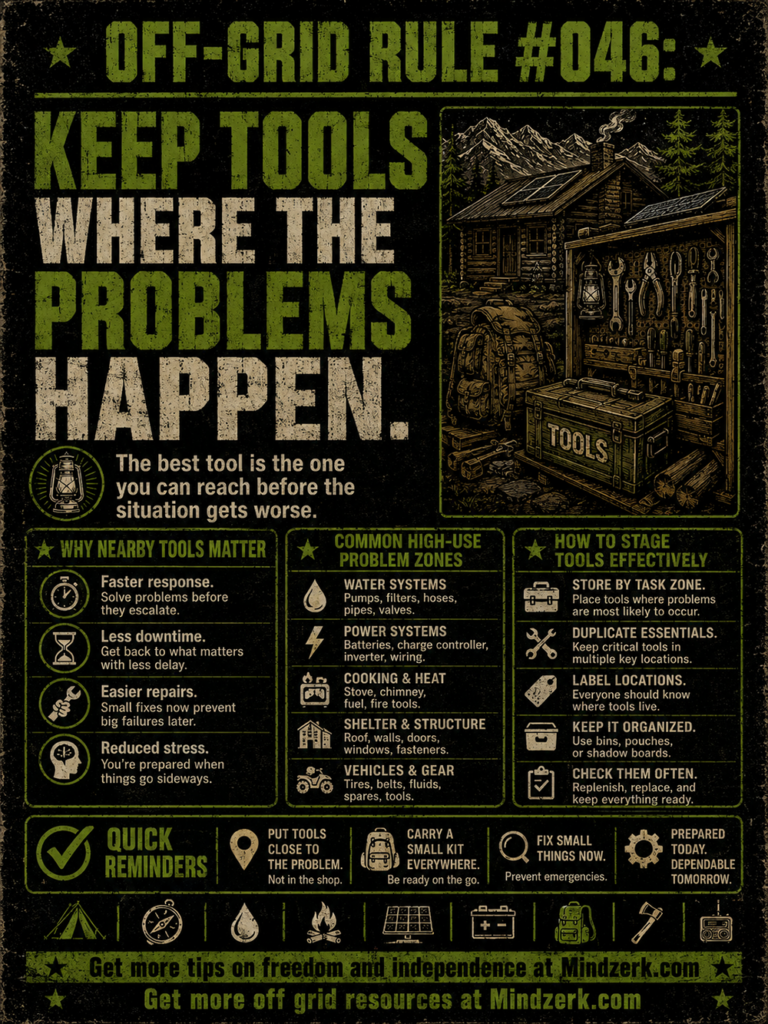
The best tool is not always the most expensive one.
It is not necessarily the newest, strongest, or most impressive.
The best tool is often the one you can reach before the situation gets worse.
A wrench stored in a distant shed does not help much when a water fitting starts leaking inside the cabin.
A flashlight buried in a storage bin is useless when the power fails at night.
A screwdriver left at the main workbench does little good when a battery terminal loosens at the far end of the property.
That is why off-grid systems are spread across different zones.
Water equipment may be near the tank.
Solar components may be outside or in a power shed.
Cooking equipment may be beside the stove.
Vehicle repairs may happen hundreds of feet from the main toolbox.
When every tool lives in one central location, even small repairs create delays.
You spend time walking, searching, carrying, and improvising while the problem continues.
A small amount of strategic duplication can make the entire property more reliable.
Why Nearby Tools Matter
Most off-grid failures begin small.
A loose clamp.
A dripping connection.
A corroded terminal.
A rattling bracket.
A damaged wire.
A blocked vent.
These are usually easy to correct when caught early.
They become expensive when ignored.
Keeping basic tools near high-risk systems reduces the time between noticing a problem and doing something about it.
That faster response can prevent damage, conserve resources, and reduce stress.
Faster Response Prevents Escalation
A slow leak may not look urgent.
But every minute it continues, water is being lost.
A loose electrical connection may still work.
But continued use can create heat, arcing, or additional damage.
A small opening in a roof or wall may seem manageable during calm weather.
Then the next storm arrives.
The faster you can respond, the more likely the repair stays small.
Tool placement is part of emergency response.
Less Downtime Keeps Systems Useful
Off-grid life depends on systems that must keep functioning.
Water.
Power.
Heat.
Cooking.
Shelter.
Transportation.
When something stops working, the inconvenience spreads quickly.
A failed water fitting affects cleaning, cooking, drinking, and sanitation.
A loose battery connection affects lights, communications, refrigeration, and charging.
A nearby repair kit shortens the interruption.
You spend less time hunting for supplies and more time restoring the system.
Small Repairs Prevent Large Failures
A major breakdown is often the final stage of a smaller problem.
The hose did not suddenly split without warning.
The mount had been loosening.
The wire had been rubbing.
The seal had been leaking.
The filter had been clogging.
Tools close at hand make it easier to fix these warning signs while they are still simple.
Preparedness is not only about surviving dramatic emergencies.
It is also about preventing ordinary maintenance problems from becoming emergencies.
Nearby Tools Reduce Stress
Problems feel larger when you are unprepared.
A minor leak becomes frustrating when you cannot find the right wrench.
A dead connection becomes overwhelming when every screwdriver is somewhere else.
A dark repair becomes dangerous when the headlamp is uncharged or missing.
Strategically placed tools create confidence.
You know where to go.
You know what is available.
You can begin immediately.
That calm response often matters as much as the tool itself.
Identify Your High-Use Problem Zones
Do not scatter random tools everywhere.
Build small kits around the problems most likely to occur in each area.
The goal is not to duplicate your entire workshop.
It is to place a compact set of essentials where they will matter most.
Water Systems
Water problems usually involve:
- Pumps
- Filters
- Hoses
- Pipes
- Valves
- Clamps
- Fittings
A nearby water-system kit might include:
- Adjustable wrench
- Pliers
- Screwdrivers
- Hose clamps
- Thread-seal tape
- Utility knife
- Spare fittings
- Small flashlight
Water loss can become serious quickly, so this is one of the best places to stage tools.
Power Systems
Electrical and charging areas may need:
- Screwdrivers
- Nut drivers
- Wire cutters
- Wire strippers
- Crimping tool
- Multimeter
- Electrical tape
- Spare fuses
- Connectors
- Protective gloves
Electrical work carries real risk. Only perform tasks you understand, disconnect power first when possible, and bring in qualified help for anything beyond your skill level.
The purpose of the kit is to handle routine inspection and basic maintenance without wasting time searching for tools.
Cooking and Heat
Stoves, chimneys, fuel lines, and fire systems need their own maintenance tools.
Useful items may include:
- Stove tool
- Heat-resistant gloves
- Small brush
- Ash shovel
- Flashlight
- Adjustable wrench
- Fire extinguisher
- Chimney-cleaning tools
- Spare fasteners
Heat systems should be kept clear, inspected often, and treated as safety-critical.
Shelter and Structure
Cabins, trailers, sheds, and outdoor structures constantly need small repairs.
Keep access to:
- Hammer
- Screwdrivers
- Pliers
- Tape measure
- Utility knife
- Fasteners
- Roofing patches
- Sealant
- Cord or wire
- Small pry bar
Doors, windows, roofs, and wall panels rarely fail at convenient times.
A small structural repair kit can prevent weather from turning a minor opening into major damage.
Vehicles and Mobile Gear
Vehicles, trailers, carts, and generators may fail away from the main work area.
A mobile kit should include:
- Tire gauge
- Tire repair supplies
- Basic socket set
- Adjustable wrench
- Pliers
- Screwdrivers
- Jumper pack or cables
- Fuses
- Work gloves
- Flashlight or headlamp
- Fluids appropriate to the vehicle
A tool left at home cannot help when the problem happens on the road.
Store Tools by Task Zone
The simplest way to organize tools is by the system they support.
Instead of asking, “Where do all the wrenches go?” ask, “Where am I most likely to need a wrench?”
That may mean keeping one near the water system, another in the vehicle, and another in the main toolbox.
The duplication costs a little more.
The saved time and avoided damage can be worth far more.
Duplicate the Essentials
You do not need five complete tool collections.
Duplicate only the tools that are:
- Used often
- Inexpensive
- Critical during failures
- Easy to lose
- Needed in distant areas
Good candidates include:
- Adjustable wrenches
- Pliers
- Screwdrivers
- Utility knives
- Flashlights
- Measuring tapes
- Work gloves
- Electrical tape
- Duct tape
- Multi-tools
Keep specialty tools in the main workshop unless a specific system requires them nearby.
Label Every Location
A tool system fails when nobody knows where anything belongs.
Label bins, pouches, cabinets, and boards.
Use clear names such as:
- Water Repair Kit
- Battery Tools
- Stove Maintenance
- Vehicle Emergency Kit
- Roof and Shelter Repair
Labels help other people use the system and help you return tools to the correct location.
They also make missing items obvious.
Keep Tools Organized
A bucket full of loose tools is better than nothing.
A small organized kit is better.
Use:
- Tool rolls
- Hard cases
- Wall boards
- Labeled bins
- Belt pouches
- Small backpacks
- Waterproof boxes
The container should match the environment.
Outdoor kits need weather protection.
Vehicle kits need to stay secure while moving.
Electrical tools should remain dry and clean.
Organization should make the tool easy to see, grab, and return.
Check and Replenish Often
A staged tool kit slowly becomes useless if items disappear and are never replaced.
Someone borrows the pliers.
The tape gets used up.
The flashlight battery dies.
The spare fuse is installed.
Then the next problem arrives, and the kit is empty.
Review each zone regularly.
Check for:
- Missing tools
- Rust or damage
- Dead batteries
- Used consumables
- Empty containers
- Outdated supplies
A kit is only reliable when it is maintained.
Carry a Small Kit Everywhere
Some problems happen between established zones.
A compact everyday kit can cover the gap.
A small pouch or backpack might contain:
- Multi-tool
- Adjustable wrench
- Compact screwdriver
- Flashlight
- Work gloves
- Tape
- Cord
- Marker
- Small first-aid supplies
This is not a replacement for system-specific kits.
It is a basic response kit for whatever you discover while moving around the property.
Put Tools Close to the Problem, Not in the Shop
Central workshops are useful for major repairs.
They are not always the best location for emergency tools.
Think of tool storage as part of system design.
A fire extinguisher belongs near fire risk.
A shutoff wrench belongs near the valve.
A headlamp belongs near the power controls.
A tire kit belongs in the vehicle.
A pump-repair kit belongs near the pump.
The closer the response equipment is to the likely failure, the faster you can regain control.
Fix Small Things Now
Off-grid maintenance rewards immediate action.
Do not walk past the same loose bolt for three weeks.
Do not ignore the small drip because the tank is still full.
Do not wait until the weak connection stops working completely.
When tools are available, small repairs become easy enough to handle immediately.
That habit changes the property.
Small problems disappear faster.
Systems last longer.
Emergency repairs become less frequent.
Tool Placement Is a Form of Redundancy
Keeping duplicate tools in multiple zones may appear inefficient.
In reality, it creates operational redundancy.
If one kit is inaccessible, another is available.
If a tool is lost, the entire property does not become dependent on replacing it immediately.
If someone else is working in another area, both people can respond without sharing one critical tool.
Redundancy is not waste when it protects essential systems.
Build the System Around Real Behavior
The perfect tool organization plan is not the one that looks best.
It is the one that matches how you actually work.
Notice where problems occur.
Notice which tools you repeatedly walk back to retrieve.
Notice which supplies are always missing during repairs.
Then move or duplicate them.
Let real experience shape the system.
Every unnecessary trip is evidence that a tool may be stored in the wrong place.
Prepared Today. Dependable Tomorrow.
Off-grid reliability depends on response time.
A problem noticed early is often easy to fix.
A problem ignored or delayed has time to spread.
The right tool nearby can mean the difference between:
- Tightening a fitting and losing a tank of water
- Replacing a fuse and losing power for the night
- Patching a seam and repairing an entire wall
- Securing a mount and replacing damaged equipment
Do not make every repair begin with a search.
Build small tool stations.
Duplicate critical items.
Label everything.
Keep kits clean, complete, and easy to reach.
Because the best tool is not the one sitting safely in the workshop.
It is the one already waiting where the problem happens.
Put tools close to the problem.
Carry a small kit everywhere.
Fix small things now.
Prepared today. Dependable tomorrow.