
AI makes it easier than ever to create a first version.
A first draft.
A first outline.
A first workflow.
A first offer.
A first design.
But many people still get stuck before they begin.
They keep planning.
Keep researching.
Keep adjusting the prompt.
Keep waiting for the perfect idea.
Meanwhile, someone else starts with an imperfect version, tests it, improves it, and moves ahead.
That is why you do not need the perfect starting point.
You need something real enough to test.
Version one creates momentum.
Iteration creates quality.
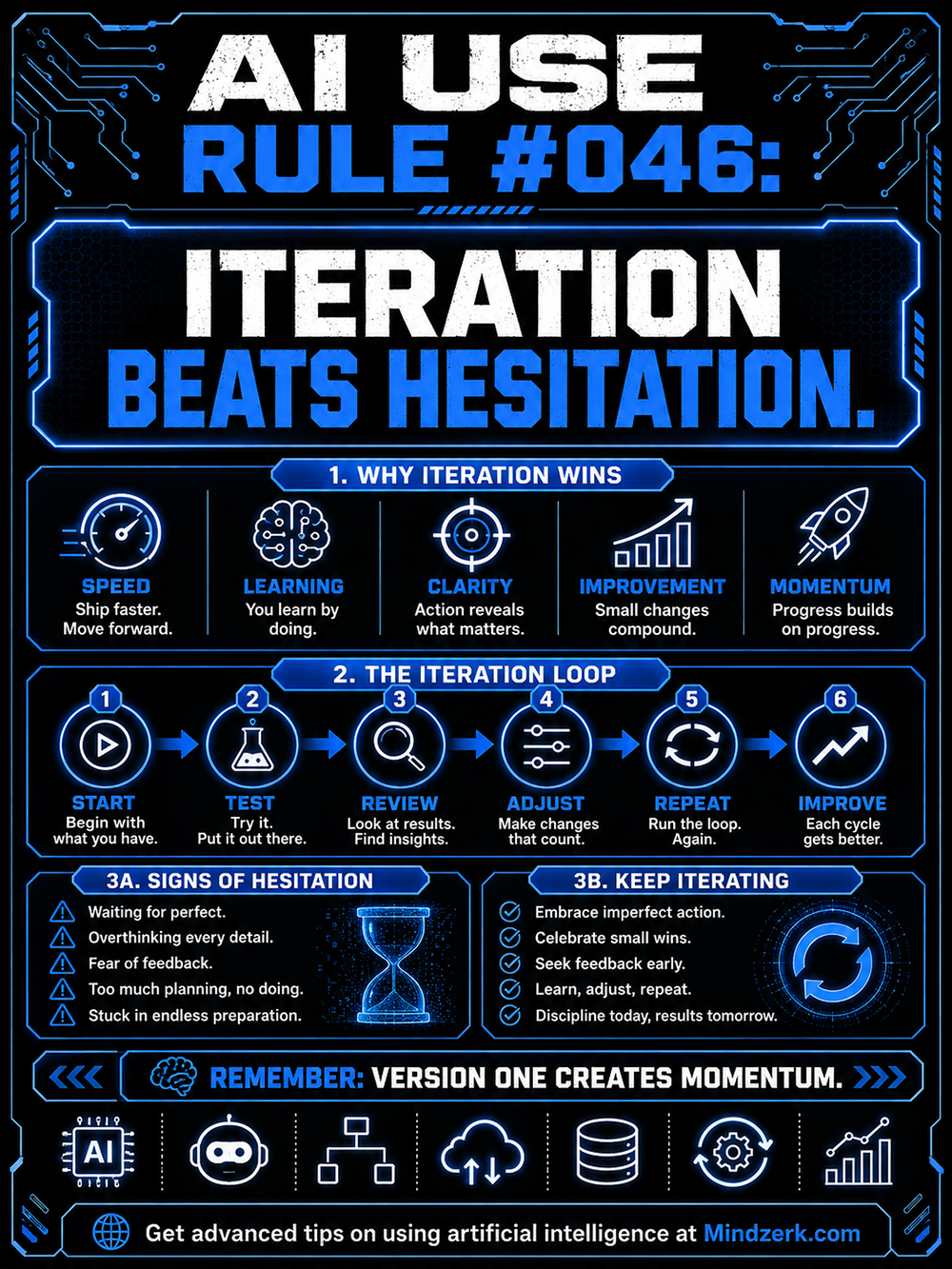
Why Iteration Wins
Iteration means making something, examining what happened, improving it, and trying again.
It replaces guessing with evidence.
Instead of asking whether an idea might work, you put it into motion and learn from the result.
That simple shift creates several major advantages.
Iteration Creates Speed
Hesitation burns time without producing information.
You can think about a project for three weeks and still know less than you would after publishing one rough version.
Action gives you something concrete.
A draft to edit.
A result to measure.
A response to evaluate.
A problem to fix.
The goal is not to rush carelessly.
It is to move quickly enough that reality can teach you what planning cannot.
You Learn by Doing
AI can give you possibilities, but experience tells you which ones matter.
You learn more by running a prompt than by endlessly rewriting it.
You learn more by publishing a product page than by debating headlines in private.
You learn more by showing a design to real people than by trying to predict every reaction.
Doing reveals:
- What people understand
- What they ignore
- What confuses them
- What creates interest
- What needs improvement
Action turns assumptions into information.
Action Creates Clarity
People often wait for clarity before moving.
Usually, clarity comes after movement.
You may not know the right structure until you see the first draft.
You may not know which offer matters until customers respond.
You may not know which workflow step is broken until you run the process.
AI makes it cheap and fast to generate starting material.
Use that advantage.
Create something.
Then let the result show you what to do next.
Small Improvements Compound
Iteration does not require dramatic reinvention.
Most progress comes from small adjustments.
A clearer instruction.
A stronger example.
A shorter introduction.
A better sequence.
A removed step.
A more specific promise.
Each change may look minor, but repeated improvements create major differences over time.
A workflow improved ten times is rarely recognizable compared with version one.
That is the power of the loop.
Momentum Builds on Progress
Hesitation makes projects feel heavier.
The longer something remains unfinished, the more intimidating it becomes.
Iteration does the opposite.
Once version one exists, you are no longer facing a blank page.
You are working with material.
One completed step makes the next one easier.
Progress creates motivation more reliably than waiting for motivation creates progress.
The Iteration Loop
A useful iteration process can be simple.
1. Start
Begin with what you have.
Use the information available.
Create the smallest complete version you can evaluate.
Do not confuse incomplete thinking with thoughtful preparation.
At some point, you must move.
2. Test
Put the work into a real or realistic environment.
Run the prompt.
Use the workflow.
Publish the post.
Send the email.
Show the design.
Let someone try the system.
Testing exposes the gap between what you expected and what actually happened.
3. Review
Look at the result honestly.
Ask:
- What worked?
- What failed?
- What was unclear?
- Where did the process slow down?
- What did users respond to?
- What outcome did I actually get?
Do not judge the entire project based on one flaw.
Find the useful signal.
4. Adjust
Change what matters.
You do not need to rebuild everything.
Fix the weakest point.
Clarify the prompt.
Remove an unnecessary step.
Improve the example.
Change the format.
Make the next version meaningfully better without turning refinement into another form of avoidance.
5. Repeat
Run the improved version.
Review it again.
Continue the cycle.
The loop is not a sign that the first version failed.
The loop is how good work gets made.
6. Improve
Each cycle should leave behind an asset.
A better template.
A stronger prompt.
A clearer checklist.
A more reliable workflow.
A documented lesson.
Over time, improvement becomes part of the system rather than a separate project.
Signs You Are Hesitating Instead of Preparing
Preparation is useful.
Avoidance often disguises itself as preparation.
Watch for these patterns.
Waiting for Perfect
You keep delaying because the output is not flawless.
Perfect is not a starting requirement.
It is not even a realistic final condition.
Aim for useful, clear, and improvable.
Overthinking Every Detail
You spend more energy choosing minor elements than testing the main idea.
Color choices, tool comparisons, formatting details, and tiny wording changes can all become distractions when the core work remains unfinished.
Fear of Feedback
Sometimes hesitation is really fear of being evaluated.
Once the work is visible, someone can criticize it.
But hidden work cannot teach you much.
Feedback is not always correct, but it gives you evidence to consider.
Too Much Planning, Not Enough Doing
Planning feels safe because nothing can fail yet.
But nothing can succeed either.
A plan should lead to action.
When planning keeps expanding without producing a testable result, it has become a trap.
Endless Preparation
Another course.
Another tool.
Another prompt.
Another round of research.
Eventually, you already know enough to create version one.
More preparation does not always reduce risk.
Sometimes it only postpones learning.
How to Keep Iterating
Embrace Imperfect Action
Your first attempt is allowed to be rough.
It should still be intentional and useful, but it does not need to represent your final ability.
Treat version one as a working prototype, not a permanent verdict.
Celebrate Small Wins
Progress deserves recognition.
A finished outline matters.
A working prompt matters.
A completed test matters.
A small improvement matters.
Not every win needs to be dramatic to be valuable.
Seek Feedback Early
Do not spend months perfecting something nobody wants.
Show the idea to trusted people.
Test it with a small audience.
Watch how they use it.
Early feedback is cheaper and easier to act on than late feedback.
Learn, Adjust, Repeat
Do not become emotionally attached to the first method.
Protect the goal, not every original decision.
When evidence shows a better direction, change direction.
Adaptation is not inconsistency.
It is intelligent persistence.
Build Discipline
Iteration works best when it becomes routine.
Create.
Review.
Improve.
Repeat.
Do not wait until you feel inspired.
A regular improvement cycle beats occasional bursts of frantic activity.
How AI Makes Iteration Easier
AI dramatically lowers the cost of trying another version.
You can ask it to:
- Rewrite an introduction
- Generate alternative headlines
- Restructure a workflow
- Compare multiple approaches
- Identify weak sections
- Simplify instructions
- Create a new version for a different audience
- Turn feedback into revisions
The point is not to generate endless variations for no reason.
The point is to use speed to learn faster.
AI gives you more attempts.
Your judgment decides which attempts deserve to survive.
Iteration Is Not Random Repetition
Doing the same thing repeatedly without reflection is not iteration.
That is just repetition.
Real iteration requires a feedback loop.
Each round should answer a question.
Did the shorter version improve completion?
Did the clearer prompt reduce errors?
Did the new hook attract more interest?
Did the revised workflow save time?
Change something intentionally.
Measure what happened.
Keep the improvement or try another approach.
Version One Creates Momentum
Your first version has one important job:
It gives you something to improve.
It does not need to impress everyone.
It does not need to prove your entire idea.
It needs to move the project from imagination into reality.
Once it exists, the work changes.
You stop wondering what might happen.
You start responding to what did happen.
That is where real progress begins.
Start Before You Feel Ready
Hesitation feels protective.
It protects you from criticism.
From failure.
From making the wrong choice.
It also protects you from momentum, feedback, improvement, and results.
Iteration accepts that uncertainty is part of creation.
You move.
You observe.
You learn.
You adjust.
Then you move again.
That is how prompts improve.
That is how workflows become reliable.
That is how products become useful.
That is how creators become skilled.
Do not wait for a flawless plan.
Build a working version.
Put it into the world.
Learn what reality teaches you.
Then make it better.
Start.
Test.
Review.
Adjust.
Repeat.
Because hesitation preserves uncertainty.
Iteration destroys it.
And in AI-assisted work, the person who learns through ten useful versions will usually beat the person still planning version one.