
Most privacy risks do not begin with a dramatic breach.
They begin with a pattern.
You leave at the same time every morning.
You post from the same places.
You use the same usernames.
You check in on the same schedule.
You follow the same route.
You respond to messages in the same predictable way.
Each habit seems harmless by itself.
Together, they create a map.
That is why patterns are easy to spot.
Habits are easy to exploit.
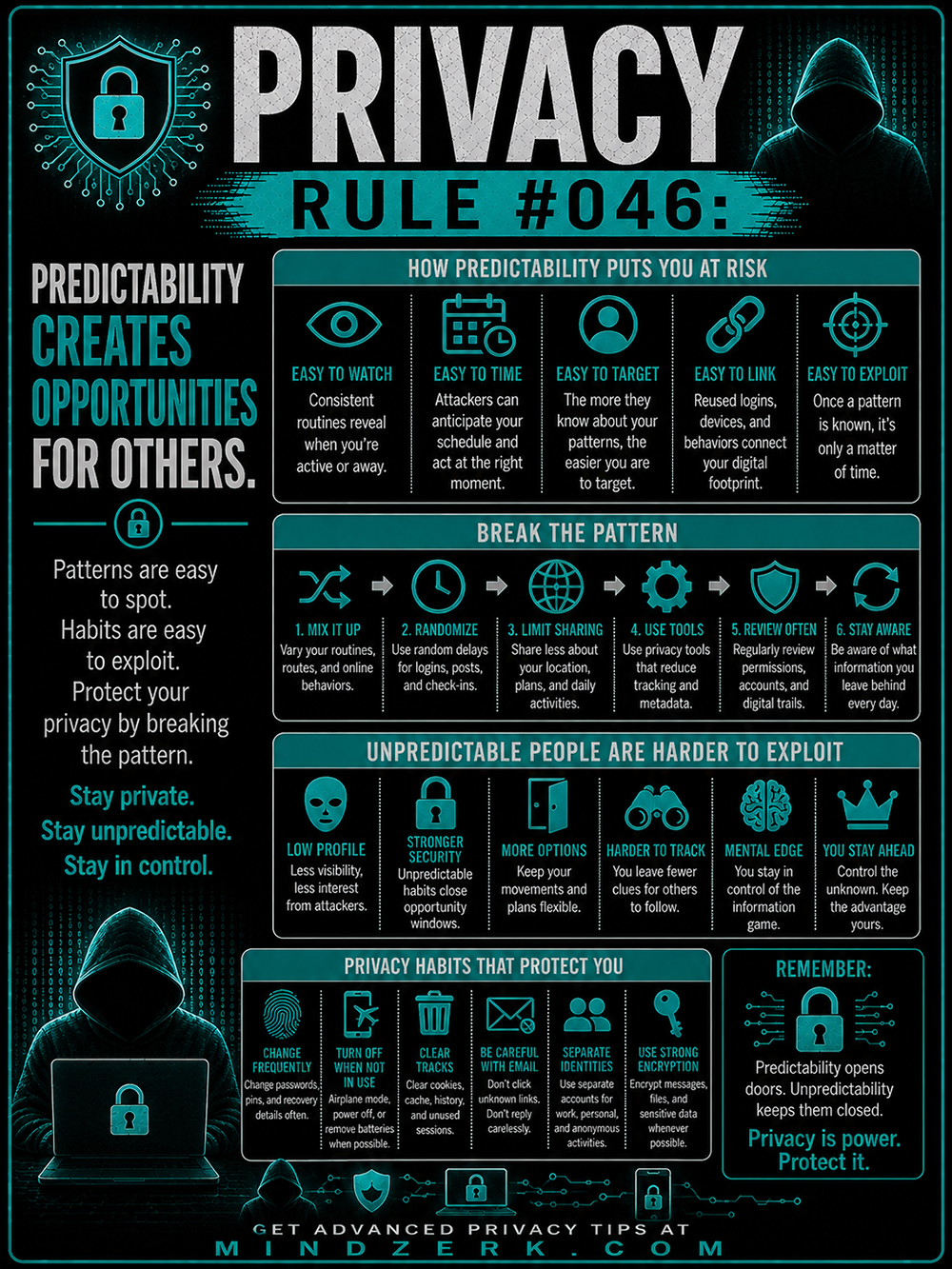
Protect your privacy by breaking the pattern.
Stay private.
Stay unpredictable.
Stay in control.
Why Predictability Creates Risk
Predictability makes life easier.
Routines help us remember things, save time, and reduce decision fatigue.
The problem is not routine itself.
The problem is exposing that routine to people who do not need to know it.
Once someone understands your patterns, they can begin anticipating your behavior.
They may know:
- When you are usually home
- When you are likely away
- Which accounts belong to you
- Which devices you use
- Where you regularly travel
- When you usually respond
- Which messages are likely to get your attention
The more predictable you become, the less effort someone else needs to study you.
Predictability Makes You Easy to Watch
Consistent routines reveal activity.
A person does not need constant access to understand your schedule.
They may only need a few clues.
Regular social posts.
Repeated check-ins.
Daily online activity at the same time.
A vehicle leaving on the same route.
Lights switching on and off in a familiar pattern.
Over time, those clues reveal when you are active, unavailable, distracted, or away.
Privacy begins with controlling who can see those patterns.
Predictability Makes Attacks Easier to Time
Timing matters.
Scammers, thieves, stalkers, and other bad actors often wait for convenient moments.
They may act when:
- You are traveling
- You are distracted
- Your business is closed
- Your home appears empty
- You are expecting a delivery
- You are waiting for an important email
- You usually respond quickly
The more someone knows about your schedule, the easier it becomes to choose the right moment.
A predictable target does not have to be attacked immediately.
They can simply be observed until the opportunity appears.
Predictability Makes You Easier to Target
Personalized attacks work because they feel familiar.
A fake message may mention a place you visit.
A phishing email may arrive when you normally receive an invoice.
A scammer may contact you while you are traveling.
A fraudulent login may come from a device or service connected to your usual behavior.
The more information someone has about your routine, the easier it becomes to create something believable.
Predictability gives attackers context.
Context makes deception stronger.
Repeated Habits Connect Your Digital Footprint
People often try to separate parts of their lives using different accounts.
That separation weakens when the behavior behind those accounts remains identical.
The same posting times.
The same phrases.
The same profile images.
The same usernames.
The same recovery email.
The same device.
The same location patterns.
Even separate identities can be linked when the habits behind them match.
Privacy is not only about changing names.
It is also about reducing repeated signals.
Once a Pattern Is Known, Exploitation Becomes a Matter of Time
A single observation may mean very little.
Repeated observations become useful.
Someone who studies your habits may eventually know:
- What gets your attention
- What makes you respond
- When you are most vulnerable
- Which systems you rely on
- Which people you trust
- Which routines you rarely break
At that point, they no longer need luck.
They only need patience.
That is why unpredictability is a defensive advantage.
Break the Pattern
You do not need to live randomly or make everyday life impossible.
The goal is to avoid revealing unnecessary regularity.
Small changes can make your habits harder to map.
1. Mix Up Your Routine
Vary predictable activities when practical.
Change your routes.
Avoid posting from the same locations repeatedly.
Do not announce every trip or absence.
Use different times for nonessential activities.
Routine can remain useful without being publicly visible.
2. Randomize Timing
Scheduled behavior creates patterns.
Consider using varied timing for:
- Social posts
- Account logins
- Public check-ins
- Newsletter delivery
- Automated messages
- Routine status updates
Even small delays can make behavior harder to predict.
The purpose is not to create chaos.
It is to avoid broadcasting a perfect schedule.
3. Limit What You Share
The safest pattern is the one nobody sees.
Share less about:
- Daily routines
- Work schedules
- Travel plans
- Regular locations
- Family habits
- Future events
- Times when you will be away
You do not need to hide your life.
You should be selective about which parts become public information.
4. Use Privacy Tools
Technology can reduce tracking when used deliberately.
Helpful tools and practices include:
- Tracker-blocking browsers
- Privacy-focused search tools
- Encrypted messaging
- Virtual private networks
- Separate browser profiles
- Permission controls
- Location access limits
Tools do not replace discipline.
They help reduce the signals your normal activity leaves behind.
5. Review Your Patterns Regularly
Look at your life from the outside.
Ask:
- Could someone predict when I am home?
- Do my posts reveal a schedule?
- Are my accounts easy to connect?
- Do I always use the same usernames?
- Are old photos exposing regular locations?
- Do apps collect more location data than necessary?
Privacy audits should examine behavior, not just passwords and settings.
6. Stay Aware of the Trail You Leave
Everyday actions create information.
A purchase.
A location ping.
A photo.
A delivery.
A login.
A public comment.
A shared calendar.
The goal is not to eliminate every trace.
It is to understand what those traces reveal when combined.
Why Unpredictable People Are Harder to Exploit
Unpredictability does not make you invisible.
It makes you more expensive to study.
That difference matters.
You Maintain a Lower Profile
Less visibility attracts less unwanted attention.
When your behavior does not constantly announce itself, fewer people have enough information to become interested in targeting you.
Your Security Becomes Stronger
Predictable habits create windows of opportunity.
Unpredictable habits make those windows harder to find.
Attackers prefer easy targets.
Making yourself harder to understand may be enough to make them move on.
You Keep More Options
Predictability locks you into expected behavior.
Flexibility gives you choices.
You can change routes.
Change accounts.
Change routines.
Change systems.
More options make it harder for someone else to control the situation.
You Become Harder to Track
Tracking depends on recognizable signals.
When you reduce repeated clues, linking your activities becomes more difficult.
Fewer connections mean a weaker profile.
You Keep the Mental Advantage
Information creates leverage.
When others know your patterns and you know nothing about theirs, they hold the advantage.
Privacy helps keep control of the information game.
You decide what becomes visible.
You decide when habits change.
You decide which clues remain available.
Privacy Habits That Protect You
Breaking predictability works best alongside ordinary security habits.
Change Important Credentials
Use strong, unique passwords.
Update recovery methods when needed.
Do not reuse the same password, PIN, or security answers across multiple services.
Credential reuse makes separate accounts easy to connect and compromise.
Turn Devices Off When Not Needed
Disable unnecessary connections.
Use airplane mode when appropriate.
Turn off Bluetooth, Wi-Fi, location services, cameras, and microphones when they are not required.
A device that is not transmitting creates fewer clues.
Clear Old Tracks
Remove outdated information.
Delete unused accounts.
Clear unnecessary histories.
Revoke old sessions.
Remove location data and old public posts that no longer serve a purpose.
You cannot erase everything, but you can stop adding to unnecessary trails.
Treat Email Carefully
Do not click links simply because they arrived at the expected time.
Verify senders.
Open important services directly instead of following email links.
Be especially cautious with messages that seem unusually relevant to your current activities.
That relevance may be intentional.
Separate Identities
Use different accounts for different purposes.
Keep business, personal, public, and private activity separated where practical.
Avoid unnecessary connections between them.
Separation becomes stronger when each account also has distinct habits and recovery information.
Use Strong Encryption
Encrypt sensitive files and communications.
Use end-to-end encrypted tools where possible.
Encryption will not hide every pattern, but it protects the content when data is intercepted or exposed.
Predictability Does Not Mean You Did Something Wrong
Most routines are normal.
People need structure.
Businesses need schedules.
Families need coordination.
The lesson is not to distrust every habit.
The lesson is to recognize that exposed habits become information.
A pattern can be convenient for you and useful to someone else at the same time.
The solution is intentional visibility.
Keep the routine.
Hide unnecessary details.
Change what does not need to remain fixed.
Avoid broadcasting your entire schedule.
Privacy Is Control Over What Others Can Predict
Many people define privacy as keeping secrets.
A better definition is maintaining control over what others can learn, connect, and anticipate.
When someone can reliably predict your movements, reactions, and availability, they hold information you may never have meant to give them.
Breaking patterns reduces that advantage.
It introduces uncertainty.
Uncertainty creates friction.
And friction discourages exploitation.
Stay Private. Stay Unpredictable. Stay in Control.
You do not need to become paranoid.
You need to become observant.
Notice the routines you expose.
Notice which accounts can be linked.
Notice when your posts reveal where you are.
Notice how frequently you repeat the same digital behaviors.
Then make small changes.
Share less.
Vary what can be varied.
Separate what should remain separate.
Review the trail you leave behind.
Because predictability opens doors.
Unpredictability helps keep them closed.
Privacy is power.
Protect it.