
Most privacy problems don’t start with hacks.
They start with shortcuts.
One-click logins.
Saved passwords.
Auto-sync everything.
“Stay signed in.”
It’s all designed to be easy.
And that’s exactly the problem.
The Trade-Off Nobody Talks About
Every convenience feature trades a little bit of control for a little bit of ease.
Individually, it seems harmless.
But stack enough of them…
And you’ve built a system that’s wide open.
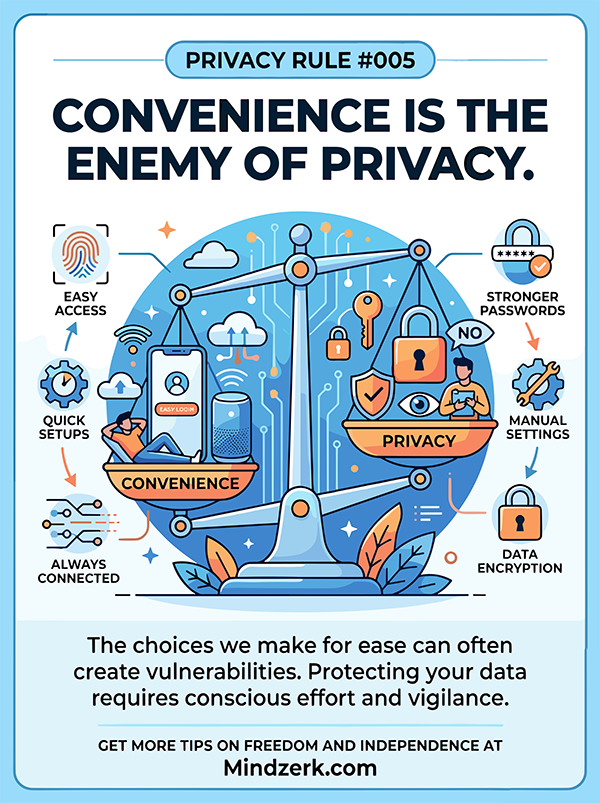
The Rule: Question Every Convenience
If something makes access easier, it usually makes exposure easier too.
That doesn’t mean you reject everything.
It means you stop accepting convenience blindly.
Where Convenience Breaks Privacy
Look at the patterns.
1. Easy Access
- Face ID everywhere
- Auto-login
- Devices always unlocked
Fast? Yes.
Secure? Not always.
2. Quick Setups
- Default settings
- “Recommended” configurations
- Skip customization
You’re trusting the system to protect you…
Without knowing what it actually does.
3. Always Connected
- Constant syncing
- Devices talking to each other
- Cloud everything
More connection = more exposure points.
What Privacy Actually Requires
The opposite of convenience.
1. Stronger Controls
- Better passwords
- Layered access
- Separation between systems
Takes effort—but reduces risk.
2. Manual Decisions
- Choosing settings
- Turning things off
- Being intentional
You decide what’s exposed—not the default.
3. Friction (The Good Kind)
- Logging in manually
- Verifying access
- Slowing down slightly
That friction protects you.
The Hidden Advantage: Awareness
When you stop chasing convenience:
- You understand your systems better
- You reduce blind spots
- You stay in control
You’re not just using tools—you’re managing them.
Where People Go Wrong
They prioritize ease.
They think:
“If it’s harder, it’s not worth it.”
But that mindset creates:
- Weak security
- Overexposure
- Dependence on systems they don’t control
The Bottom Line
Convenience feels good in the moment.
Privacy protects you long-term.
You rarely get both at the same level.
So you choose.
Apply This Everywhere
This isn’t just about digital privacy.
Think:
- Financial systems
- Business setups
- Daily habits
If something is too easy…
It’s worth asking what you’re giving up.
Final Thought
You don’t need to reject convenience.
You just need to understand the cost.
A little friction now can prevent a big problem later.