
AI isn’t the advantage.
How you use it is.
Right now, most people are barely scratching the surface. They toss in vague prompts, accept whatever comes out, and move on. That creates a gap—and if you’re smart, you step right into it.
The gap between lazy use and intentional use is where leverage lives.
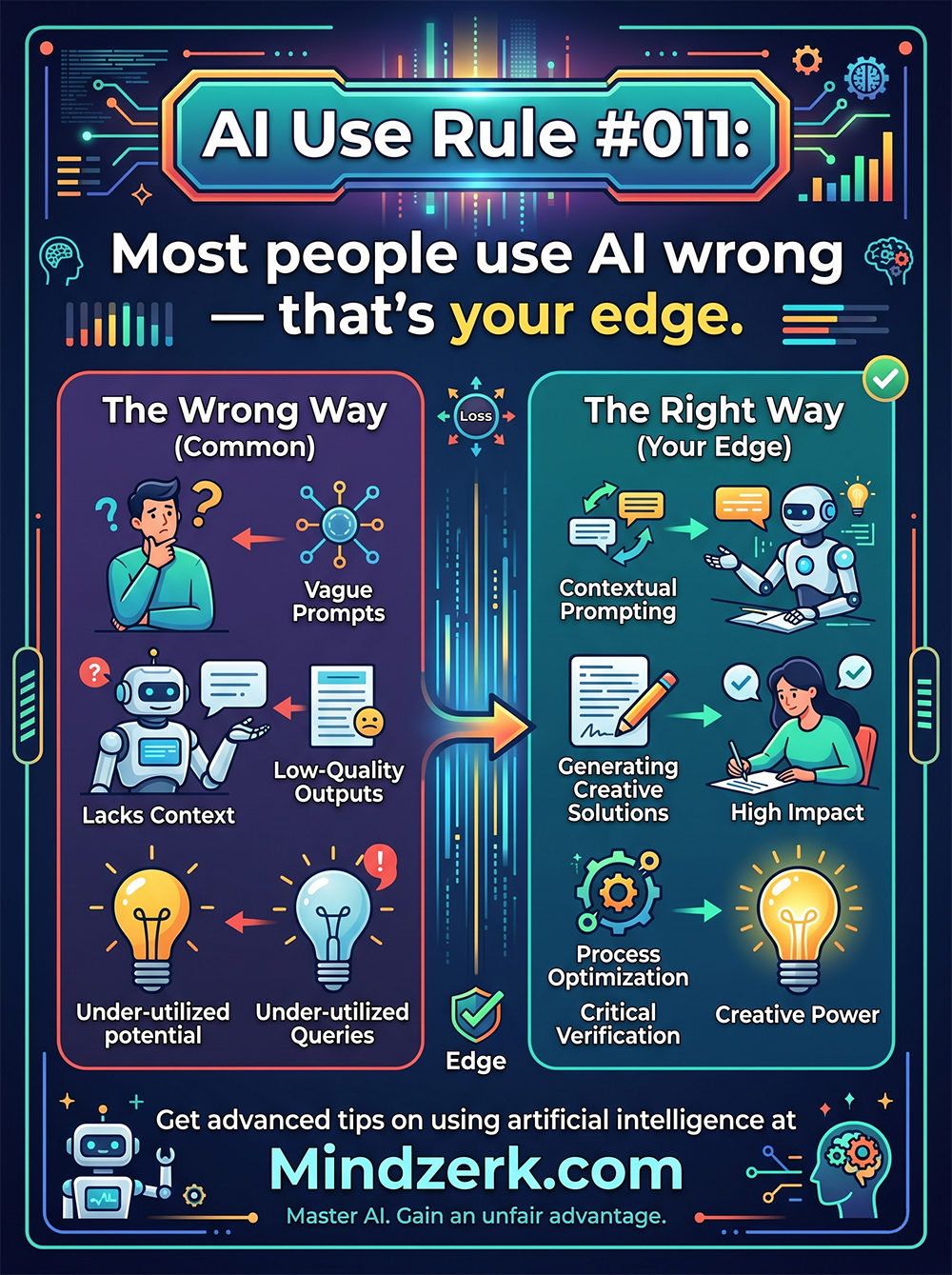
The Wrong Way (What Most People Do)
Let’s be blunt.
Most AI usage looks like this:
- “Write me a blog post about X”
- “Give me ideas for Y”
- “Make this better”
No structure. No context. No direction.
What happens next?
- Generic outputs
- Surface-level ideas
- Recycled content
- No real advantage
The tool isn’t failing.
The input is.
The Common Mistakes
1. Vague prompts
AI can’t read your mind. If your input is fuzzy, your output will be too.
2. No context
You skip the who, why, and how—and expect a sharp result.
3. One-shot thinking
You treat AI like a vending machine instead of a system you iterate with.
4. No verification
You trust outputs blindly instead of refining or pressure-testing them.
The Right Way (Your Edge)
Using AI properly isn’t complicated.
But it is intentional.
1. Contextual Prompting
Give AI something to work with:
- Goal
- Audience
- Tone
- Constraints
- Format
Instead of:
“Write a sales email”
Try:
“Write a short, punchy sales email for beginner marketers selling a $9 digital product. Keep it direct, slightly edgy, and focused on solving a clear problem.”
That alone changes everything.
2. Treat It Like a Process, Not a Tool
The real power comes from iteration.
- Generate → Refine → Expand → Cut → Reframe
Each pass sharpens the result.
You’re not asking for answers. You’re shaping outcomes.
3. Use AI to Think, Not Just Produce
Most people use AI for output.
You use it for:
- Breaking down ideas
- Finding angles
- Stress-testing logic
- Exploring alternatives
That’s where creative advantage comes from.
4. Optimize Your Workflow
AI isn’t just for content.
Use it to:
- Build systems
- Create templates
- Speed up decisions
- Remove friction from repeat tasks
The more repeatable your process becomes, the more powerful your output gets.
5. Always Verify and Improve
AI is fast.
It is not always right.
- Check facts
- Tighten language
- Add your voice
- Cut fluff
AI gives you raw material. You turn it into something sharp.
The Real Advantage
When you use AI the right way, three things happen:
1. You move faster
Less time starting. More time finishing.
2. You think better
You explore more angles than you would alone.
3. You produce more leverage
One idea turns into multiple assets, systems, or opportunities.
The Shift That Changes Everything
Most people treat AI like a shortcut.
That’s why they get average results.
You treat it like a multiplier.
That’s why you win.
A Simple Framework You Can Use Today
Next time you use AI, follow this:
Step 1: Define the outcome
What exactly are you trying to create?
Step 2: Add context
Who is it for? What tone? What constraints?
Step 3: Generate a draft
Get something on the page.
Step 4: Refine it
Ask for improvements, rewrites, variations.
Step 5: Finalize manually
Cut, polish, and make it yours.
Final Thought
Most people are using AI like amateurs.
That’s not a problem.
That’s your opportunity.
The difference isn’t access.
It’s approach.
Use it with intention, and you don’t just keep up—you pull ahead.