
Out there, failure isn’t rare.
It’s guaranteed.
Gear breaks.
Things get lost.
Conditions change fast.
So here’s the rule that separates prepared from exposed:
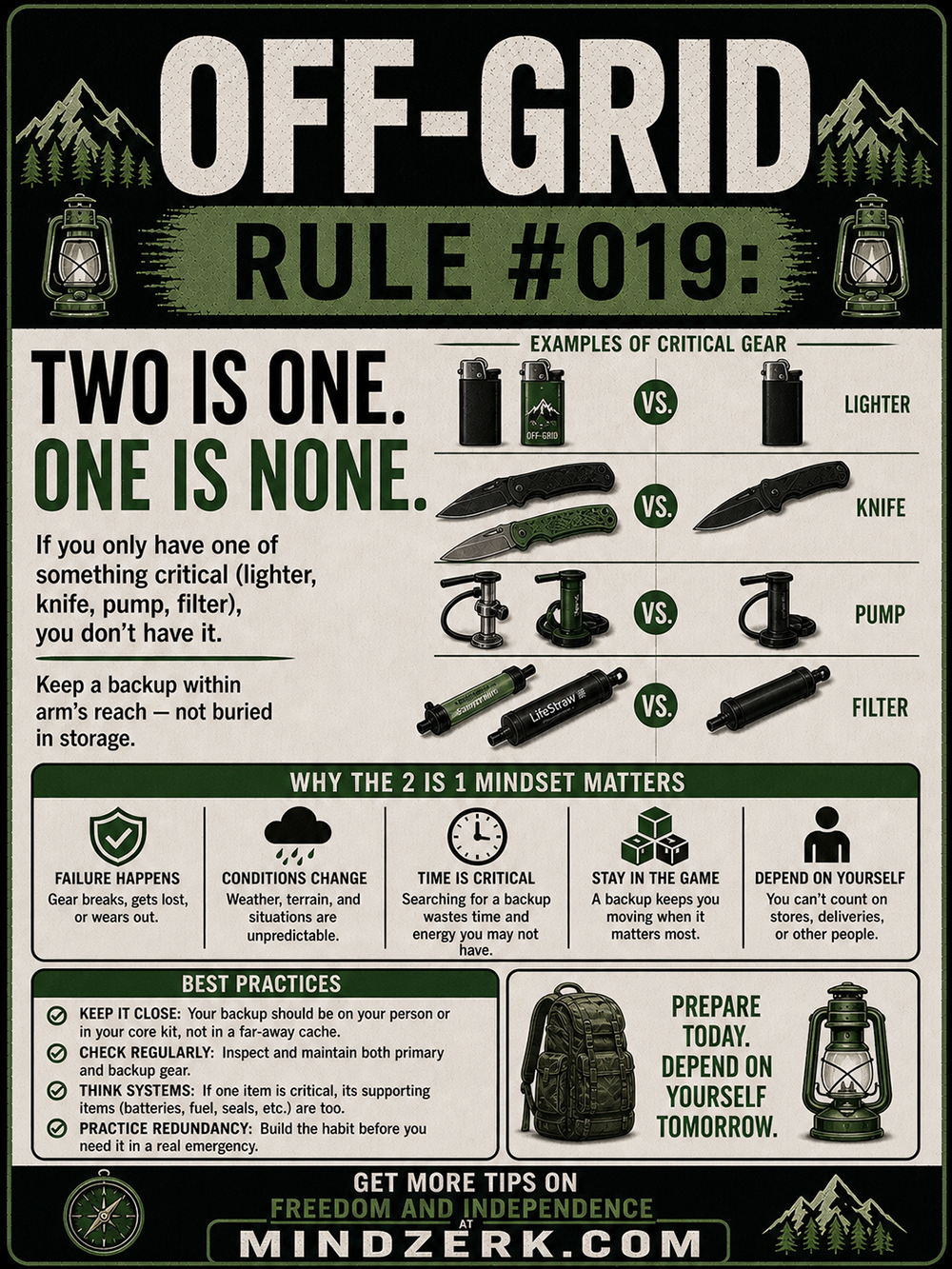
If you only have one of something critical…
you don’t have it.
The Core Idea
Redundancy isn’t overkill.
It’s survival.
When something matters—fire, water, tools, power—you don’t trust a single point of failure.
You carry a backup.
And you keep it within reach.
Not buried in a bin.
Not locked in a shed.
On you. Ready. Now.
What Counts as “Critical”
Think in terms of systems, not items.
Fire
- Lighter
- Ferro rod
- Backup ignition source
If one fails, you still get heat.
Cutting
- Primary knife
- Backup blade or multitool
You don’t want to be stuck without a way to cut, fix, or build.
Water
- Pump
- Gravity filter
- Backup filter or tablets
Water failure isn’t inconvenient—it’s dangerous.
Power
- Main power source
- Backup (battery, hand crank, or generator)
No power means no light, no comms, no options.
If it keeps you alive or moving—it needs a backup.
Why “Two Is One” Matters
Failure Happens
Even the best gear fails.
- Wear and tear
- Drops and damage
- Manufacturing defects
It’s not if. It’s when.
Conditions Change
Weather shifts. Terrain fights you.
What worked yesterday might not work today.
Time Is Critical
When something breaks, you don’t have time to troubleshoot.
You switch to the backup and keep moving.
Stay in the Game
Redundancy keeps momentum.
You don’t stop.
You adapt.
Depend on Yourself
Out there, you can’t rely on:
- Stores
- Deliveries
- Other people
Your backup is your safety net.
The Biggest Mistake
People store backups like collectibles.
- Deep in a pack
- Buried in a bin
- Locked away “just in case”
That defeats the purpose.
A backup you can’t reach is the same as no backup.
Best Practices That Actually Work
Keep It Close
Your backup should be:
- On your person
- In your core kit
- Instantly accessible
Not “somewhere in camp.”
Check Regularly
A broken backup is a false sense of security.
- Test it
- Maintain it
- Replace when needed
Think in Systems
If an item is critical, its support is too.
- Batteries
- Fuel
- Seals
- Spare parts
Don’t just duplicate the tool—support it.
Practice Redundancy
Don’t wait for an emergency.
Use your backups now and then.
Know they work.
Real-World Example
You have one lighter.
It fails.
Now what?
- No fire
- No heat
- No cooked food
- No signal
Now imagine:
- Lighter + ferro rod
The lighter fails—you switch.
No panic. No delay.
That’s the difference redundancy makes.
The Mindset Shift
Most people think:
“I have it covered.”
Off-grid thinking says:
“What happens when this fails?”
That question changes everything.
The Bottom Line
“Two is one. One is none.” isn’t paranoia.
It’s preparation.
- Duplicate what matters
- Keep backups close
- Test them regularly
- Think in systems
Because when something breaks—and it will—
Your backup is what keeps you alive, moving, and in control.
Prepare today.
Depend on yourself tomorrow.