
Most people use AI like a vending machine.
Type something in.
Get something out.
Repeat from scratch tomorrow.
That’s not leverage. That’s labor with better tools.
Here’s the shift:
Stop creating one-off outputs.
Start building assets you can reuse everywhere.
The Core Idea
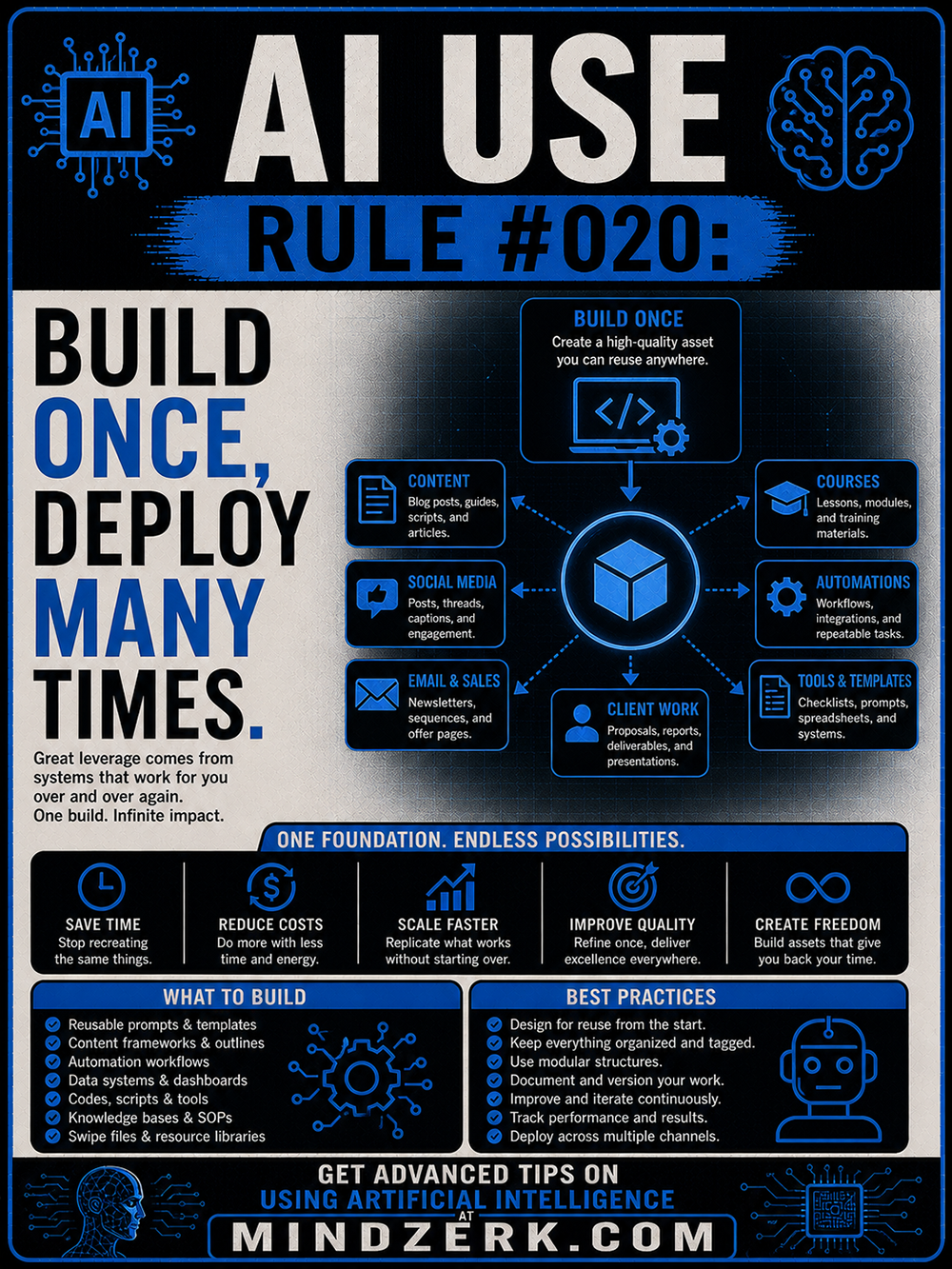
One strong build can feed everything.
A single well-structured asset can turn into:
- Blog posts
- Social content
- Emails
- Sales pages
- Courses
- Client deliverables
- Templates
- Automations
One build. Infinite deployment.
What “Build Once” Actually Means
It doesn’t mean “write something and reuse it blindly.”
It means:
- You create with structure
- You design for reuse
- You think in systems, not outputs
Instead of asking:
“What do I need right now?”
You ask:
“How can I build this so it works everywhere?”
The Asset Mindset
Stop thinking in posts.
Start thinking in assets.
Weak Approach:
- Write one tweet
- Write one email
- Write one article
Each is disconnected. No compounding.
Strong Approach:
- Build one core idea (structured)
- Break it into components
- Deploy it across channels
Now everything connects.
Now everything multiplies.
Example: One Idea, Many Outputs
Let’s say you build one strong concept.
From that, you get:
Content
- Blog post
- Guide
- Script
- Article
Social Media
- Threads
- Short posts
- Hooks
- Captions
Email & Sales
- Newsletter
- Sequences
- Offer pages
Courses
- Lessons
- Modules
- Training materials
Client Work
- Reports
- Presentations
- Deliverables
Tools & Templates
- Checklists
- Prompts
- Systems
Same idea. Multiple forms. Maximum reach.
Why This Wins
Save Time
You stop rebuilding the same thing over and over.
Reduce Costs
Less time wasted = more output with less effort.
Scale Faster
When something works, you replicate it instantly.
Improve Quality
Each iteration gets better.
Your system evolves.
Create Freedom
You build once…
Then your system keeps working for you.
What You Should Be Building
If it can be reused, it’s worth building properly.
Focus on:
- Reusable prompts and templates
- Content frameworks and outlines
- Automation workflows
- Data systems and dashboards
- Scripts, tools, and utilities
- Knowledge bases and SOPs
- Swipe files and resource libraries
If you’re going to do it twice, build it right once.
The System Behind It
Think of everything you create as modular.
- Break content into pieces
- Store them cleanly
- Tag them clearly
- Recombine them later
This is how you move from creator → operator.
Best Practices That Actually Work
Design for Reuse From the Start
Don’t “repurpose later.” Build it reusable from day one.
Stay Organized
If you can’t find it, you won’t reuse it.
- Tag everything
- Name things clearly
- Store in one system
Use Modular Structures
Think in blocks:
- Hooks
- Frameworks
- Sections
- CTAs
These can be swapped and reused anywhere.
Document and Version
Track what works.
Refine over time.
Don’t overwrite—improve.
Iterate Constantly
Your best asset is version 5, not version 1.
Track Results
Know what performs.
Then deploy it harder.
Publish Everywhere
Don’t let a good asset sit in one place.
Spread it.
The Trap to Avoid
People hear “repurpose” and think:
“Copy and paste.”
That’s not it.
Real leverage comes from:
- Adapting
- Reframing
- Improving
- Re-deploying
Same core. Better execution.
The Bigger Shift
This rule isn’t about content.
It’s about control.
When you build reusable systems:
- You’re not dependent on constant creation
- You’re not starting over every day
- You’re not stuck in output mode
You’re building infrastructure.
The Bottom Line
Most people create once… and it dies there.
You build once… and it keeps working.
- One idea → many formats
- One system → many outputs
- One effort → ongoing returns
Build like it’s going to be reused.
Because that’s where the real leverage lives.
One foundation.
Endless possibilities.