
A lot of people think better AI results come from chasing the newest model.
Sometimes that helps.
But most of the time?
The real difference comes from the quality of the input.
The truth is simple:
Garbage in. Garbage out.
Even the most advanced AI system can only work with what you give it.
If your prompts are vague, confused, rushed, or incomplete, the output usually will be too.
But when your inputs are:
- Clear
- Specific
- Structured
- Context-rich
- Goal-oriented
…the results improve dramatically.
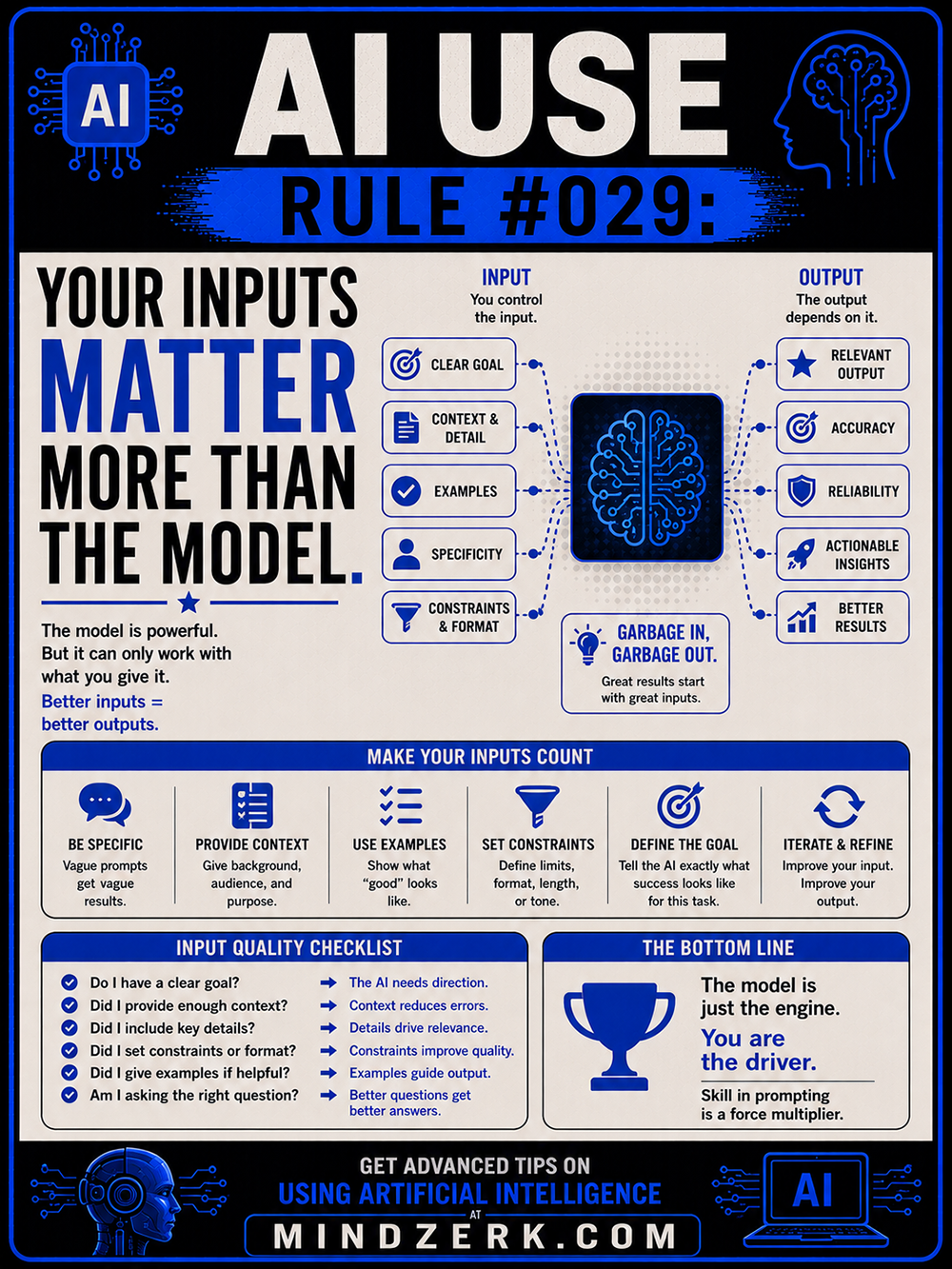
The model is the engine.
You are the driver.
Why Most People Get Mediocre AI Results
Most users treat AI like a magic vending machine.
They throw in:
- Half-thought-out prompts
- One-sentence requests
- No context
- No examples
- No direction
Then they wonder why the output feels generic.
AI is not mind reading.
It responds to:
- Framing
- Clarity
- Context
- Constraints
- Examples
- Intent
The better your instructions, the better the outcome.
Better Inputs = Better Outputs
Think of AI like working with a highly skilled assistant.
If you say:
“Make me something good.”
You’ll probably get average results.
But if you say:
“Create a 1970s underground screen-printed style infographic for beginner off-grid users using dark forest green, cream, and black. Use thick icon layouts, bold typography, and practical survival-focused copy.”
Now the AI has:
- Direction
- Tone
- Audience
- Style
- Constraints
- Goal clarity
That changes everything.
The Five Inputs That Matter Most
1. Clear Goals
AI works best when success is defined clearly.
Bad input:
“Write a blog post.”
Better input:
“Write a 1,500-word conversational blog post for beginner internet marketers explaining why consistency matters more than motivation.”
Specificity improves relevance.
2. Context & Detail
Context reduces errors.
The AI should understand:
- Audience
- Purpose
- Style
- Platform
- Constraints
- Desired outcome
The more useful context you provide, the less guessing the AI has to do.
3. Examples
Examples are powerful.
If you show the AI:
- A writing style
- A layout
- A tone
- A structure
- A visual direction
…the output becomes dramatically more aligned.
Examples eliminate ambiguity.
4. Constraints & Format
Constraints improve quality.
People assume creativity means infinite freedom.
Usually the opposite is true.
Strong constraints create stronger results.
Examples:
- Word count
- Tone
- Audience
- Layout structure
- Color limitations
- Formatting rules
- Brand voice
AI performs better with boundaries.
5. Iteration
Great AI users rarely get perfect results in one shot.
They:
- Refine prompts
- Adjust direction
- Improve wording
- Clarify intent
- Remove confusion
- Build on previous outputs
Iteration compounds quality.
The Real Skill Is Prompt Thinking
The future advantage is not just access to AI.
Everyone will have access.
The advantage becomes:
Knowing how to think clearly enough to direct it well.
That means:
- Clear communication
- Systems thinking
- Taste
- Decision making
- Problem framing
- Goal clarity
AI amplifies thinking.
Weak thinking produces weak output.
Strong thinking produces leverage.
Why Prompting Is A Force Multiplier
Good prompting saves:
- Time
- Money
- Frustration
- Rework
- Creative energy
It also improves:
- Accuracy
- Relevance
- Reliability
- Usability
- Scalability
One well-structured input can outperform hours of random experimentation.
Vague Inputs Create Vague Results
A common mistake:
Users blame the model instead of the prompt.
Sometimes the model is limited.
But often the issue is:
- Undefined goals
- Missing context
- Weak instructions
- Contradictory requests
AI responds directly to input quality.
If the output feels generic:
- The direction may be generic
- The request may be incomplete
- The expectations may be unclear
Great AI Users Think Like Directors
The best AI workflows feel less like “asking questions” and more like:
Directing a production.
You guide:
- Vision
- Structure
- Tone
- Constraints
- Purpose
- Standards
AI handles:
- Speed
- Drafting
- Processing
- Expansion
- Repetition
- Synthesis
That partnership is where the real power lives.
Make Your Inputs Count
Be Specific
Vague prompts create vague answers.
Clarity matters.
Provide Context
Tell the AI:
- Who it’s for
- Why it matters
- What success looks like
Use Examples
Show the standard.
Examples reduce randomness.
Set Constraints
Limits improve focus.
Structure improves reliability.
Define The Goal
The AI should know:
- What you want
- Why you want it
- What outcome matters
Iterate & Refine
Refinement creates quality.
Great outputs are usually shaped, not discovered instantly.
Input Quality Checklist
Before submitting a prompt, ask:
- Do I have a clear goal?
- Did I provide enough context?
- Did I define the audience?
- Did I include examples if needed?
- Did I explain tone or formatting?
- Did I set useful constraints?
- Am I asking the right question?
Small improvements in input quality create massive improvements in output quality.
The Biggest Shift People Miss
The most valuable AI skill is not:
- Tool collecting
- Model obsession
- Prompt trick gimmicks
It’s:
Clear thinking.
Because AI magnifies direction.
If the direction is weak, confusion scales.
If the direction is strong, leverage scales.
AI Is The Engine — You Are The Driver
The model matters.
But the operator matters more.
The people getting extraordinary AI results are usually not:
- The smartest coders
- The people with the newest tools
- The loudest “AI experts”
They are often the people who:
- Think clearly
- Communicate clearly
- Build systems
- Understand outcomes
- Refine consistently
That is the real edge.
Final Thought
AI is not magic.
It is amplification.
And amplification makes inputs matter even more.
Better questions create better answers.
Better direction creates better outputs.
Better thinking creates better systems.
The model is powerful.
But the quality of your inputs determines whether that power becomes:
- Noise
or - Leverage
Because at the end of the day:
The AI is the engine.
You are the driver.