
Most people use AI like a gadget.
One prompt.
One result.
Done.
That’s why most people get average output.
Because they’re using tools, not building systems.
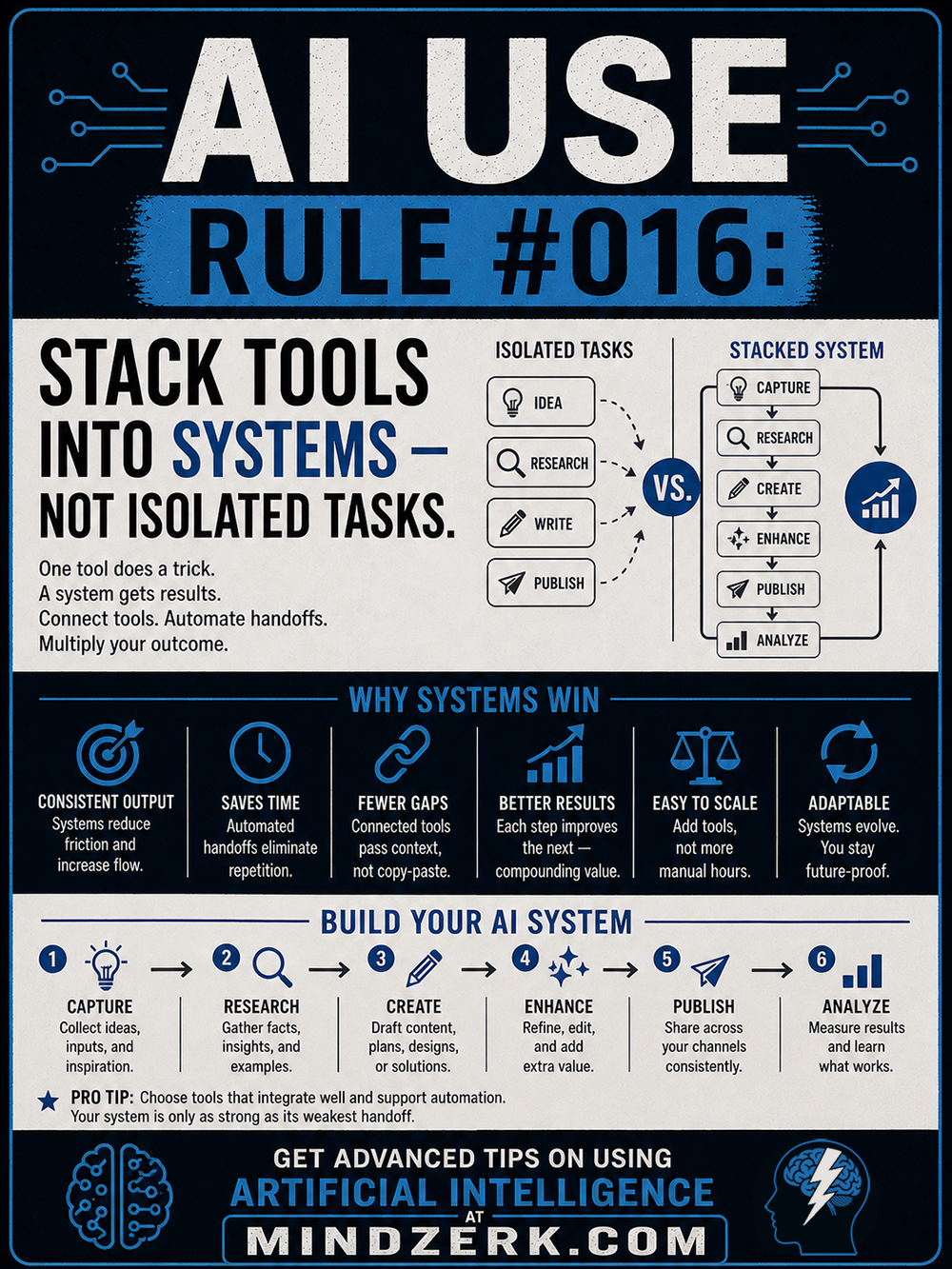
One tool does a trick. A system gets results.
The Problem With Isolated AI Use
Here’s what most workflows look like:
- Get an idea
- Open AI
- Generate something
- Copy it somewhere else
- Repeat later
Every step is disconnected.
That creates:
- Friction
- Lost context
- Repetition
- Inconsistent results
You’re working harder than you should.
Isolated tasks waste time. Systems multiply output.
What a System Actually Looks Like
A real AI workflow isn’t random.
It’s connected.
It flows like this:
- Capture
- Research
- Create
- Enhance
- Publish
- Analyze
Each step feeds the next.
Nothing gets lost.
Everything compounds.
The Difference Is Massive
Isolated Workflow
- You redo work
- You lose ideas
- You copy and paste constantly
- Results vary every time
Stacked System
- Ideas flow automatically
- Context carries forward
- Output improves each step
- Results become consistent
Systems turn effort into momentum.
Why Systems Win
1. Consistent Output
When your process is structured, your results stabilize.
You stop guessing.
You start producing.
2. Saves Time
No more repeating the same setup.
No more re-explaining context.
You build once. You run it over and over.
3. Fewer Gaps
Disconnected tools create breakdowns.
Systems eliminate them.
Everything stays linked.
4. Better Results
Each step improves the last:
- Research feeds better drafts
- Drafts improve edits
- Edits improve publishing
Quality compounds.
5. Easy to Scale
You don’t need more hours.
You add:
- Better tools
- Better automation
- Better steps
And the system grows.
6. Adaptable
Tools change.
Systems evolve.
If one tool breaks, you swap it.
The system still runs.
Build Your AI System (Step-by-Step)
Step 1: Capture
Collect:
- Ideas
- Prompts
- Notes
Use something simple.
Notion, a notes app, whatever works.
Step 2: Research
Use AI to:
- Expand ideas
- Gather examples
- Find angles
Feed this back into your system.
Step 3: Create
Generate:
- Drafts
- Outlines
- Concepts
This is your raw material.
Step 4: Enhance
Refine everything:
- Rewrite
- Improve clarity
- Add depth
This is where average becomes valuable.
Step 5: Publish
Push it out:
- Blog
- Social
- Products
Consistency matters more than perfection.
Step 6: Analyze
Look at:
- What performed
- What didn’t
- What can improve
Then loop it back.
Your system gets smarter every cycle.
The Pro Tip Most People Miss
Your system is only as strong as its weakest handoff.
If one step breaks:
- Output slows
- Quality drops
- Friction returns
So optimize transitions:
- Make tools talk to each other
- Reduce manual steps
- Keep context flowing
Real Talk
If you’re jumping between tools randomly…
You don’t have a system.
You have chaos with extra steps.
The Bottom Line
AI isn’t your advantage.
How you use it is.
Stack tools into systems, and you stop working harder—you start working smarter.
Build the system once.
Then let it produce for you.