
Most people quit too early because they expect their first product to change their life.
It usually won’t.
That’s normal.
Your first products are not just products.
They are reps.
Training.
Education.
Market research.
Skill building.
The people who eventually build powerful businesses are rarely the people who got everything right immediately.
They are the people who:
- Kept shipping
- Kept learning
- Kept improving
- Kept adapting
Experience compounds.
That’s the real advantage.
Beginners Want Immediate Success
Most new creators and entrepreneurs secretly hope:
- Their first product goes viral
- Their first course explodes
- Their first design becomes a bestseller
- Their first offer changes everything
Sometimes that happens.
Usually it doesn’t.
And that’s okay.
Because the biggest value of your early products is not immediate money.
It’s:
- Feedback
- Experience
- Clarity
- Process improvement
- Skill development
- Market understanding
Those things become extremely valuable later.
Every Product Teaches You Something
Even failed products teach useful lessons.
You learn:
- What people respond to
- What people ignore
- What headlines work
- What offers convert
- What designs attract attention
- What messaging creates trust
- What customers actually want
You cannot fully learn these things through theory alone.
The market teaches differently than books do.
Shipping Builds Real Skill
A lot of people stay trapped in “preparation mode.”
They:
- Research endlessly
- Watch tutorials constantly
- Rearrange branding
- Rewrite plans forever
- Wait until everything feels perfect
But skill comes from:
Repetition under real conditions.
Every completed product strengthens:
- Decision making
- Creative speed
- Communication
- Production systems
- Audience understanding
- Technical ability
- Confidence
That only happens through execution.
Perfect Is The Enemy
Your first 50 products are not supposed to be perfect.
They are supposed to:
- Exist
- Teach
- Improve you
- Build momentum
Perfectionism destroys output.
And without output:
You never gather real-world data.
The market rewards iteration more than hesitation.
Customers Teach Faster Than Theory
One real customer interaction teaches more than:
- 50 motivational videos
- Endless market research
- Overthinking ideas for months
Why?
Because customers reveal reality.
They show you:
- What they value
- What they ignore
- What confuses them
- What they’re willing to pay for
- What emotionally connects
That feedback is priceless.
Your Early Products Build Clarity
At first, most people think they know what they want to create.
Then reality refines them.
Over time you begin discovering:
- Your strengths
- Your voice
- Your audience
- Your style
- Your niche
- Your systems
- Your advantages
This clarity emerges through repetition.
Not endless thinking.
Momentum Matters More Than Perfection
The creators who eventually dominate often look unstoppable later.
But what most people never see are:
- The awkward first products
- The ignored posts
- The failed launches
- The weak designs
- The low sales
- The experiments
Momentum compounds quietly.
Consistency matters more than early brilliance.
Your First 50 Products Teach Process
You eventually stop thinking only about individual products.
You begin learning:
- Production workflows
- Marketing systems
- Customer acquisition
- Fulfillment
- Distribution
- Automation
- Scaling
- Content repurposing
That process knowledge becomes an asset.
And process creates freedom.
Experience Creates Confidence
Confidence is not built through positive thinking.
It’s built through proof.
Every shipped product tells your brain:
- You can finish things
- You can survive failure
- You can improve
- You can adapt
- You can create value
That creates real confidence.
Not fake hype.
Most Successful People Have Huge Graveyards
Behind almost every successful creator or entrepreneur is:
- A pile of mediocre products
- Failed experiments
- Weak launches
- Broken ideas
- Abandoned concepts
The difference is:
They kept going.
Most people stop before experience compounds.
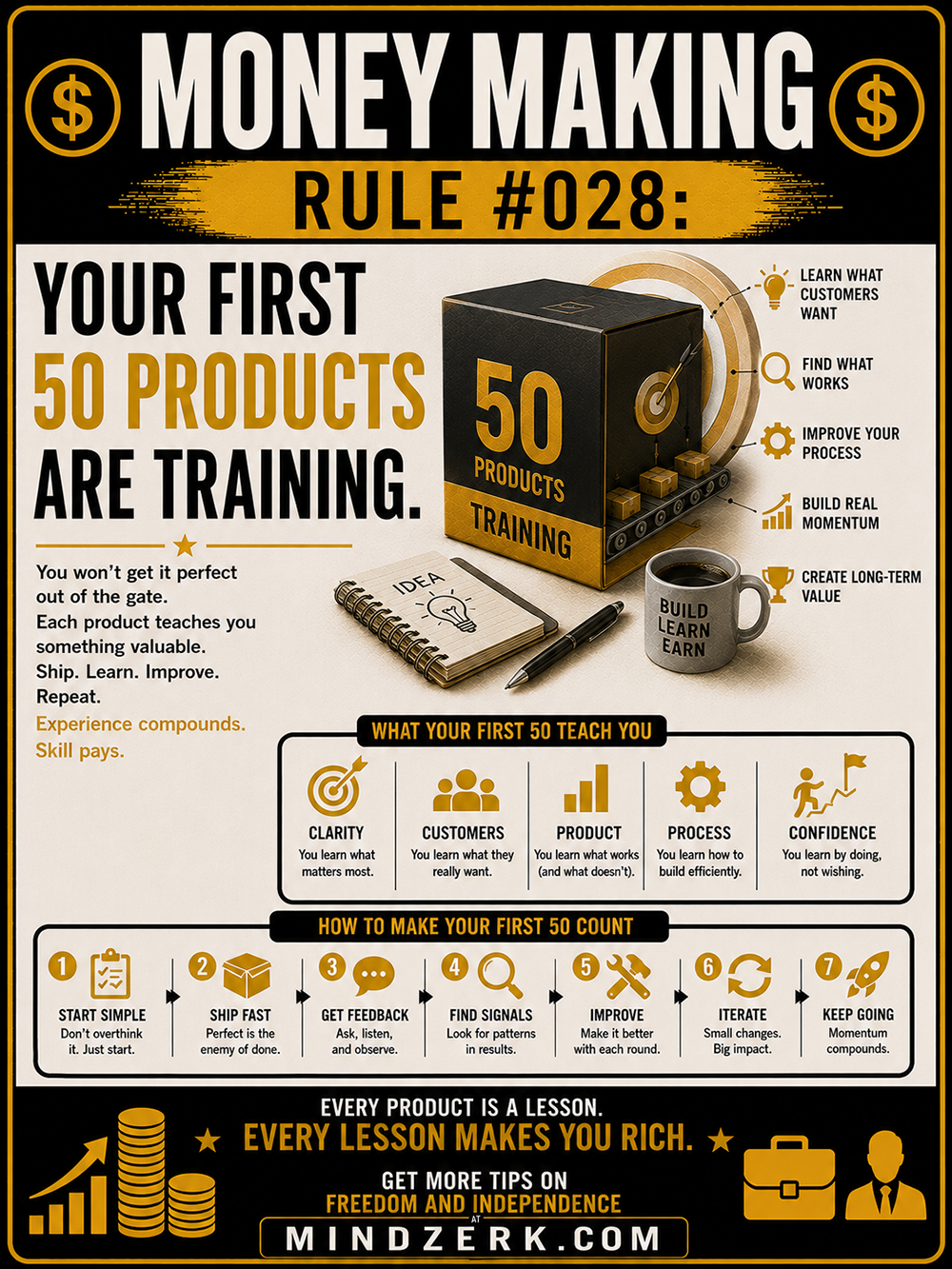
What Your First 50 Products Teach You
Clarity
You learn what actually matters.
Customers
You discover what people truly want.
Product Sense
You begin recognizing:
- Strong ideas
- Weak ideas
- Real demand
- Better positioning
Process
You learn how to build faster and better.
Confidence
You stop fearing execution.
How To Make Your First 50 Count
1. Start Simple
Do not overengineer early products.
Focus on finishing.
2. Ship Fast
Done beats endlessly delayed.
3. Get Feedback
Listen carefully.
The market tells the truth.
4. Watch For Signals
Pay attention to:
- Clicks
- Shares
- Sales
- Engagement
- Questions
- Emotional reactions
Patterns matter.
5. Improve Constantly
Each version should become:
- Clearer
- Faster
- Better positioned
- More valuable
6. Iterate
Small improvements compound massively over time.
7. Keep Going
This is where most people fail.
Not because they lack talent.
Because they stop too early.
Repetition Builds Advantage
Every completed product strengthens:
- Skill
- Taste
- Speed
- Systems
- Confidence
- Audience understanding
Eventually:
What once felt difficult becomes automatic.
That’s where leverage begins.
Quantity Creates Quality
This is uncomfortable for perfectionists.
But many people become excellent by creating large amounts of work.
Not by waiting for perfection before starting.
The process looks like:
- Create
- Learn
- Improve
- Repeat
Over and over.
That repetition sharpens skill faster than endless preparation.
Most People Never Reach Product #10
That’s important to understand.
Many people:
- Quit after one launch
- Give up after low sales
- Stop after weak engagement
- Abandon projects too early
Which means:
Persistence alone creates advantage.
If you keep building while others stop:
You naturally improve faster.
Your Goal Is Not One Perfect Product
Your goal is:
- Building capability
- Building systems
- Building resilience
- Building experience
- Building momentum
Those things eventually produce better products automatically.
Final Thought
Your first 50 products are not wasted effort.
They are training.
Every product teaches:
- Something about the market
- Something about customers
- Something about systems
- Something about yourself
Skill compounds.
Experience compounds.
Confidence compounds.
The people who eventually succeed are often not the smartest or most talented.
They are the people who stayed in the game long enough to become dangerous through repetition.
Ship.
Learn.
Improve.
Repeat.