
Most privacy advice focuses on protection.
Encryption.
Tools.
Settings.
That all matters.
But there’s a simpler layer most people ignore:
Don’t give away what doesn’t need to be said.
The Problem With Oversharing
We live in a system that rewards exposure.
Post more.
Share more.
Explain everything.
So people do.
They share:
- Personal details
- Business plans
- Opinions tied to identity
- Information that feels harmless in the moment
And piece by piece, they build a profile of themselves.
One they don’t control.
The Rule: Say Less by Default
If it doesn’t need to be shared, don’t share it.
Not everything needs to be:
- Posted
- Typed
- Recorded
- Explained
Silence is a form of control.
Why This Matters
Information doesn’t exist in isolation.
It stacks.
A small detail here.
Another there.
Over time, it creates:
- A clear identity map
- Predictable behavior patterns
- Data that can be interpreted in ways you didn’t intend
Once it’s out there…
You don’t get it back.
What This Looks Like in Practice
This isn’t about disappearing.
It’s about being selective.
1. Filter Before You Share
Ask:
“Does this need to exist outside my head?”
If not—keep it there.
2. Separate Public and Private
Not everything belongs in the same space.
- Personal life
- Business moves
- Opinions
Keep boundaries.
3. Avoid Real-Time Exposure
Sharing things as they happen:
- Locations
- Actions
- Decisions
Creates unnecessary risk.
Delay it—or don’t share it at all.
The Hidden Advantage: Power
When you control what’s known about you:
- You reduce attack surface
- You stay unpredictable
- You maintain flexibility
People can’t use what they don’t have.
Where People Go Wrong
They think:
- “It’s harmless”
- “Nobody cares”
- “It’s just one post”
But systems don’t forget.
And context can change.
What’s irrelevant today can matter later.
The Bottom Line
Privacy isn’t just about protection.
It’s about restraint.
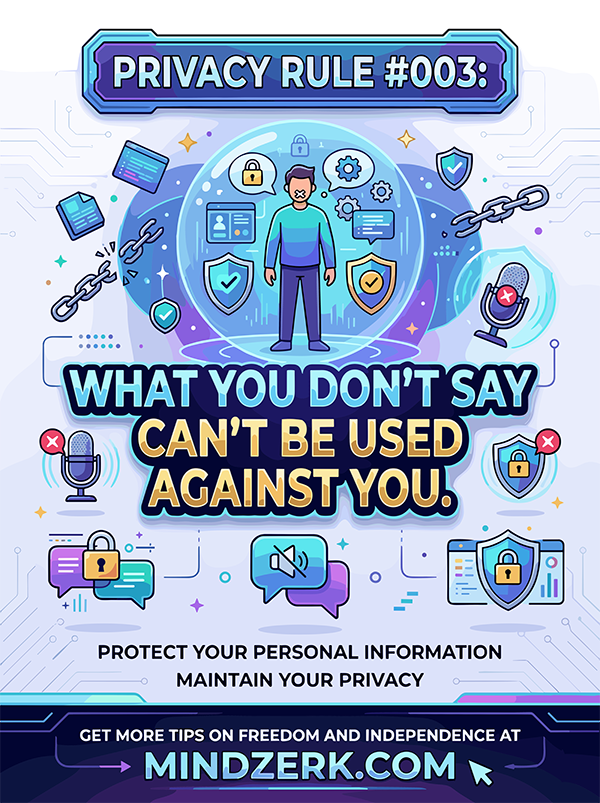
Every piece of information you don’t release is one less thing that can be used against you.
Apply This Everywhere
This applies beyond social media.
Think:
- Conversations
- Emails
- AI tools
- Forms and signups
If it creates a record…
It’s worth thinking twice.
Final Thought
You don’t need to hide everything.
You just need to stop giving everything away.
Control what leaves your mouth, your keyboard, and your systems—and you control a lot more than you think.