
Most people think privacy begins and ends with encryption.
Encrypt your messages.
Encrypt your files.
Use secure apps.
That’s all good advice.
But there is a problem.
Even when nobody can read your content, they can often still see the trail around it.
That trail is called metadata.
And metadata can reveal far more than most people realize.
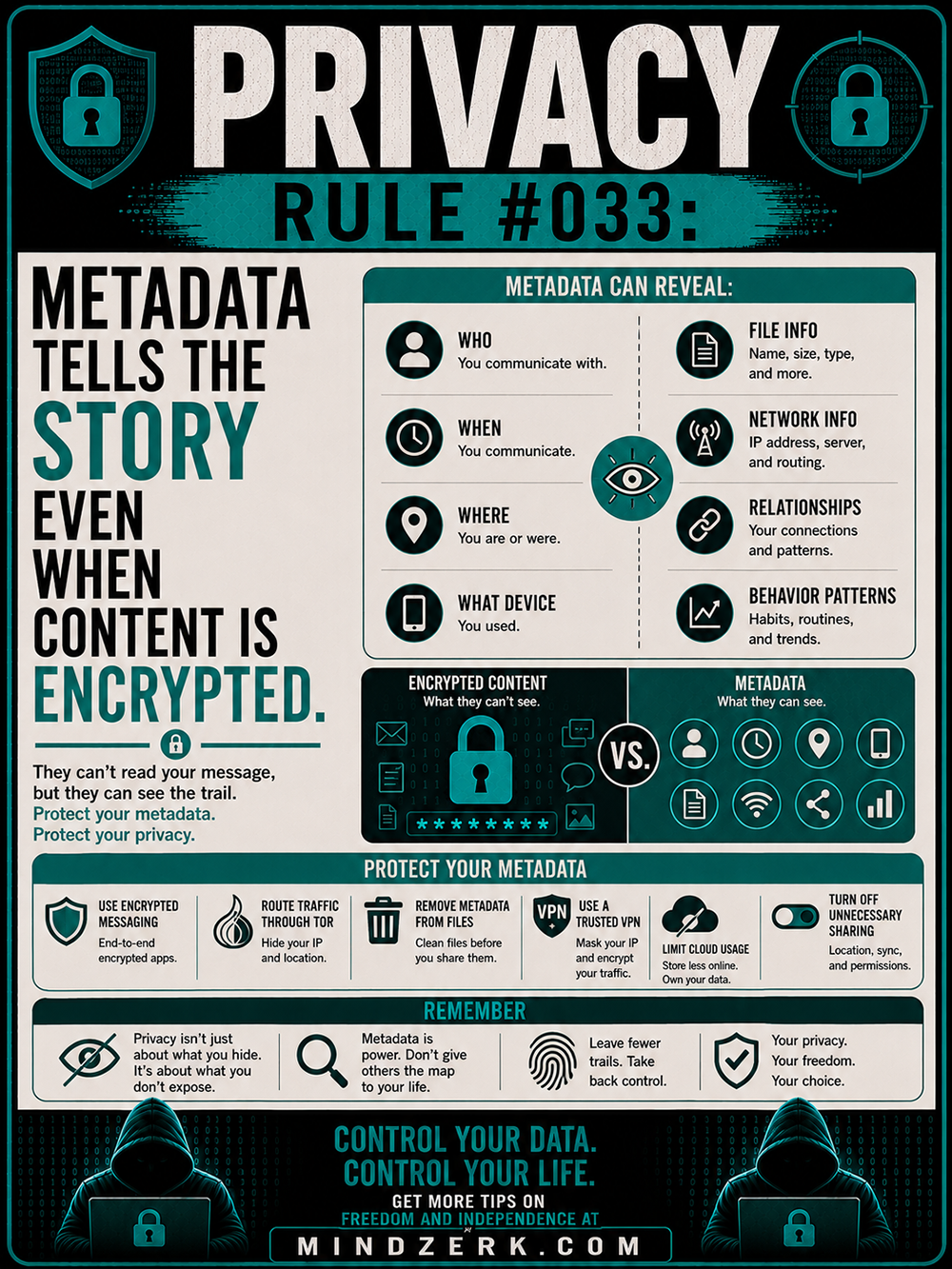
Privacy Rule #033: Metadata tells the story even when content is encrypted.
What Is Metadata?
Metadata is information about information.
Think of it as the envelope instead of the letter.
Someone may not be able to read the message inside, but they can still see:
- Who sent it
- Who received it
- When it was sent
- How often you communicate
- Where it originated
- What device was used
The contents stay hidden.
The patterns do not.
Why Metadata Matters
Imagine someone can’t read your text messages.
Sounds private, right?
Maybe.
But what if they know:
- You text the same person every morning at 6:30 AM.
- You communicate with a specific group every Friday night.
- You travel to the same location every weekend.
- Your device connects to certain networks regularly.
Without reading a single message, they can begin building a profile of your habits, relationships, routines, and interests.
That’s the power of metadata.
Metadata Can Reveal More Than You Think
Who
Metadata reveals who you communicate with.
Not necessarily what you said.
But who matters.
Connections create maps.
Maps reveal networks.
When
Communication timestamps tell stories.
Daily habits.
Work schedules.
Sleep patterns.
Travel routines.
Even encrypted traffic often reveals timing information.
Where
Location data is one of the most revealing forms of metadata.
It can expose:
- Home addresses
- Work locations
- Travel habits
- Social circles
Many apps collect far more location information than users realize.
What Device
Metadata often includes information about:
- Device type
- Operating system
- Browser
- Network characteristics
Combined together, these details can help identify users.
Relationships
Patterns reveal connections.
Even when names are hidden, repeated interactions often expose social relationships.
The network itself becomes the story.
Behavior Patterns
This is where metadata becomes truly powerful.
Patterns reveal:
- Habits
- Routines
- Preferences
- Work schedules
- Movement patterns
Over time, metadata becomes a behavioral fingerprint.
Encryption vs. Metadata
Many people assume encryption solves everything.
It doesn’t.
Encryption protects content.
Metadata often remains visible.
Think of it this way.
Encrypted Content Hides:
- Messages
- Documents
- Photos
- Conversations
Metadata May Still Reveal:
- Sender
- Recipient
- Time
- Device
- Network
- Location
- Frequency of communication
The message may be hidden.
The story often remains.
Real-World Examples
Your email may be encrypted.
But metadata can still reveal:
- Sender
- Recipient
- Subject lines (sometimes)
- Time sent
- Server routing information
Phone Calls
Call metadata may include:
- Numbers involved
- Duration
- Time of call
- Cell tower locations
Nobody needs to hear the conversation to learn a lot.
Photos
Images often contain hidden metadata such as:
- GPS coordinates
- Device model
- Date taken
- Camera settings
One photo can accidentally reveal where you live.
Social Media
Every interaction creates metadata:
- Likes
- Shares
- Connections
- Posting times
- Device information
Together they create a remarkably detailed profile.
How to Protect Your Metadata
You may never eliminate metadata completely.
But you can reduce how much you expose.
Use Encrypted Messaging
End-to-end encryption protects content.
It’s not a complete solution.
But it’s a critical first step.
Remove Metadata From Files
Before sharing documents, photos, or PDFs:
- Remove author information
- Strip GPS coordinates
- Remove embedded metadata
Many tools can do this automatically.
Limit Cloud Usage
Every cloud service creates another source of metadata.
Whenever practical:
- Store locally
- Backup locally
- Control your own systems
More control means fewer observers.
Use Privacy-Focused Networks
VPNs and privacy-focused routing tools can reduce exposure by masking certain network details.
They’re not magic.
But they can remove some of the easiest tracking methods.
Reduce Unnecessary Sharing
Many apps collect metadata because users grant permissions without thinking.
Ask:
- Does this app need my location?
- Does it need my contacts?
- Does it need constant network access?
Often the answer is no.
Privacy Is About More Than Secrets
One of the biggest misunderstandings about privacy is believing it only matters if you’re hiding something.
That’s not the point.
Privacy is about control.
Control over:
- Your habits
- Your relationships
- Your location
- Your behavior
- Your personal information
Metadata chips away at that control.
Often silently.
The Freedom Perspective
For people pursuing independence, self-reliance, and sovereignty, metadata matters.
You don’t need someone reading your communications to lose privacy.
Sometimes knowing:
- Who you know
- Where you go
- What devices you use
- When you’re active
is enough.
The more trails you leave, the easier it becomes for others to map your life.
The fewer trails you leave, the more control remains in your hands.
The Bottom Line
Privacy isn’t only about hiding content.
It’s about managing exposure.
Encryption protects what you say.
Metadata often reveals everything around it.
And sometimes the surrounding information is enough to tell the entire story.
Metadata tells the story even when content is encrypted.
Protect your data. Protect your patterns. Protect your privacy.
Because the trail you leave behind may reveal more than the message itself.