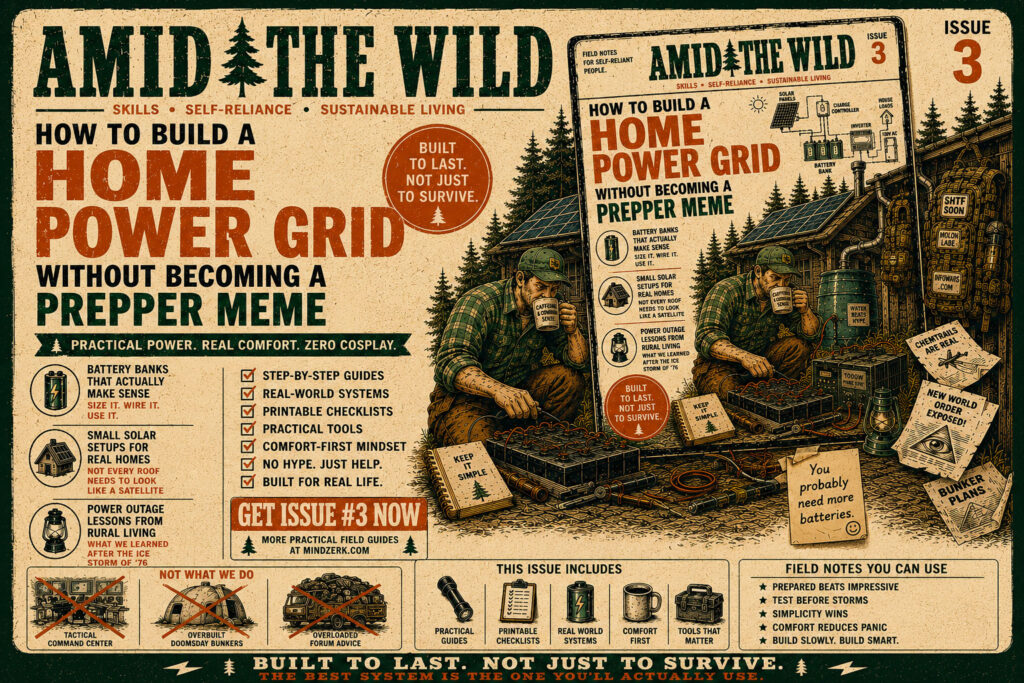


Going off-grid isn’t about living in the woods with a bucket and a dream. It’s about making systems that don’t break when everything else does.
Most setups fail not because of bad gear, but bad planning — and overconfidence. Here are ten cheap, sanity-saving fixes that turn “barely running” into self-sustaining.
1. The $12 Surge Protector That Saves $1,200
Solar inverters and charge controllers don’t die from hard work — they die from voltage spikes.
A $12 inline surge protector between your inverter and battery bank can save your entire system from a lightning hiccup or grounding issue.
Pro move: Get one with indicator lights so you know when it’s blown. Replace it like you would a fuse.
2. Silicone Tape = Leak Insurance
Forget duct tape. Silicone self-fusing tape is the off-grid equivalent of a miracle. It seals water, gas, and air leaks without glue. It stretches, melts into itself, and lasts through weather cycles.
Use it on:
- Hose connections
- Cracked PVC joints
- Fuel lines
- Temporary plumbing
$10 roll > $100 repair call.
3. The Battery Bank Spacer Trick
Your deep-cycle batteries hate heat. Even a 10°F rise above normal can cut their lifespan in half.
Cheap fix: 1-inch foam or wood spacers between each battery for airflow.
Bonus: Drop a $6 USB fan in the compartment with a small solar trigger. That fan will add years of battery life.
4. Insulated Reflectix Curtains
Windows are death traps for heat. Reflectix insulation cut to fit each pane will stabilize cabin temps by 10–15 degrees, summer or winter.
Tape it in for winter. Velcro it for summer. A $30 roll replaces $300 worth of lost power efficiency every season.
5. The “Half-Barrel” Graywater Hack
Stop wasting fresh water.
Cut a 55-gallon barrel in half lengthwise. Line it with pond liner. Route your sink and shower runoff into it. Use a gravity-fed hose to water trees or a garden bed.
Cost: $25
Savings: 20–40 gallons a day.
Just avoid dumping graywater on edible crops — soap residue builds up.
6. LED Strip Lighting Beats Lantern Hoarding
String a $9 12V LED strip around your cabin or trailer interior, hook it directly to your battery with an inline switch.
It draws next to nothing — 1/10 the power of bulbs.
No more tripping over your generator cord at night.
7. Old Car Battery = Nighttime Power Buffer
Your junkyard car battery still has life. Use it as a buffer between panels and your main bank.
Charge it during the day on its own mini solar line, and use it to power low-load items like lights or fans overnight.
It’s the off-grid version of recycling your past mistakes.
8. Inline Fuel Filter on Your Generator
Gas up in the wild long enough and you’ll eventually pour sand into your carb.
Add a $7 clear inline fuel filter before the carburetor. It’ll save you hours of teardown hell.
You’ll see the sediment before it becomes sabotage.
9. Trash Can Compost Reactor
A plastic trash can with 20 drilled holes becomes a compost system that beats $300 tumblers.
Add scraps, sawdust, and a few worms. Turn it every few days with a stick.
In 30 days, you’ll have black gold for garden beds — no smell, no guilt.
Optional upgrade: Stick a $3 thermometer in the lid. When it hits 140°F, it’s cooking right.
10. The Solar Shower Trick
You don’t need plumbing to feel civilized.
Fill a black five-gallon jug with water, set it in the sun for two hours, hang it on a tree branch, and connect a simple gravity-fed shower nozzle.
Cost: $20.
Effect: Feels like you’re cheating death and camping at the same time.
Bonus: The Mental Fix
Every system fails. The question is whether you do.
The cheapest fix of all is the mindset that nothing is permanent, everything is patchable, and your ability to improvise is your real power source.
The modern world runs on panic. Off-grid living runs on patience.
Final Transmission
Freedom doesn’t need to be expensive. You don’t need a $50k setup, an Earthship, or a YouTube channel to live cleanly. You just need a little discipline, a few hacks, and the will to adapt.
Civilization collapses from comfort. You’ll be fine — you’ve got duct-tape energy, solar faith, and a $10 fix for every $1,000 problem.