
There’s a simple test for any “off-grid” system:
When it breaks, can you fix it with what you already have?
If the answer is no—if it needs a specialist, proprietary parts, internet access, or a supply chain—you’re not off-grid.
You’re just temporarily disconnected.
Real independence shows up when things fail.
The Illusion of Off-Grid
A lot of setups look self-sufficient:
- Solar arrays
- Battery banks
- Water systems
- Fancy controllers
But the moment something goes wrong:
- You need a replacement part
- You need a technician
- You need instructions you can’t access
Now you’re stuck.
Off-grid isn’t about what works. It’s about what you can recover from.
The Hand Tool Standard
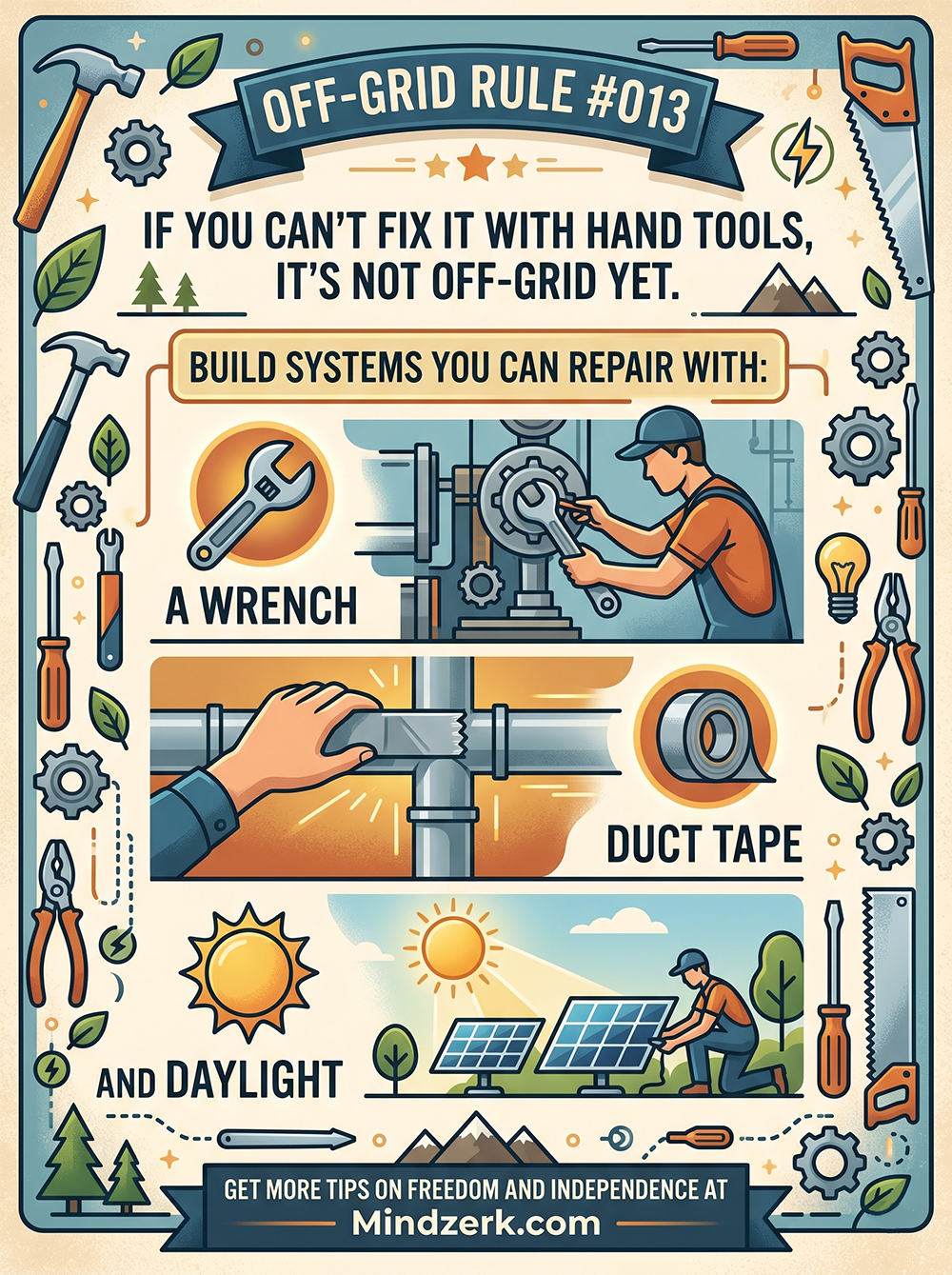
If you want systems that last, build them around what you can fix with:
- A wrench
- A screwdriver
- Basic pliers
- A saw
- Duct tape (yes, seriously)
- And your own hands
No diagnostics apps.
No firmware updates.
No waiting for shipping.
Just direct, physical control.
Why Simplicity Wins
Simple systems don’t just break less.
They break better.
1. Failures Are Obvious
You can see the issue:
- A loose fitting
- A cracked pipe
- A worn part
No guessing. No black boxes.
2. Repairs Are Immediate
You don’t wait.
You fix it on the spot.
That’s the difference between inconvenience and disaster.
3. Parts Are Replaceable
You’re not hunting for a specific model number.
You’re using:
- Standard fittings
- Common materials
- Improvised solutions
4. You Stay in Control
No dependence on:
- Companies
- Software
- Availability of service
You become the system’s operator and mechanic.
The Role of Duct Tape (And What It Represents)
Duct tape isn’t just a joke—it’s a mindset.
It represents:
- Improvisation
- Adaptability
- Quick fixes that buy you time
Off-grid living rewards people who can:
- Patch
- Reinforce
- Stabilize
Not just replace.
Why Daylight Matters
The rule includes something people overlook:
Daylight is a tool.
If your system requires:
- Artificial lighting
- Precision electronics
- Nighttime troubleshooting
You’ve added friction.
Design so you can:
- Inspect
- Repair
- Maintain
In daylight, with your eyes and hands.
Where People Go Wrong
1. Overengineering
They build systems that are:
- Efficient
- Advanced
- Fragile
When something fails, everything stops.
2. Dependency on Components
They rely on:
- Proprietary parts
- Complex electronics
- Hard-to-source materials
One missing piece = full shutdown.
3. Ignoring Maintenance Reality
It’s easy to design something.
It’s harder to live with it when it breaks.
How to Apply This Rule
1. Audit Your Systems
Ask:
- Can I fix this without outside help?
- Do I understand how it works?
- Do I have the tools needed?
If not, simplify.
2. Choose Standard Over Specialized
Use:
- Common fittings
- Widely available parts
- Mechanical over digital when possible
3. Build for Access
Don’t bury critical components.
Make everything:
- Reachable
- Visible
- Serviceable
4. Practice Repairs Before You Need Them
Don’t wait for failure.
- Take things apart
- Reassemble
- Learn your system
Confidence comes from repetition.
5. Keep a Basic Tool Kit Ready
At minimum:
- Adjustable wrench
- Screwdrivers
- Pliers
- Tape
- Spare connectors
That kit is your safety net.
The Real Meaning of Off-Grid
It’s not about disconnecting.
It’s about self-reliance under pressure.
If your system depends on anything you can’t access when things go wrong, it’s a liability—not a solution.
Final Thought
Technology can take you far.
But when it fails—and it will—what matters is what’s left.
If you can fix it with your hands, you own it.
If you can’t, it owns you.
Build accordingly.