
There’s a hard truth most people ignore until it’s too late:
If your system depends on the internet to work—or to be fixed—it’s not a survival system. It’s a convenience system.
And convenience disappears fast.
Power drops.
Signal dies.
Servers go down.
Now what?
The Hidden Fragility of “Smart” Systems
Modern gear looks impressive:
- App-controlled everything
- Cloud-based diagnostics
- Firmware updates for basic functions
- Online manuals you can’t access offline
But strip away connectivity, and a lot of it turns into dead weight.
When failure hits, complexity becomes a liability.
What “Core Setup” Really Means
Your core setup isn’t your full system.
It’s the minimum you need to function when everything else breaks.
That includes:
- Light
- Heat
- Water
- Power
- Basic tools
And every one of those should work:
- Offline
- In the dark
- Under stress
The Rule in Practice
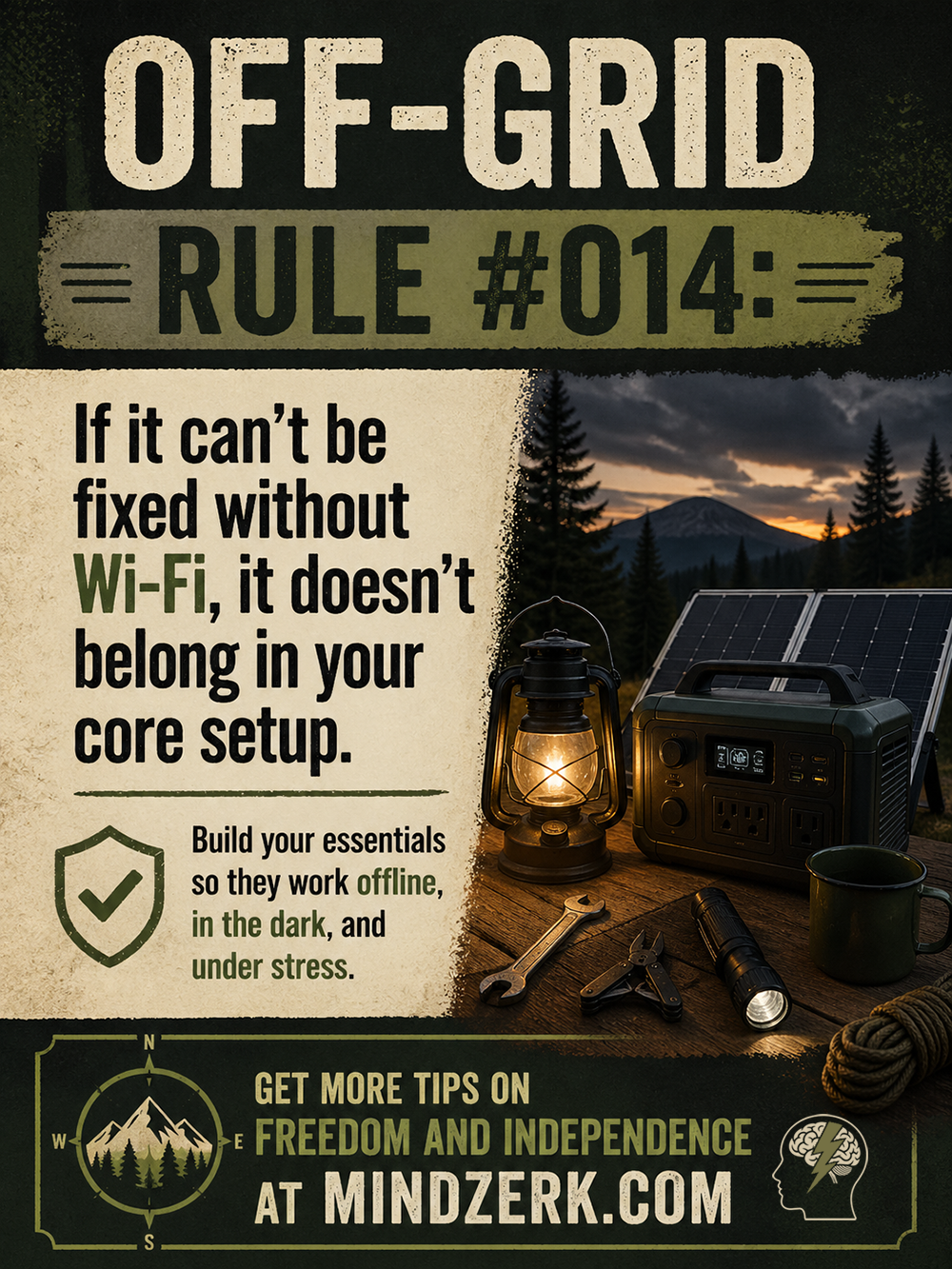
Before adding anything to your core setup, ask one question:
“Can I fix this without internet access?”
If the answer is no, it doesn’t belong at the center.
That doesn’t mean you can’t use advanced gear.
It means you don’t rely on it when it matters most.
Build for Failure, Not Comfort
Most people build for ideal conditions.
Off-grid systems need to be built for the opposite.
Think:
- Nighttime repairs
- Cold hands
- No instructions
- No signal
- No second chances
If it only works when everything is perfect, it will fail when it matters.
The Offline Standard
Your essentials should meet these criteria:
1. No Internet Required
No apps. No logins. No updates needed to function.
2. Manual Override
Every critical system should have a way to run or repair it by hand.
3. Simple Diagnostics
You should be able to see what’s wrong—not guess through software.
4. Physical Documentation
Printed instructions beat dead screens every time.
5. Tool-Based Repair
If you can’t fix it with basic tools, it’s too complicated for your core.
Real-World Examples
❌ Fragile Setup
- Smart battery system locked behind an app
- Online-only manuals
- Firmware-dependent devices
- Cloud-controlled power management
✅ Resilient Setup
- Battery with physical indicators
- Mechanical switches
- Printed guides
- Systems that run without updates
Stress Testing Your Setup
Here’s a simple test:
Kill your internet. Turn off the lights. Now try to fix something.
If you get stuck, you’ve found a weak point.
The Mindset Shift
You’re not building a tech stack.
You’re building a system that survives interruption.
That means:
- Less dependency
- More redundancy
- More simplicity
- More control
The Bottom Line
Off-grid isn’t about rejecting technology.
It’s about removing fragile dependencies.
If your system needs Wi-Fi to survive, it won’t survive long.
Build your essentials so they work:
- Without signal
- Without support
- Without perfect conditions
Because when things go sideways,
you don’t want to be troubleshooting—you want to be operating.