
Most people think better results come from longer prompts.
More detail.
More instructions.
More constraints.
It feels logical.
But in reality?
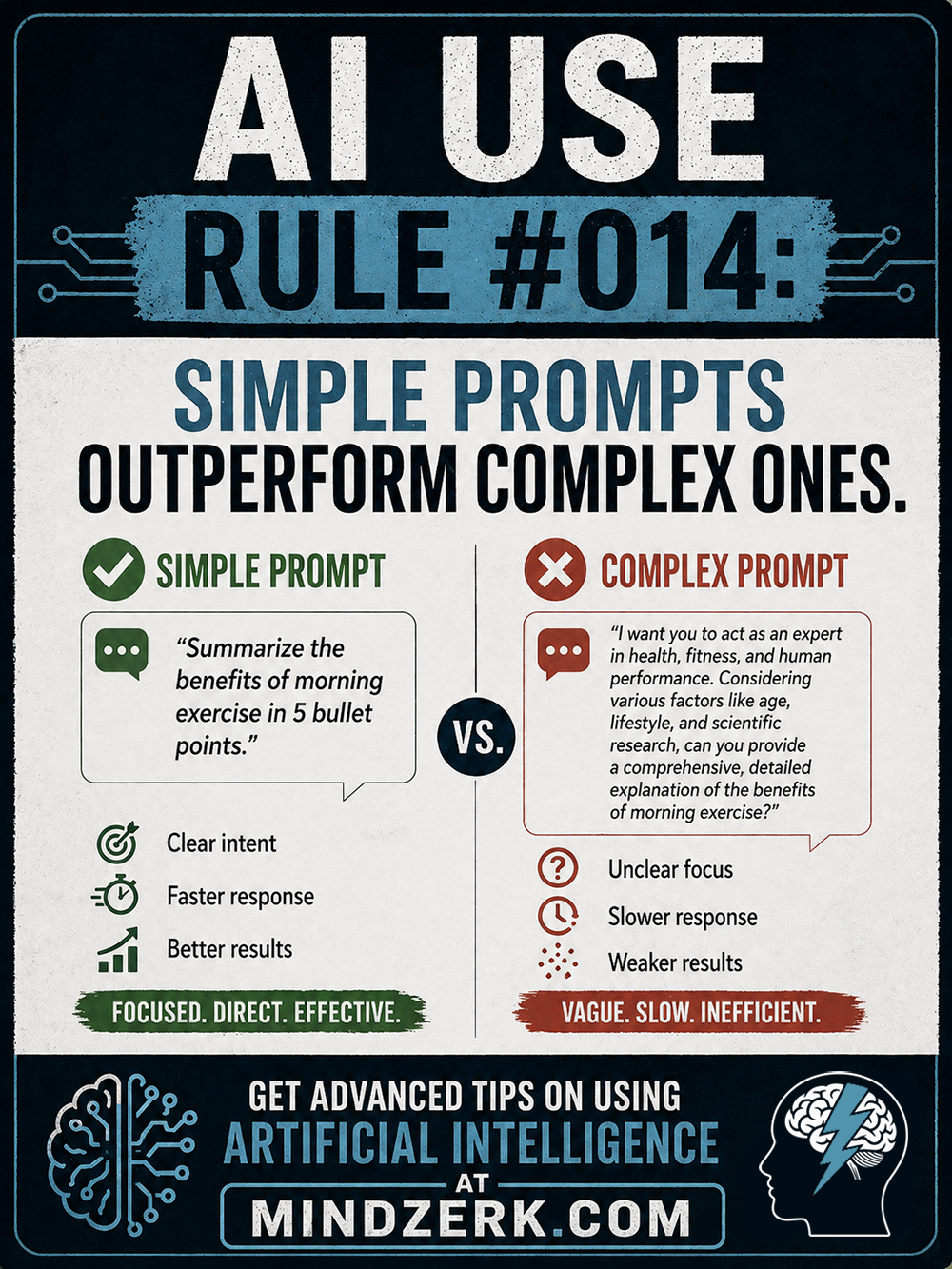
Simple prompts win more often than complex ones.
Because clarity beats complexity every time.
The Problem With Complex Prompts
You’ve seen them.
Massive blocks of text like:
- “Act as an expert in…”
- “Considering all variables…”
- “Provide a comprehensive, deeply detailed…”
They try to control everything upfront.
But what they actually create is:
- Blurred intent
- Slower responses
- Inconsistent results
When you say too much, you dilute what actually matters.
What Simple Prompts Do Better
A simple prompt focuses on one thing:
Clear intent.
Example:
“Summarize the benefits of morning exercise in 5 bullet points.”
That works because it tells the AI exactly:
- What to do
- How to format it
- How long it should be
No fluff. No confusion.
Why Simplicity Works
1. Clear Input = Clear Output
AI responds to direction.
If your prompt is:
- Direct
- Specific
- Focused
The output improves instantly.
2. Faster Execution
Simple prompts:
- Generate faster responses
- Let you iterate quickly
- Keep your workflow moving
You don’t get stuck “perfecting” the ask.
3. Better Control Through Iteration
Instead of overloading one prompt, you:
- Ask
- Get output
- Refine
That gives you more control than trying to get everything right in one shot.
4. Less Cognitive Overhead
Long prompts drain you.
Simple prompts keep you:
- Focused
- Decisive
- Productive
The goal isn’t to impress the AI. It’s to get usable output fast.
The Hidden Flaw in “Detailed Prompting”
People believe:
“If I include more detail, I’ll get better results.”
But more detail often means:
- Mixed signals
- Conflicting instructions
- Unclear priorities
The AI doesn’t know what matters most.
So the result gets weaker.
What Good Prompting Actually Looks Like
1. One Clear Task
Don’t stack multiple objectives.
Bad:
“Explain, analyze, compare, and summarize…”
Good:
“Summarize X in 5 bullet points.”
2. Defined Output Format
Tell it how to respond.
- Bullet points
- Short paragraph
- List
- Step-by-step
3. Minimal Necessary Context
Add only what’s needed.
Not everything you could say.
Only what improves the result.
A Better Way to Work With AI
Instead of writing one giant prompt:
Break it into steps.
- Start simple:
“Write a short blog post about X.” - Refine:
“Make it more direct and actionable.” - Enhance:
“Add examples to each section.” - Polish:
“Format this for publishing.”
Multiple simple prompts beat one complex prompt every time.
Where Most People Go Wrong
Overcomplicating the Ask
Trying to get perfection in one shot.
Treating AI Like a Mind Reader
Assuming it will “figure it out” from a messy prompt.
Avoiding Iteration
Expecting one response to do everything.
The Real Skill
It’s not writing longer prompts.
It’s:
- Knowing what you want
- Asking clearly
- Refining quickly
That’s it.
The Payoff
When you switch to simple prompts:
- Output improves
- Speed increases
- Friction drops
- Results compound
Because you’re working with the system—not against it.
Final Thought
You don’t need more words.
You need more clarity.
Simple prompts. Clear intent. Fast iteration.
That’s how you unlock real power from AI.
Keep it focused. Keep it direct. Keep it moving.