
Most people build systems under ideal conditions.
The sun is out.
They’re fully awake.
The tools are nearby.
Nothing is broken.
Everything works.
The problem is that emergencies rarely happen during ideal conditions.
Pumps fail at midnight.
Batteries die during storms.
Water lines leak when you’re exhausted.
Generators refuse to start when it’s freezing outside.
That’s why one of the most important off-grid principles is this:
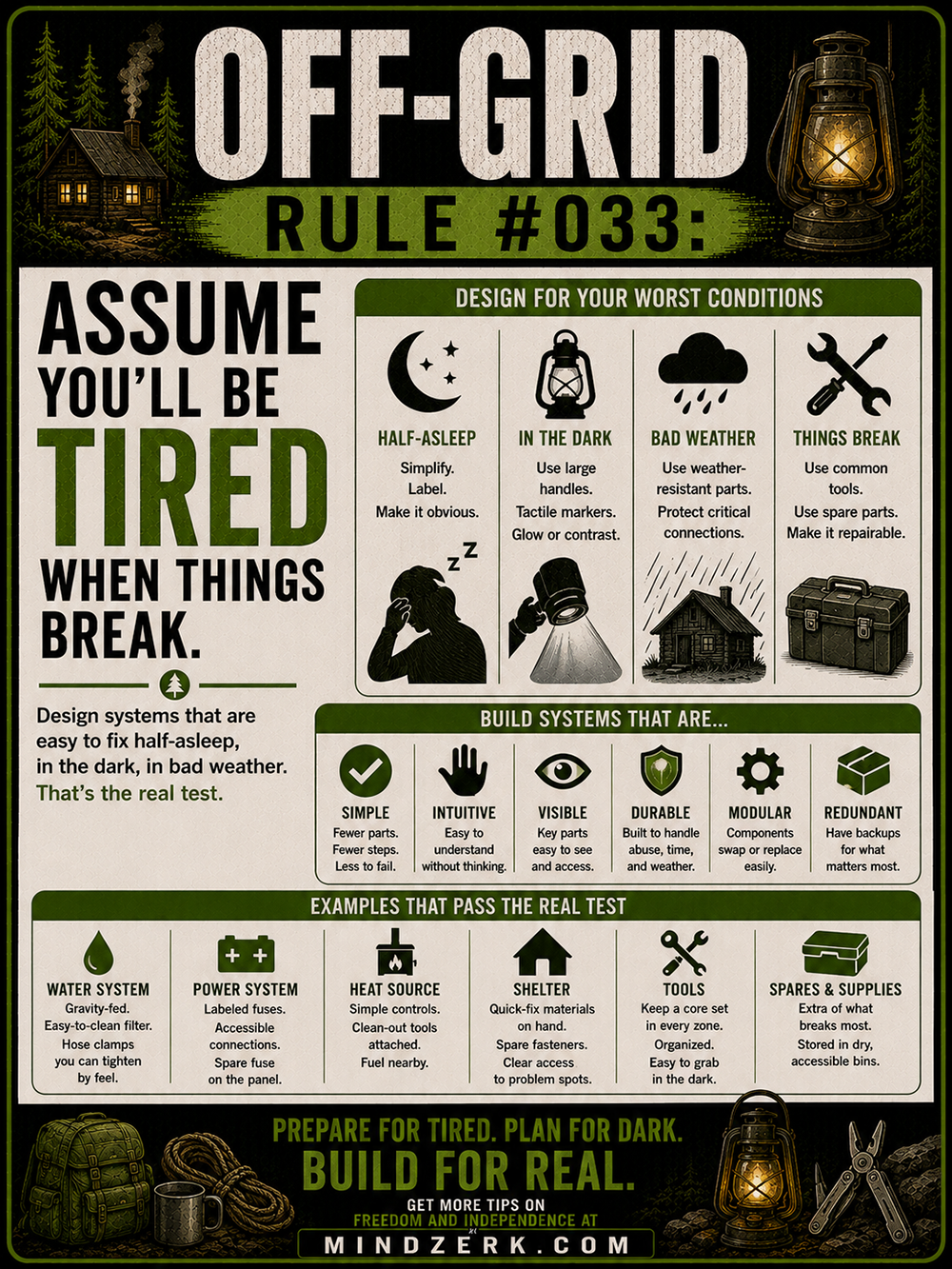
Assume you’ll be tired when things break.
If your system only works when you’re alert, comfortable, and thinking clearly, it isn’t truly resilient.
The real test is whether you can fix it half-asleep, in the dark, during bad weather.
Build for Reality, Not Perfection
Many people overcomplicate their setups.
They add:
- More components
- More wiring
- More switches
- More automation
- More points of failure
On paper, the system looks impressive.
In reality, every added layer creates another thing that can go wrong.
When something fails, complexity becomes the enemy.
A simple system may not impress visitors.
But it will often outperform a complicated one when conditions get rough.
Design for Your Worst Day
When evaluating any off-grid system, ask:
Could I troubleshoot this when I’m exhausted?
If the answer is no, simplify it.
Half-Asleep
At 2 AM, your brain is not operating at full capacity.
That’s why systems should be:
- Clearly labeled
- Easy to understand
- Obvious to operate
The fewer decisions required, the better.
When you’re tired, simple wins.
In the Dark
Power failures don’t always happen during daylight.
Can you:
- Find critical tools quickly?
- Identify switches easily?
- Access spare parts without searching?
Large labels, clear organization, and consistent placement matter more than most people realize.
During Bad Weather
Storms expose weak systems.
Rain, wind, snow, and mud turn simple repairs into difficult ones.
Build with weather in mind:
- Protect electrical connections
- Use weather-resistant components
- Cover critical equipment
- Store emergency supplies nearby
A system that works only in perfect weather isn’t truly reliable.
When Things Break
Everything eventually fails.
The question isn’t whether something will break.
The question is how difficult it will be to repair.
Choose:
- Common parts
- Standard fittings
- Easily sourced components
Exotic solutions often become problems when replacement parts are needed.
Build Systems That Are Easy to Live With
The best off-grid systems share several characteristics.
Simple
Every part should have a purpose.
Fewer parts mean:
- Fewer failures
- Easier troubleshooting
- Lower maintenance
Complexity is often disguised fragility.
Intuitive
You shouldn’t need a manual every time something goes wrong.
Controls should make sense.
Components should be logically organized.
A visitor should be able to understand the basics quickly.
Visible
Critical systems should be easy to inspect.
If a fuse blows, you should know where it is.
If a tank is low, you should see it immediately.
Visibility reduces surprises.
Durable
Off-grid equipment lives a harder life than most household systems.
Choose components that tolerate:
- Dust
- Moisture
- Temperature swings
- Physical abuse
Durability creates resilience.
Modular
When one part fails, the entire system shouldn’t fail with it.
Modular systems allow you to:
- Swap components
- Upgrade gradually
- Repair quickly
Isolation limits damage.
Redundant
The most important systems deserve backups.
Especially:
- Water
- Heat
- Lighting
- Communication
One backup can turn a crisis into a minor inconvenience.
Real-World Examples
Water Systems
A gravity-fed backup can save the day when pumps fail.
Use:
- Simple filtration
- Easy-access valves
- Clearly labeled shutoffs
If you can operate it by feel, even better.
Power Systems
Battery banks should be organized and labeled.
Keep:
- Spare fuses
- Basic troubleshooting instructions
- Essential tools nearby
You shouldn’t need to search three buildings to solve a simple electrical issue.
Heat Sources
When temperatures drop, simplicity becomes critical.
Keep:
- Fuel nearby
- Cleaning tools accessible
- Spare ignition supplies available
The easier it is to maintain, the more likely it will work when needed.
Shelter Repairs
Leaks and storm damage happen.
Store:
- Fasteners
- Sealants
- Patch materials
Close to where problems occur.
Time matters when water is entering your shelter.
Tools
A tool that is fifty yards away might as well not exist during an emergency.
Keep core tools where they are most likely to be needed.
Duplicate inexpensive items.
The convenience pays for itself the first time something breaks.
Spare Parts
Store extras of what fails most often.
Examples include:
- Hose clamps
- Fittings
- Fuses
- Batteries
- Filters
The part that costs two dollars often causes the biggest headache when it’s unavailable.
The Hidden Cost of Complexity
Many off-grid failures aren’t equipment failures.
They’re human failures.
People become overwhelmed.
They forget procedures.
They make mistakes.
Not because they’re careless.
Because they’re tired.
A system that demands perfect attention is a fragile system.
A system that remains functional when you’re exhausted is a resilient one.
The Bottom Line
The goal isn’t to build a system that works on your best day.
The goal is to build a system that works on your worst day.
Design for:
- Fatigue
- Darkness
- Bad weather
- Equipment failures
- Stress
That’s where resilience comes from.
Anyone can build something that works when conditions are perfect.
The people who stay comfortable, safe, and independent are the ones who build for reality.
Prepare for tired.
Plan for dark.
Build for real.