
Most people think AI is about being clever.
It’s not.
AI isn’t impressed by creativity—it responds to clarity.
If your input is vague, your output will be weak.
If your input is precise, your output gets sharp fast.
That’s the game.
The Real Problem: Vague Prompts
People approach AI like this:
- “Write something about marketing”
- “Make this better”
- “Give me ideas”
That’s not direction. That’s confusion.
And confusion forces the AI to guess.
When AI guesses, you get average results.
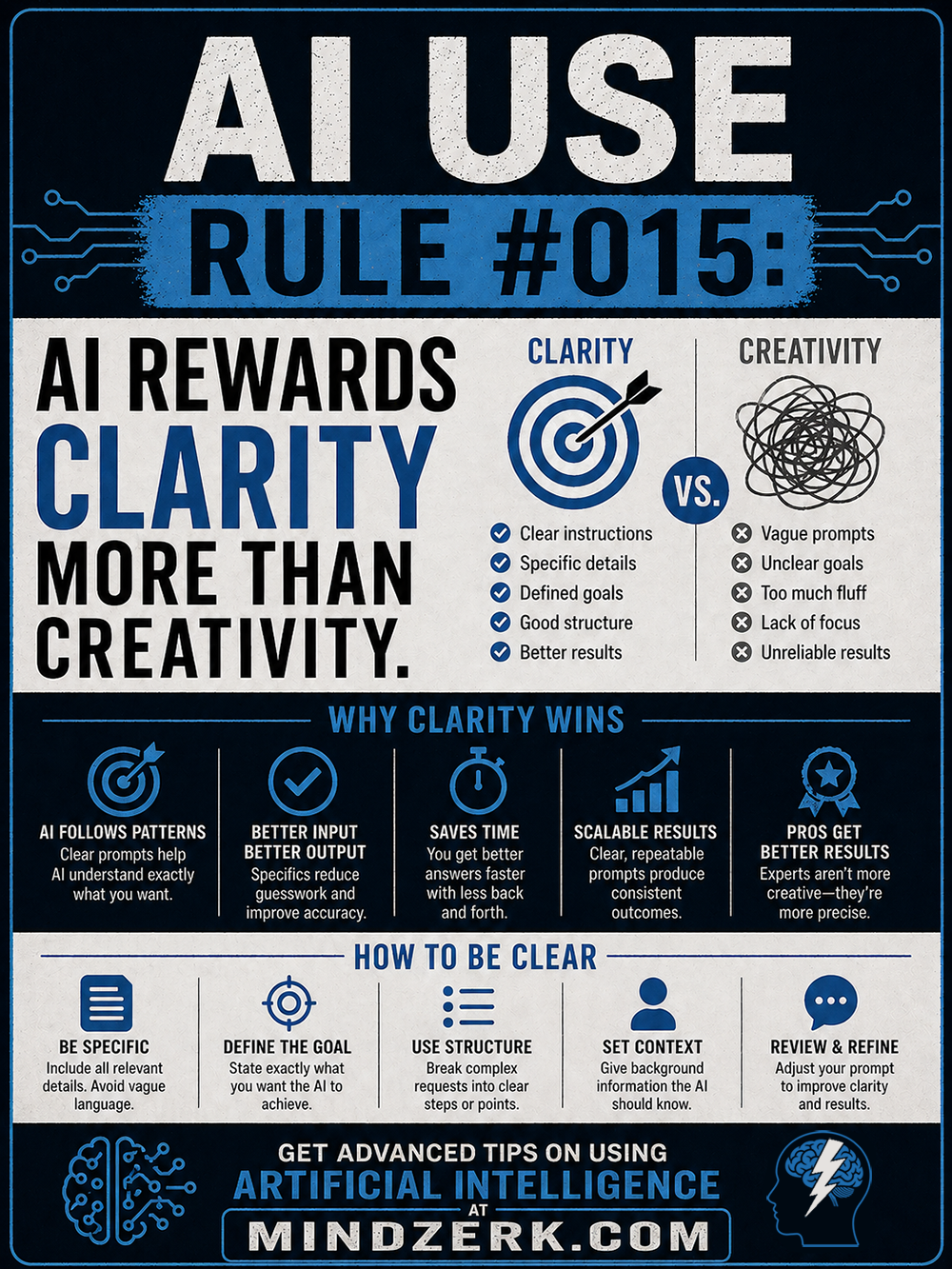
Why Clarity Wins
AI doesn’t “think” like you.
It follows patterns. It interprets instructions. It fills in gaps.
The fewer gaps you leave, the better it performs.
Clarity gives AI:
- A defined target
- Constraints to work within
- Context to understand intent
- Structure to follow
Better input = better output. Every time.
Creativity vs. Clarity
Let’s break it down.
❌ Creativity-First (What Most People Do)
- Vague prompts
- Abstract ideas
- Too much fluff
- No clear goal
Result:
- Inconsistent outputs
- More revisions
- Frustration
✅ Clarity-First (What Actually Works)
- Clear instructions
- Specific details
- Defined outcome
- Structured request
Result:
- Faster responses
- Higher quality outputs
- Repeatable success
Why Clarity Beats Creativity
1. AI Follows Patterns
Clear prompts help AI match the right patterns instantly.
2. Specifics Reduce Guesswork
When you define the details, AI doesn’t have to “fill in the blanks.”
3. It Saves Time
Less back-and-forth. Fewer corrections. Faster execution.
4. It Scales
Clear prompts can be reused, refined, and turned into systems.
5. Pros Aren’t More Creative—They’re More Precise
The people getting the best results aren’t “better thinkers.”
They’re better at telling AI exactly what they want.
How to Write Clear Prompts (That Actually Work)
Use this simple framework.
1. Be Specific
Bad:
“Write a blog post about fitness.”
Better:
“Write a 1,000-word blog post about the benefits of morning exercise for beginners, using a conversational tone and actionable tips.”
2. Define the Goal
What’s the outcome?
- Inform?
- Sell?
- Entertain?
- Convert?
Tell the AI.
3. Use Structure
Break your request into parts:
- Headline
- Sections
- Bullet points
- Tone
Structure reduces chaos.
4. Set Context
Give background:
- Who it’s for
- Where it will be used
- What style you want
Context sharpens output.
5. Review and Refine
Your first prompt won’t be perfect.
That’s fine.
Tighten it. Clarify it. Improve it.
Prompting is iteration, not magic.
The Shortcut Most People Miss
You don’t need better ideas.
You need better instructions.
AI doesn’t reward imagination—it rewards precision.
The Real Advantage
Once you master clarity:
- You get better results faster
- You waste less time fixing outputs
- You can scale your work
- You gain consistency
That’s where the real leverage is.
Final Thought
Creativity still matters.
But in AI, it comes after clarity—not before.
Say exactly what you want.
Structure how you want it.
Refine until it’s tight.
Do that, and AI stops being a toy…
…and starts becoming a weapon.