
When things go sideways off-grid, most problems trace back to one thing:
You can’t process water.
No power? No pump.
No pump? No pressure.
No pressure? No clean water.
That’s where this rule cuts through the noise:
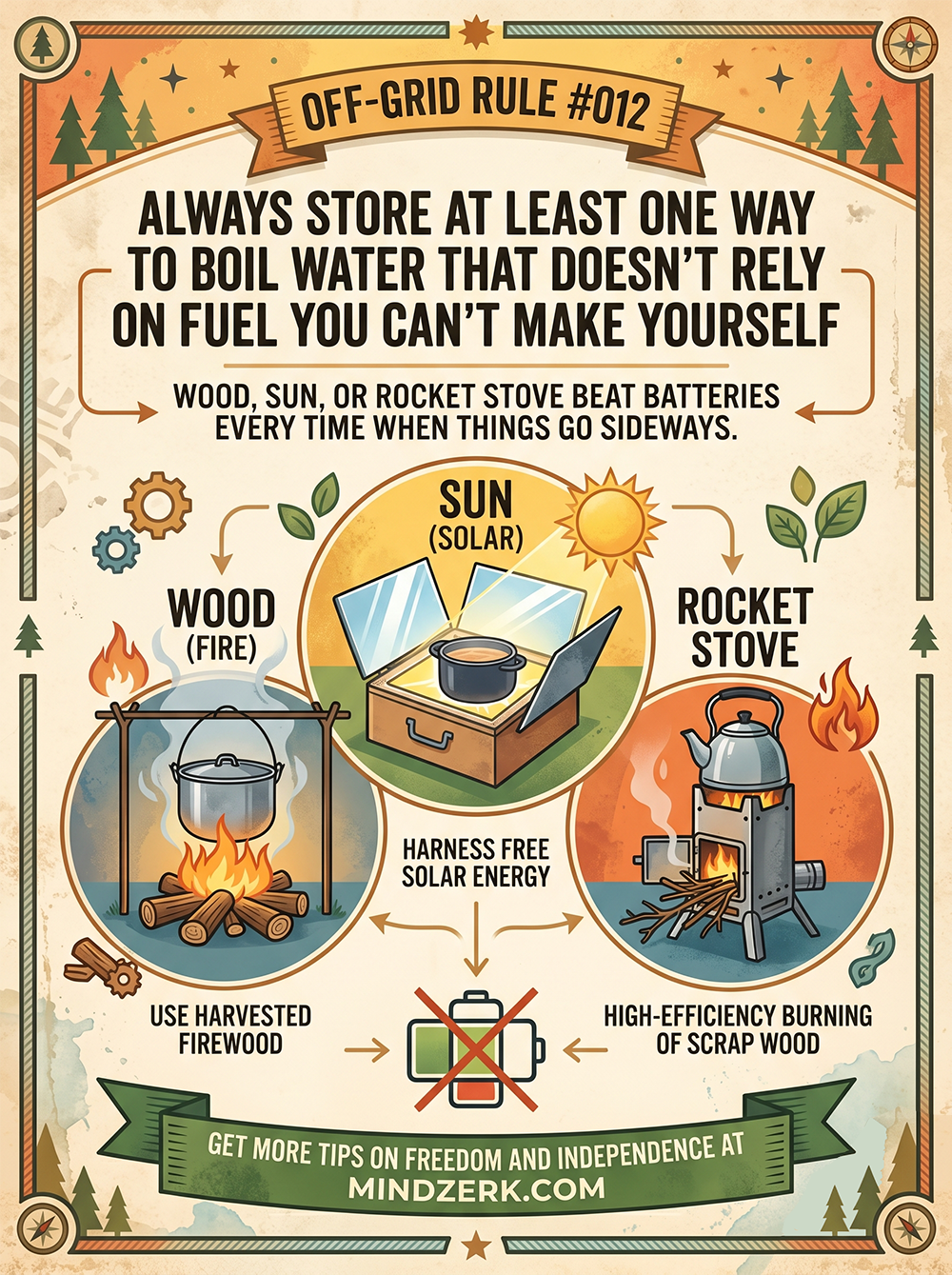
Always store at least one way to boil water that doesn’t rely on fuel you can’t produce yourself.
If you can’t make the fuel, you don’t control the system.
Why Boiling Still Wins
Filtration is great. Chemicals help. UV tools exist.
But boiling is simple, reliable, and universal.
- Kills pathogens
- Works on questionable sources
- Requires minimal gear
- Doesn’t depend on supply chains
Heat is the most dependable purifier you have.
The only catch?
You need a heat source you control.
The Problem With “Modern” Solutions
A lot of setups lean too hard on:
- Propane
- Butane
- Electric kettles
- Battery-powered systems
These work—until they don’t.
- Tanks run empty
- Batteries drain
- Supply runs dry
And suddenly, your “system” is just dead weight.
If your boiling method depends on something you can’t replace locally, it’s temporary.
Three Methods That Keep You Independent
You don’t need all of these.
But you need at least one.
1. Wood Fire (The Baseline)
This is the oldest method for a reason.
- Uses locally available fuel
- Simple to set up
- Scales easily
All you need:
- A metal pot
- A safe fire setup
- Dry wood
That’s it.
If you can gather sticks, you can boil water.
Pro tip:
Practice in different conditions—wet wood, wind, low light. Skills matter more than gear.
2. Solar (The Silent Option)
Solar boiling doesn’t get enough credit.
- No fuel required
- No smoke
- No moving parts
With a basic solar cooker:
- You can heat and pasteurize water
- You can cook food at the same time
- You reduce reliance on fire entirely
It’s slower. That’s the trade-off.
But it’s free energy and works every sunny day.
Sunlight is the one fuel source you never run out of.
3. Rocket Stove (Efficiency Mode)
If you want to stretch fuel, this is the move.
- Burns small sticks and scrap wood
- High heat output
- Minimal fuel use
Perfect when:
- Wood is limited
- You want faster boils
- You need consistency
A handful of twigs can do what a pile of logs would in an open fire.
The Real Principle: Fuel Independence
This rule isn’t about boiling water.
It’s about control.
Ask yourself:
- Can I produce or gather the fuel locally?
- Can I operate this without electricity?
- Can I repair or rebuild it if it breaks?
If the answer is no, you’re relying on something fragile.
Build Redundancy (Without Overcomplicating It)
You don’t need a dozen systems.
You need one solid fallback.
A simple setup could be:
- Metal pot or kettle
- Fire-safe area
- Basic ignition method (lighter, ferro rod)
- Backup option (solar cooker or rocket stove)
That’s enough to stay operational.
When Things Go Sideways
This is where this rule pays off.
- Power outage? You still boil.
- Fuel shortage? You still boil.
- Equipment failure? You still boil.
While others scramble, you stay steady.
Water security is calm under pressure.
Final Thought
Off-grid living isn’t about having the best gear.
It’s about removing weak points.
If you can make fire—or harness the sun—you can make safe water.
And if you can make safe water, you’re still in control.