
Most people worry about what they share.
They should be thinking about how often, when, and in what pattern they share it.
Because in the modern data world, a single piece of information is weak.
But a pattern?
A pattern is a blueprint of your life.
You’re not identified by one data point—you’re revealed by repetition.
The Dangerous Illusion: “It’s Just One Thing”
You post a photo.
You like a few things.
You check in somewhere.
You follow a routine.
Individually, each action feels harmless.
But systems don’t look at events in isolation.
They look at behavior over time.
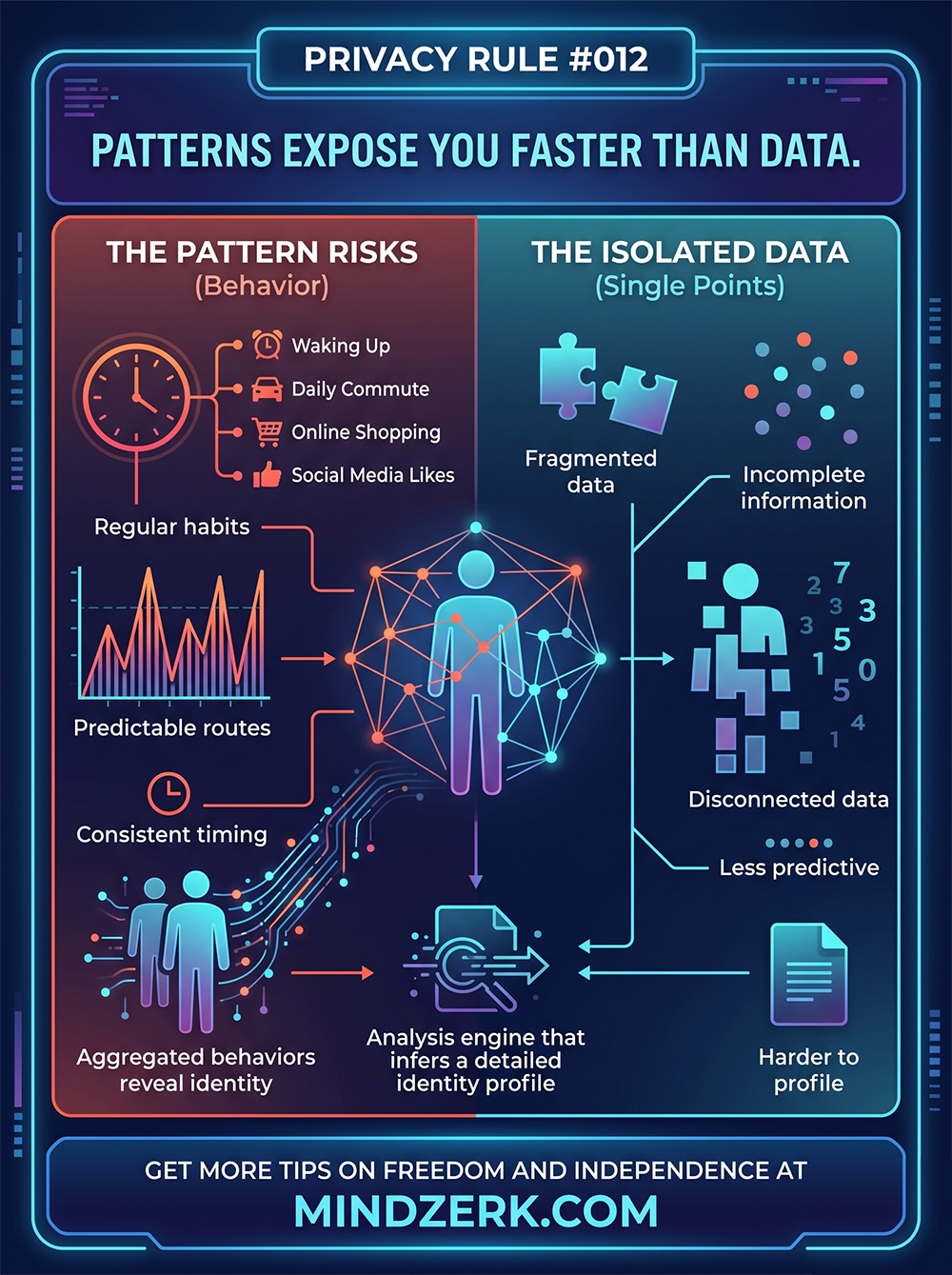
Why Patterns Are More Powerful Than Data
A single data point might say:
- You visited a location
- You bought something
- You liked a post
That’s noise.
But patterns reveal:
- When you wake up
- Where you go daily
- What you value
- Who you interact with
- How you think and decide
That’s identity.
The Pattern Risks (Where You Get Exposed)
1. Regular Habits
You wake up at the same time.
You check apps at the same time.
You follow predictable routines.
This creates a time signature.
2. Predictable Routes
Same commute.
Same stores.
Same places.
This creates a movement map.
3. Consistent Timing
Posting at certain hours.
Logging in at certain intervals.
Making purchases on a pattern.
This creates a behavior rhythm.
4. Aggregated Behavior
Likes + searches + clicks + locations.
Individually? Nothing special.
Combined? A full psychological profile.
You don’t need to say who you are—your patterns say it for you.
The Reality: Systems Don’t Guess—They Infer
Modern data systems don’t wait for you to reveal yourself.
They build you.
- Identity models
- Behavioral predictions
- Preference mapping
- Risk scoring
And they do it from patterns, not declarations.
You become predictable long before you become visible.
Why Isolated Data Is Safer
A single disconnected action is weak.
- One purchase = nothing
- One login = nothing
- One post = nothing
But when those actions are:
- Repeated
- Timed
- Connected
They stop being data.
They become signals.
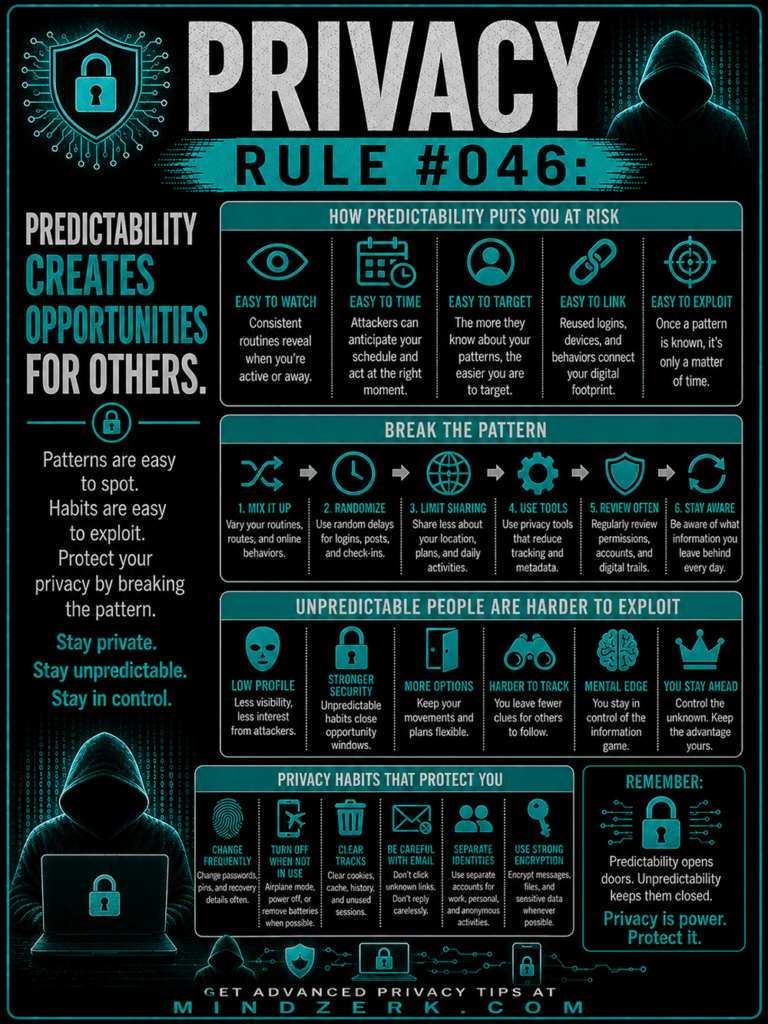
The Goal: Break the Pattern, Not Just the Data
If you want to protect yourself, don’t just share less.
Share less predictably.
Practical Ways to Reduce Pattern Exposure
1. Disrupt Your Timing
- Don’t always post at the same hour
- Avoid rigid daily routines online
- Mix up when you interact
2. Vary Your Behavior
- Don’t use the same apps in the same order every day
- Avoid predictable engagement loops
- Change how and when you browse
3. Limit Location Signals
- Avoid real-time check-ins
- Delay posting location-based content
- Reduce precise geo-tagging
4. Separate Your Activities
- Use different accounts for different roles
- Don’t blend personal, financial, and public behavior
- Reduce cross-linking between identities
5. Reduce Continuous Tracking
- Limit app permissions
- Turn off unnecessary background tracking
- Avoid always-on data streams
The Core Shift
Most people think:
“If I don’t share much, I’m safe.”
That’s incomplete.
The real shift is:
“If I’m predictable, I’m trackable.”
Final Thought
Data points are fragments.
Patterns are fingerprints.
And fingerprints don’t need your permission.
Control your patterns, and you control what can be known about you.
Everything else is just noise.