
Most people build their lives like a single connected system.
One email.
One device.
One identity.
One network of accounts tied together.
That’s convenient.
It’s also dangerous.
One breach should not expose your entire life.
That’s why compartmentalization matters.
What Compartmentalization Actually Means
It means separation.
Different tools.
Different accounts.
Different identities.
Different purposes.
Walls up.
Risk down.
You reduce the damage any single failure can cause.
Why This Matters
Most privacy failures don’t happen because someone breaks through ten layers.
They happen because one small leak connects everything.
- One reused password
- One compromised email
- One exposed device
- One public account tied to everything else
And suddenly your entire system unfolds in front of someone else.
Compartmentalization limits the blast radius.
Think Like a Ship
Modern ships use watertight compartments for a reason.
If one section floods, the whole ship doesn’t sink.
Your life should work the same way.
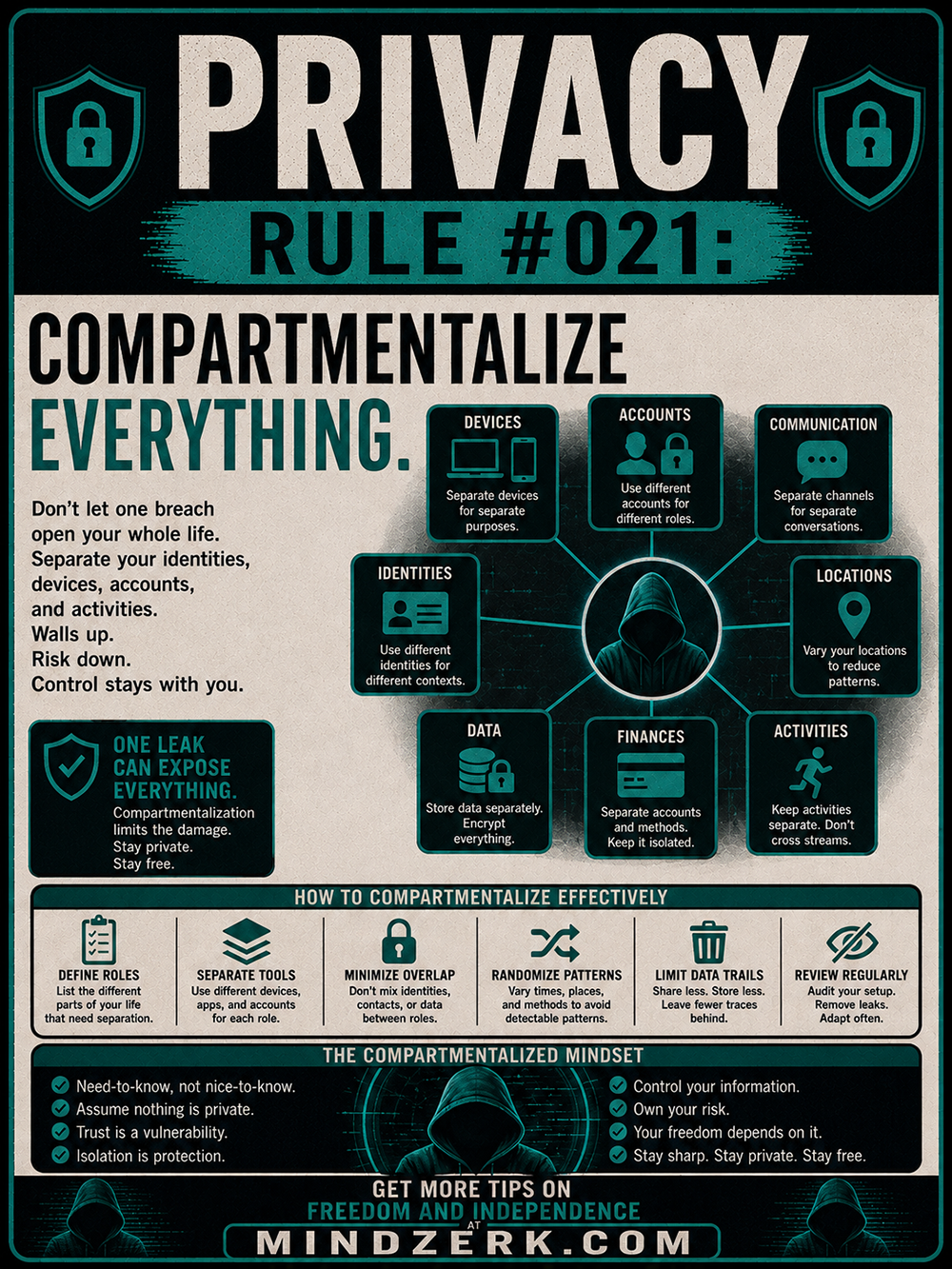
What You Should Separate
Devices
Different devices for different purposes.
- Work
- Personal
- Financial
- Experimental
Not everything needs to exist on one machine.
Accounts
Don’t use the same account ecosystem for everything.
Separate:
- Email accounts
- Recovery methods
- Authentication systems
Especially for sensitive activities.
Communication
Not every conversation belongs on the same channel.
Different contexts deserve different communication methods.
Identities
Different roles should stay separate.
Public-facing identity ≠ private operations.
The more overlap, the easier you are to map.
Data
Store things separately.
Encrypt sensitive information.
Avoid centralized exposure whenever possible.
Finances
Separate payment methods and financial accounts where appropriate.
One compromise shouldn’t freeze your entire operation.
Activities
Don’t cross-stream everything.
Your hobbies, projects, business activity, and private life do not all need to be publicly connected.
The Biggest Mistake: Overlap
Overlap creates patterns.
Patterns create exposure.
Exposure creates vulnerability.
People often destroy their own privacy by connecting things unnecessarily:
- Same username everywhere
- Same profile photo everywhere
- Same email everywhere
- Same habits everywhere
That creates an easy map of your life.
How to Compartmentalize Effectively
Define Roles
Figure out what parts of your life need separation.
Examples:
- Public work
- Personal life
- Financial activity
- Research
- Sensitive communication
Use Separate Tools
Different accounts and devices for different roles.
Convenience is not the priority.
Control is.
Minimize Crossovers
Don’t mix:
- Contacts
- Accounts
- Devices
- Data
Between roles unless necessary.
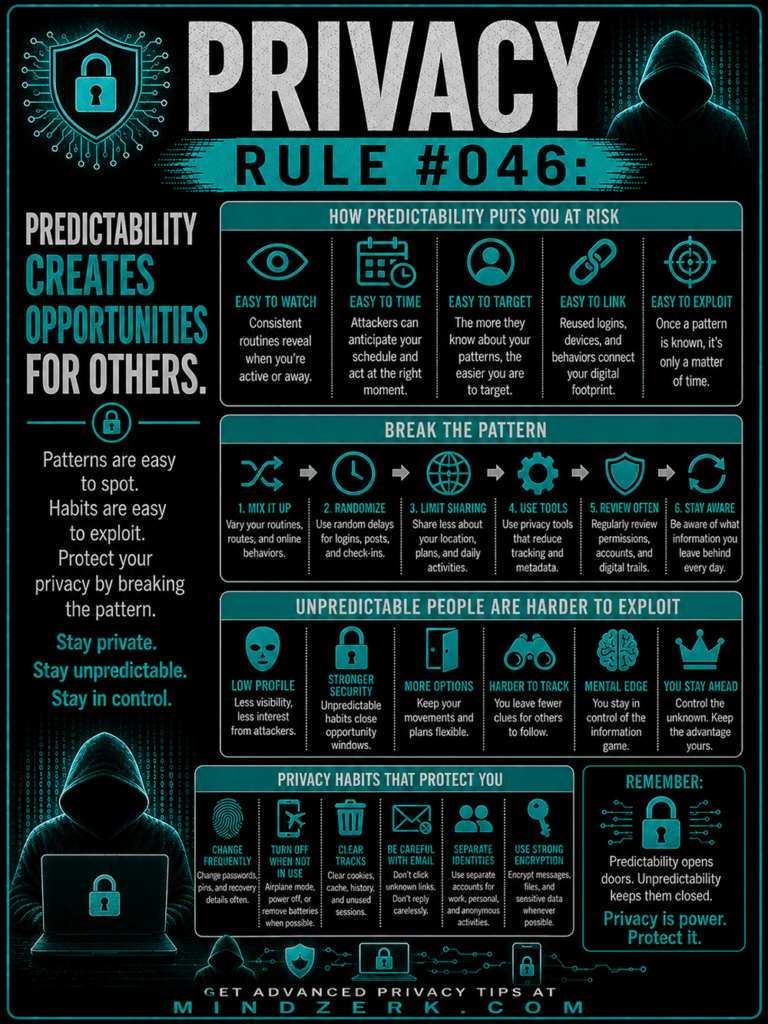
Randomize Patterns
Predictability weakens compartmentalization.
Vary:
- Timing
- Locations
- Methods
- Behaviors
Reduce detectable patterns.
Limit Data Trails
Share less.
Store less.
Delete what you don’t need.
Review Regularly
Compartmentalization is not a one-time setup.
Audit your exposure often.
Look for leaks.
Fix overlap.
The Compartmentalized Mindset
This rule is bigger than technology.
It’s a philosophy.
Need-to-Know Beats Nice-to-Know
Not everyone needs access to everything.
Assume Nothing Is Truly Private
Operate with awareness.
Not fear—awareness.
Trust Carefully
Blind trust creates weak points.
Isolation Is Protection
Distance between systems creates resilience.
The Goal
The goal isn’t paranoia.
The goal is control.
You want a life where:
- One mistake doesn’t destroy everything
- One leak doesn’t expose every layer
- One compromise doesn’t collapse your system
That’s real privacy.
The Bottom Line
Compartmentalization is one of the strongest forms of protection available.
Not because it makes you invisible.
But because it limits damage.
- Separate identities
- Separate systems
- Separate risks
One leak should never expose everything.
Build walls.
Stay sharp.
Stay private.
Stay free.