
Most people design for when everything works.
That’s the mistake.
Because off-grid… things will fail.
Power drops.
Pipes freeze.
Heat systems go out.
It’s not if.
It’s when.
The Rule: Assume Failure—Then Design Around It
Build systems expecting them to break—and make sure they fail slowly, visibly, and fixable by hand.
That’s the difference between inconvenience…
…and a real problem.
The Real Danger: Quiet Failures
The worst failures aren’t loud.
They’re silent.
- A slow leak you don’t notice
- A battery draining without warning
- A system that stops working with no signal
By the time you realize it…
You’re already behind.
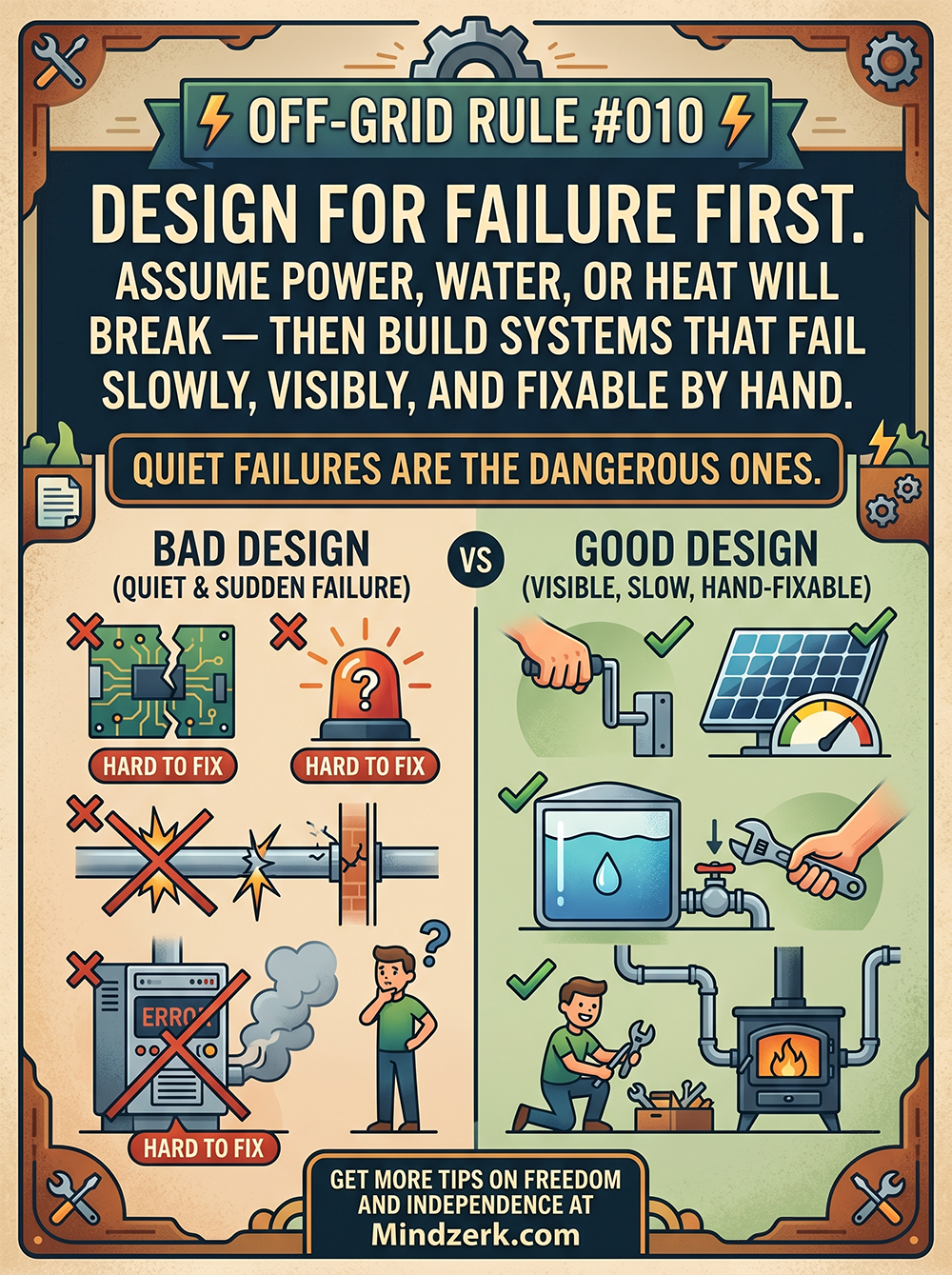
Bad Design vs Good Design
Bad Design (Quiet & Sudden Failure)
- Breaks without warning
- Hard to diagnose
- Requires specialized tools
- Fails all at once
You go from “fine” to “problem” instantly.
Good Design (Visible & Slow Failure)
- Shows signs early
- Degrades over time
- Can be fixed manually
- Gives you time to respond
You see it coming.
You stay in control.
What “Designing for Failure” Looks Like
1. Visible Systems
You should be able to see what’s happening.
- Water levels
- Battery status
- Flow and pressure
If you can’t see it, you can’t manage it.
2. Manual Overrides
Every system should work without tech.
- Hand pumps
- Manual valves
- Mechanical backups
If power goes out, your system shouldn’t.
3. Simple Components
Complex systems break harder.
Simple systems:
- Are easier to fix
- Require fewer parts
- Fail more predictably
4. Gradual Degradation
Avoid systems that fail instantly.
Instead:
- Output slows
- Performance drops
- Warning signs appear
That gives you time to act.
Real-World Examples
- A water tank you can visually inspect vs a hidden system
- A wood stove vs fully electric heat
- A hand-crank tool vs a power-only tool
One fails quietly.
The other stays usable.
The Hidden Advantage: Time
Designing for failure buys you time.
Time to:
- Notice
- Diagnose
- Fix
Without time, small problems become big ones.
Where People Go Wrong
They design for efficiency.
Not resilience.
They want:
- Clean systems
- Automated everything
- Minimal manual involvement
Until something breaks…
And now they’re stuck.
The Better Approach
Think like this:
“How does this fail?”
Then ask:
- Will I notice it?
- Can I fix it quickly?
- Can I fix it without special tools?
If the answer is no…
It needs redesign.
The Principle: Control the Failure
You can’t avoid failure.
But you can control how it happens.
- Loud vs silent
- Slow vs instant
- Fixable vs locked
That choice matters.
The Bottom Line
Systems don’t need to be perfect.
They need to be recoverable.
The best systems don’t avoid failure—they make failure manageable.
Final Thought
Don’t build for the best-case scenario.
Build for the worst—and make it survivable.
**If your system fails well, you’ll never be caught off guard.