
Most people use AI like a slot machine.
Type something.
Get something.
Move on.
That works… until you try to scale.
Because what lives in your head today?
It disappears tomorrow.
If it’s not written down, it can’t be repeated.
If it can’t be repeated, it can’t be scaled.
The Core Idea
AI isn’t just about getting results.
It’s about building repeatable systems.
And systems require documentation.
Your workflow is the real asset.
Not the output.
What a Workflow Actually Is
A workflow is simply:
- The steps you take
- The prompts you use
- The decisions you make
- The order everything happens
From idea → finished result.
If you can’t explain it clearly…
You don’t have a workflow yet.
Why Documenting Changes Everything
1. It Scales You
Do it once. Write it down. Repeat forever.
No guesswork. No starting from scratch.
2. It Builds Consistency
Same inputs → same process → better outputs.
You stop getting random results.
3. It Makes Delegation Possible
You can’t hand off what you can’t explain.
Clear steps = someone else can run it.
4. It Accelerates Growth
When your process is visible, you can improve it.
Tweak one step → everything gets better.
5. It Protects Your IP
Your workflow is a system.
That system is an asset.
Outputs are disposable.
Systems compound.
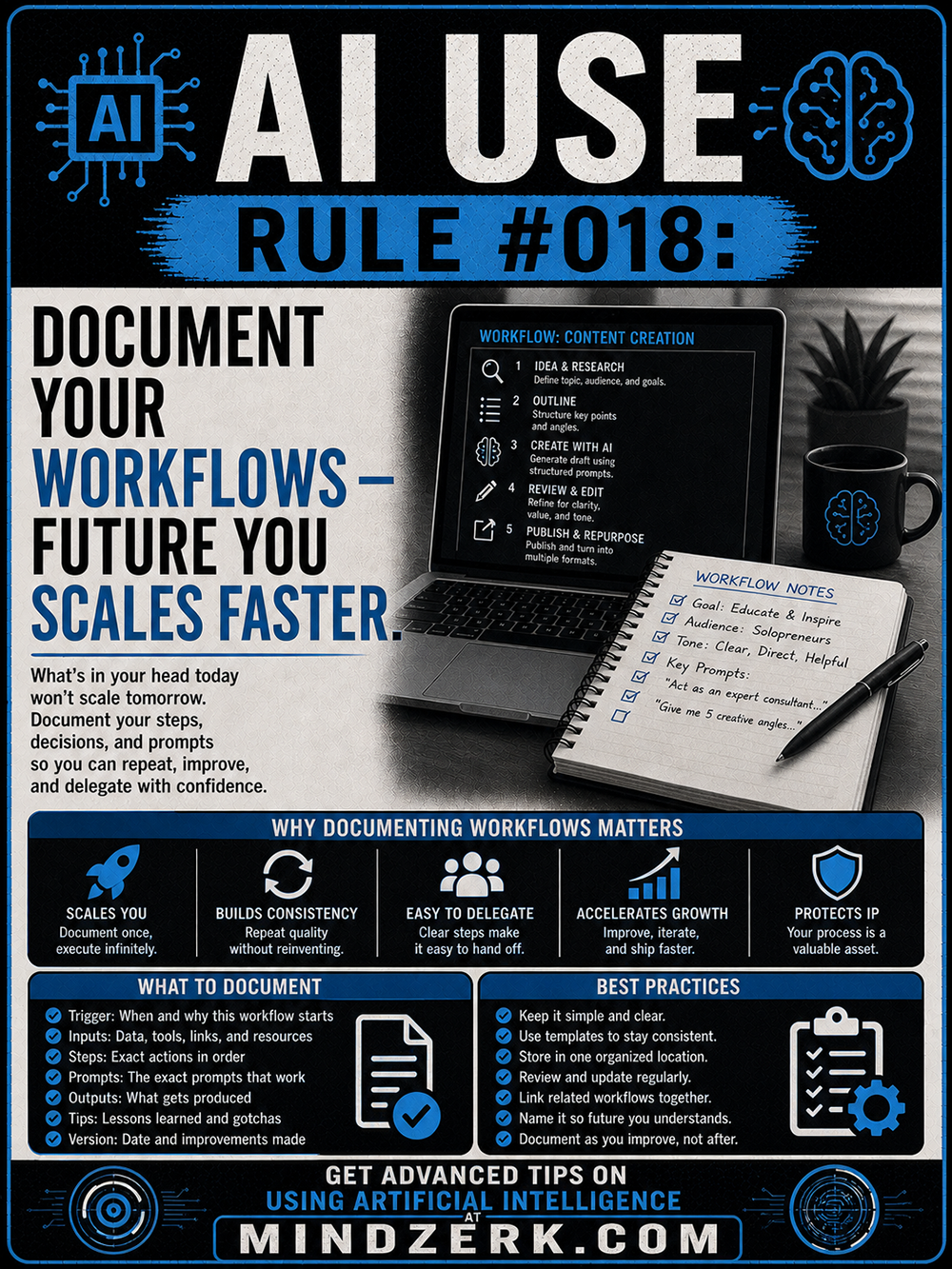
A Simple Example Workflow (Content Creation)
Here’s what a clean AI workflow might look like:
- Idea & Research
Define topic, audience, goal - Outline
Structure key points - Create with AI
Use tested prompts - Review & Edit
Improve clarity and value - Publish & Repurpose
Turn one piece into many
That’s it.
Simple. Repeatable. Scalable.
What You Should Be Documenting
Don’t overcomplicate it. Capture the essentials:
Trigger
When does this workflow start?
Example: “When I need a new blog post”
Inputs
What do you need?
- Tools
- Links
- Data
- References
Steps
Exact actions in order.
No skipping. No assumptions.
Prompts
The actual prompts that work.
This is where most people fail.
If you find a good prompt, save it.
Outputs
What gets created?
- Blog post
- Image
- Video
Tips & Lessons
What improves the result?
What mistakes to avoid?
Version
Track changes over time.
Because your workflow should evolve.
Best Practices That Make This Work
Keep It Simple
If it’s complicated, you won’t use it.
Use Templates
Same structure every time.
Less thinking. Faster execution.
Store Everything in One Place
Notebooks, docs, databases—doesn’t matter.
Just don’t scatter it.
Update as You Go
Don’t wait until it’s perfect.
Document while you’re doing it.
Link Related Workflows
Connect systems together.
Content → Email → Product → Funnel
Now you’re building something real.
Write for “Future You”
Assume you’ll forget everything.
Make it idiot-proof.
The Biggest Mistake
People think:
“I’ll remember how I did this.”
You won’t.
And even if you do, you won’t do it the same way.
That’s where inconsistency creeps in.
The Mindset Shift
Stop thinking like a user.
Start thinking like a builder.
Instead of:
“I need to create this.”
Think:
“I need a system that creates this every time.”
That’s the shift.
The Real Power Move
Once your workflow is documented:
- You can automate it
- You can delegate it
- You can scale it
- You can sell it
Now AI isn’t just helping you.
It’s working for you.
The Bottom Line
AI gives you speed.
Workflows give you leverage.
Documentation turns both into scale.
What you document today…
builds the system that runs tomorrow.
And that’s how you stop creating one-off results
and start building something that grows without you.