
Most off-grid people prepare for freezing temperatures.
Fewer prepare for heat.
That’s a mistake.
Because while cold damage is obvious, heat damage is often silent.
It builds slowly:
- Inside batteries
- Inside fuel cans
- Inside electronics
- Inside solar systems
- Inside storage containers
Then one day:
- The battery fails
- The fuel goes bad
- The inverter shuts down
- The electronics glitch
- The system loses efficiency
- The backup you depended on suddenly dies
And the cause was not dramatic.
It was heat.
Heat Quietly Destroys Systems
Cold usually announces itself.
Frozen pipes burst.
Ice forms.
Things stop visibly.
Heat is different.
Heat slowly:
- Breaks materials down
- Accelerates wear
- Weakens seals
- Reduces lifespan
- Damages electronics
- Creates instability
- Causes unpredictable failures
The danger is cumulative.
Systems may appear fine right up until they fail.
Heat Is an Invisible Wear Multiplier
Every degree of excess heat increases stress on equipment.
Especially:
- Batteries
- Fuel storage
- Solar systems
- Generators
- Radios
- Inverters
- Power stations
- Pumps
- Refrigeration systems
- Electronics
Off-grid living depends on reliability.
Heat attacks reliability.
Batteries Hate Heat
Batteries are one of the biggest victims of excessive temperatures.
Heat accelerates:
- Chemical breakdown
- Capacity loss
- Internal resistance
- Swelling
- Corrosion
- Reduced charge cycles
People often think batteries only struggle in winter.
But high heat can permanently shorten lifespan far faster than cold.
A battery left in direct summer sun may survive temporarily while quietly losing years of usable life.
Direct Sunlight Is Brutal
Sun exposure compounds heat damage quickly.
A shaded area might be:
- 90°F
But equipment sitting in direct sunlight can exceed:
- 120°F
- 140°F
- Even higher inside enclosed containers
That difference matters enormously.
Especially for:
- Lithium batteries
- Fuel cans
- Plastic fittings
- Electronics
- Solar generators
- Power stations
Shade is not cosmetic.
Shade is protection.
Fuel Breaks Down Faster in Heat
Heat increases:
- Pressure buildup
- Evaporation
- Fuel degradation
- Vapor expansion
Gasoline stored improperly in heat:
- Loses effectiveness faster
- Creates dangerous pressure
- Increases fire risk
- Produces varnish and residue
Diesel and other fuels also degrade over time faster under poor storage conditions.
Hot storage destroys fuel reliability.
Electronics Fail Under Heat Stress
Electronics are sensitive to sustained temperature extremes.
Excess heat causes:
- Random shutdowns
- Component fatigue
- Reduced efficiency
- Sensor failures
- Condensation issues after cooling
- Circuit degradation
Many people assume electronics fail from age alone.
Often they fail from years of thermal abuse.
Heat Reduces System Efficiency
Even when systems do not fail immediately, heat lowers performance.
Solar systems may:
- Lose efficiency under high panel temperatures
Batteries may:
- Deliver weaker output
Electronics may:
- Slow down or throttle
Cooling systems may:
- Work harder and consume more power
Heat wastes energy.
Off-grid systems cannot afford waste.
The Cost of Heat Damage
Heat damage creates:
- More repairs
- More replacements
- More downtime
- More unreliability
- More dependency
And usually at the worst possible time.
The goal of off-grid living is resilience.
Heat silently attacks resilience.
Keep It Cool. Keep It Running.
The good news is most heat damage is preventable.
Simple precautions dramatically extend equipment life.
Use Natural Shade
Trees are powerful infrastructure.
Shade from:
- Trees
- Roof overhangs
- Tarps
- Small shelters
- Lean-tos
- Ventilated covers
…can reduce temperatures significantly.
Sometimes the simplest solutions work best.
Improve Airflow
Heat trapped in enclosed spaces becomes destructive fast.
Ventilate:
- Battery boxes
- Storage sheds
- Power stations
- Generator areas
- Electronics enclosures
Avoid stagnant heat pockets.
Moving air matters.
Monitor Temperatures
Guessing is dangerous.
Use:
- Thermometers
- Temperature sensors
- Battery monitors
- Infrared thermometers
Monitoring allows you to spot problems early before damage compounds.
Reflect the Sun
Light-colored surfaces and reflective materials reduce heat absorption.
Dark surfaces trap heat aggressively.
Simple reflective coverings can lower temperatures noticeably.
Inspect Regularly
Heat damage often leaves clues before catastrophic failure.
Watch for:
- Swelling batteries
- Brittle plastics
- Warped containers
- Fuel smells
- Weak performance
- Random shutdowns
- Corrosion
- Cracked seals
Catching problems early saves systems.
Design for the Environment
Many off-grid systems fail because they were designed for convenience instead of environmental reality.
A strong setup accounts for:
- Summer heat
- Direct sun
- Ventilation
- Thermal expansion
- Dust
- Airflow
- Seasonal shifts
Nature always wins long term.
Work with it.
Simplicity Survives Better
Complex systems generate more heat.
More heat means:
- More cooling needs
- More failure points
- More maintenance
Simple systems usually:
- Run cooler
- Last longer
- Fail less often
- Stay repairable
Simplicity is resilience.
Preparedness Means Environmental Awareness
Many preparedness plans obsess over dramatic disasters while ignoring slow environmental wear.
But systems usually die from:
- Neglect
- Exposure
- Heat
- Moisture
- Corrosion
- Poor maintenance
Long before they die from catastrophe.
Environmental management is preparedness.
Final Thought
Most people underestimate heat because damage happens slowly.
But heat quietly destroys:
- Batteries
- Fuel
- Electronics
- Storage systems
- Reliability
- Independence
And once failure begins, it compounds fast.
A little shade today can save thousands of dollars later.
A little airflow can add years to critical equipment.
A little environmental awareness can prevent complete system collapse.
So:
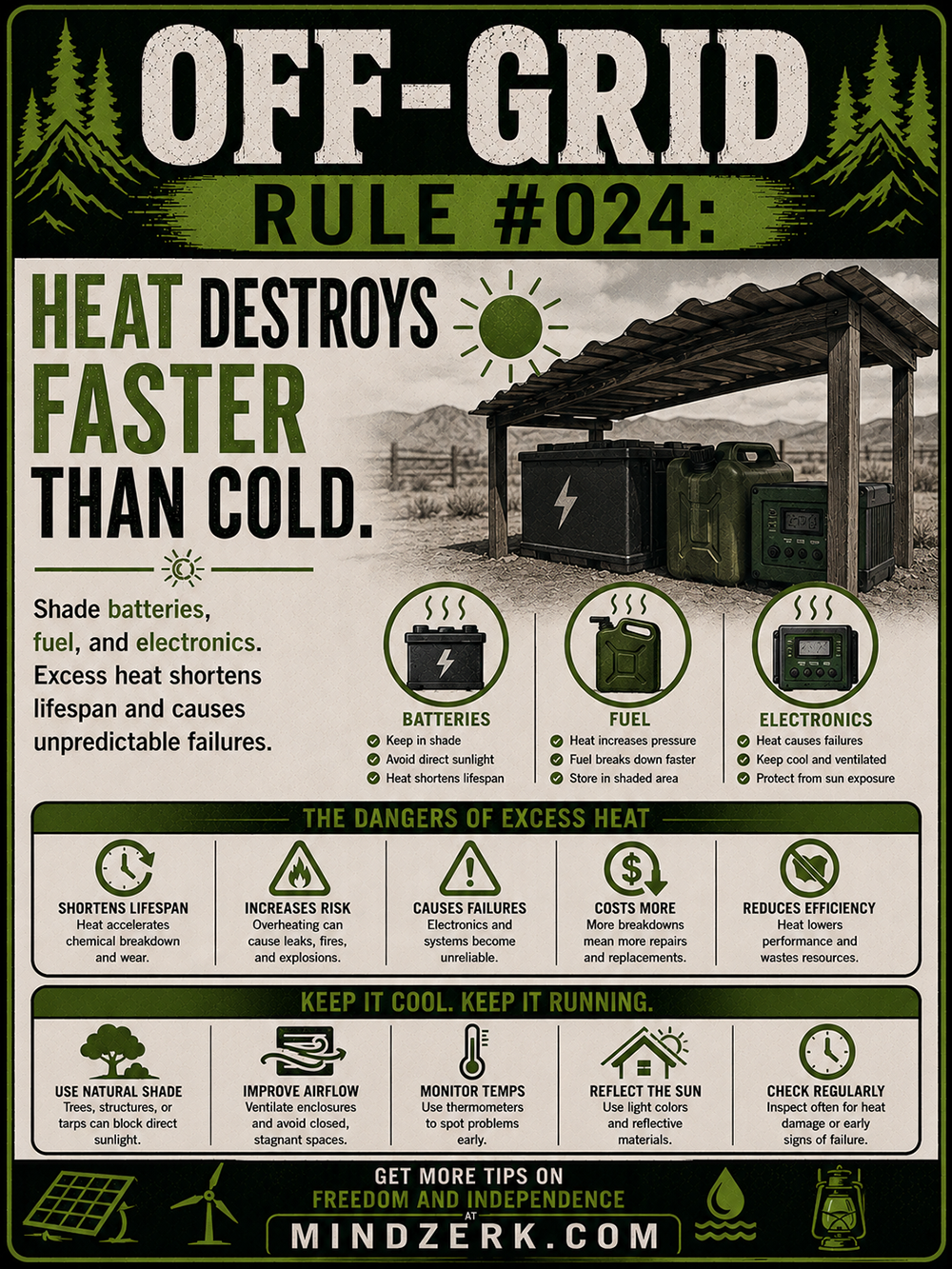
- Keep batteries shaded
- Ventilate enclosures
- Protect fuel
- Monitor temperatures
- Reduce sun exposure
- Inspect regularly
- Design for longevity
Because off-grid freedom depends on systems that keep working.
And heat destroys systems faster than most people realize.