
Memory lies.
Systems don’t.
If you’re living off-grid—or even just trying to run a tight, independent setup—you need something most people overlook:
A simple written log.
Not an app.
Not a dashboard.
Not something that disappears when the battery dies.
Paper.
Why a Written Log Matters
When everything is running fine, it feels unnecessary.
You “know” your system.
You “remember” how things behave.
Until something drifts.
Then breaks.
Then you’re guessing.
What a Log Actually Does
A written log turns chaos into patterns.
It shows you:
- How much water you really use
- How your batteries behave day to day
- What weather does to your systems
- What breaks—and how often
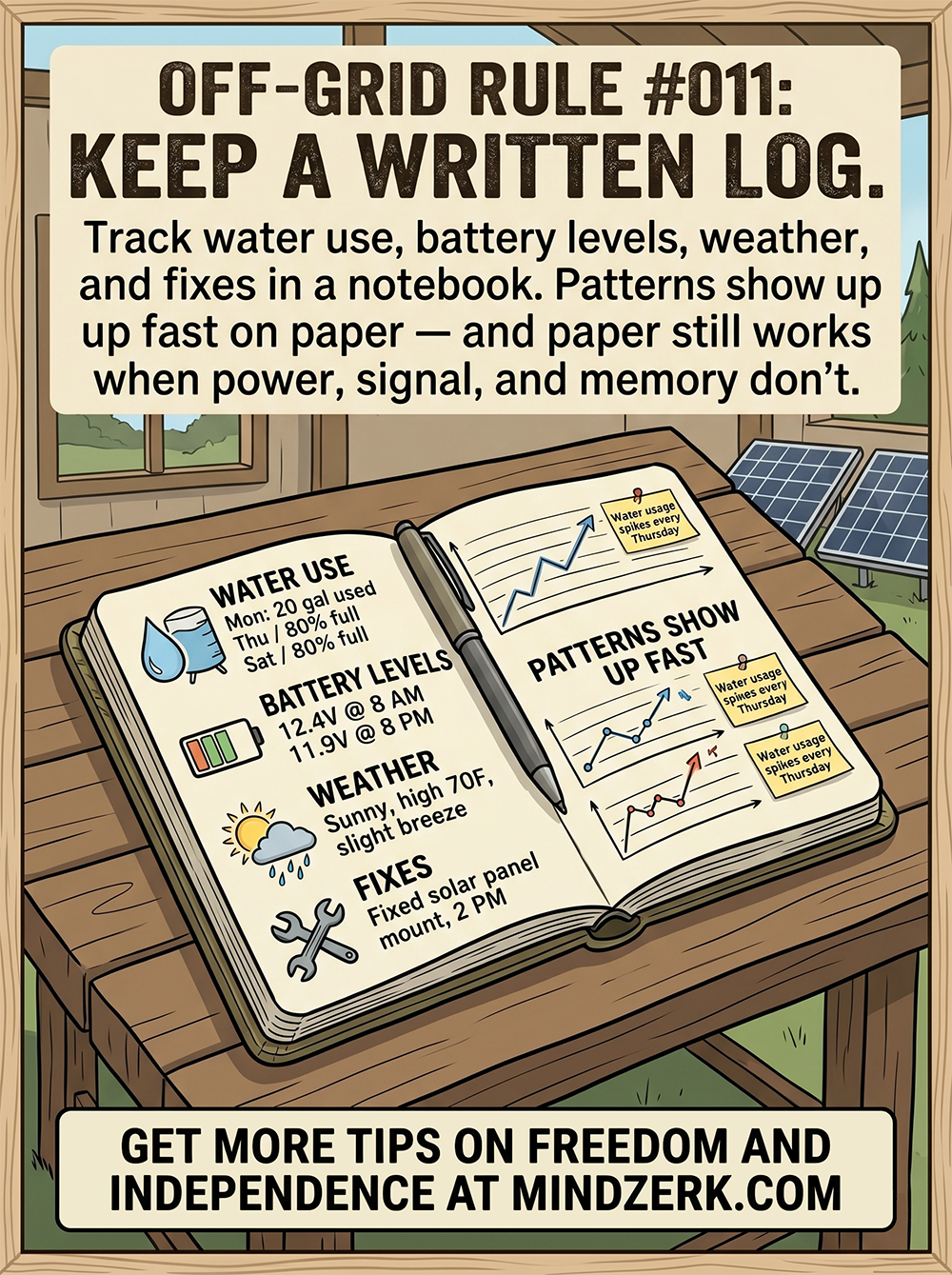
Patterns show up fast on paper. Faster than memory ever will.
What to Track (Keep It Simple)
You don’t need to overcomplicate this.
Track the basics consistently.
1. Water Use
- Daily or weekly usage
- Tank levels
- Refill timing
You’ll quickly see:
- Waste patterns
- Leak indicators
- Consumption spikes
2. Battery Levels
- Morning voltage
- Evening voltage
- Charging performance
This reveals:
- System health
- Solar efficiency
- Power drain habits
3. Weather
- Temperature
- Sun exposure
- Wind, storms, rain
Why it matters:
Weather drives everything off-grid.
Power, water, comfort, and failure all follow it.
4. Fixes & Maintenance
- What broke
- What you did
- How long it took
This builds:
- A repair memory
- Faster troubleshooting next time
- A record of weak points
The Real Power: Pattern Recognition
Here’s where it gets interesting.
After a couple weeks of logging, you’ll notice things like:
- Water spikes every Thursday
- Battery dips after cloudy days
- Certain parts failing repeatedly
- Performance shifts tied to weather
You stop reacting.
You start predicting.
Why Paper Beats Digital Here
This is one place where analog wins.
Paper:
- Never runs out of battery
- Doesn’t crash
- Doesn’t depend on signal
- Always accessible
Digital:
- Requires power
- Easy to ignore
- Easy to lose
- Fragile under stress
When systems fail, paper keeps working.
The Hidden Benefit: Clear Thinking
Writing things down forces clarity.
You’re not just tracking data.
You’re seeing your system as a whole.
- Inputs
- Outputs
- Weak points
- Trends
It turns you from a user into an operator.
Keep It Dirt Simple
Don’t build a complex system.
Use:
- A notebook
- One page per day (or per check-in)
- Short entries
Example:
- Water: 20 gal used
- Battery: 12.4V AM / 11.9V PM
- Weather: Sunny, light wind
- Fix: Tightened hose clamp
That’s it.
Consistency beats detail.
What Happens If You Don’t Log
Without a log:
- You rely on memory (which drifts)
- You miss slow problems
- You repeat the same fixes
- You react instead of plan
You stay in guess mode.
The Off-Grid Advantage
With a log:
- You see problems early
- You understand your system
- You move faster when things break
- You reduce stress
You trade guessing for knowing.
The Bottom Line
A written log turns your setup into a system you actually understand.
It’s low-tech.
But it gives you high-level control.
Final Thought
You don’t need more gear.
You need more awareness.
And awareness comes from tracking.
Write it down. Watch the patterns. Stay ahead of failure.