
Most people build their digital lives like a tangled extension cord.
Everything connected to everything else.
One login tied to every account.
One email connected to every service.
One cloud provider holding everything.
One identity stretched across every platform.
Convenient? Sure.
Safe? Not even close.
Because tightly connected systems create chain reactions.
One breach becomes ten.
One leak spreads everywhere.
One compromised account opens your entire life.
Loose connections isolate damage.
Tight connections multiply it.
The more separated your systems are, the harder it becomes for one failure to destroy everything else.
The Problem With Tight Coupling
Modern platforms push integration constantly.
“Connect your accounts.”
“Sync your contacts.”
“Link your devices.”
“Use single sign-on.”
“Share across platforms automatically.”
Every connection feels small.
Until something breaks.
Then suddenly:
- A hacked email compromises dozens of accounts
- One data breach exposes your full identity
- A platform ban wipes out multiple systems
- One compromised device leaks everything connected to it
Convenience creates invisible fragility.
Loose Connections Create Resilience
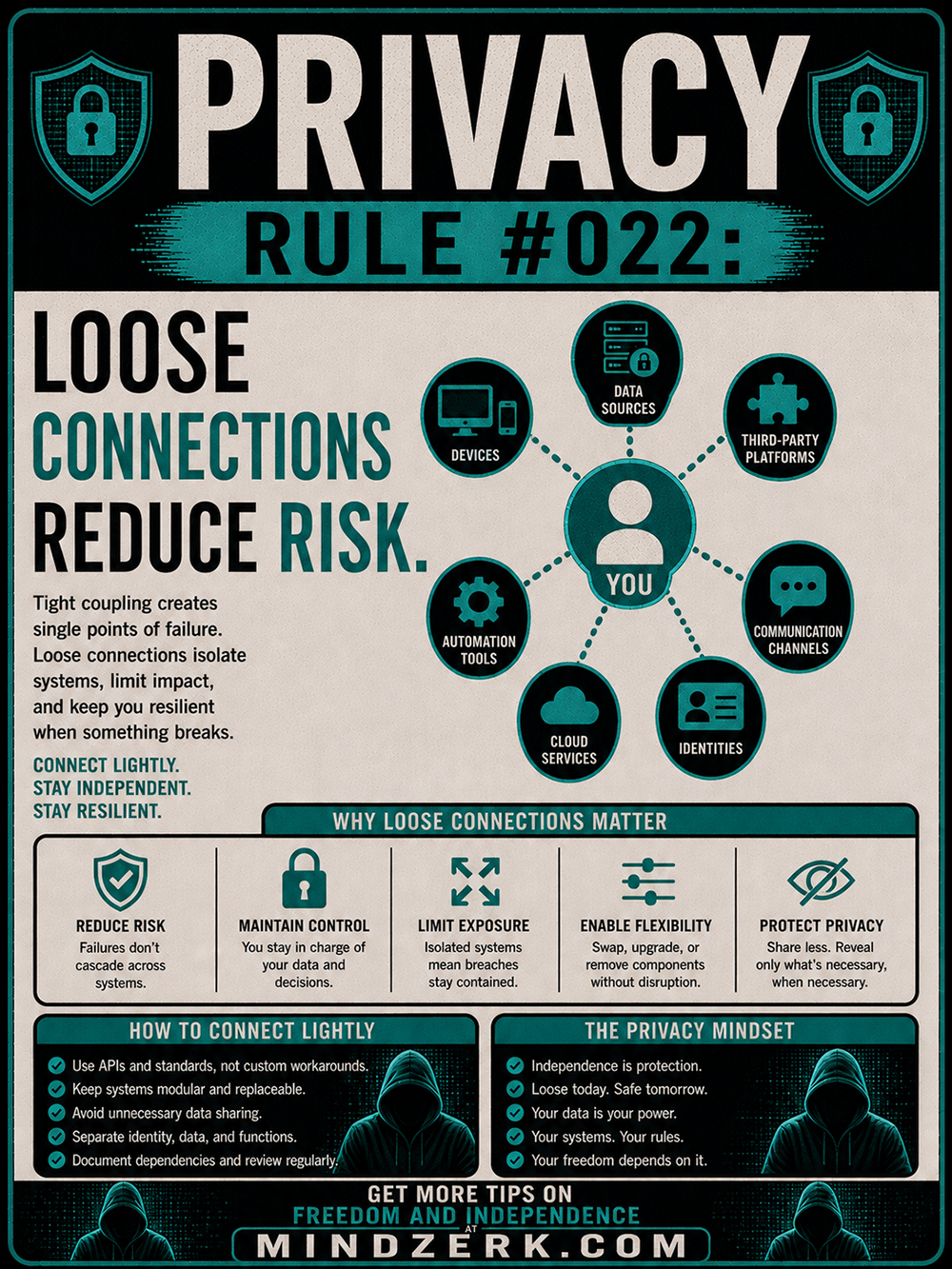
Loose connections mean your systems stay partially independent.
If one component fails:
- The rest continue operating
- Exposure stays limited
- Damage stays contained
- Recovery becomes easier
This principle exists everywhere:
- Engineering
- Cybersecurity
- Survival systems
- Military operations
- Infrastructure design
Compartmentalization keeps failures from cascading.
Why Loose Connections Matter
Reduce Risk
The fewer direct dependencies between systems, the fewer catastrophic chain reactions.
A breach should remain a breach — not become a total collapse.
Maintain Control
The more integrated your systems become, the more outside platforms control your life.
Loose systems are easier to:
- Replace
- Migrate
- Shut down
- Upgrade
- Isolate
That flexibility matters.
Limit Exposure
When systems remain separated:
- Data leaks stay smaller
- Identities stay isolated
- Tracking becomes harder
- Profiles become incomplete
Not every service needs access to everything.
Enable Flexibility
Modular systems adapt better.
You can swap:
- Platforms
- Devices
- Providers
- Tools
- Accounts
…without rebuilding your entire life from scratch.
Protect Privacy
Oversharing often happens automatically through integrations.
Apps collect:
- Contacts
- Calendars
- Locations
- Photos
- Messages
- Browsing habits
Many people have no idea how connected their systems actually are.
Loose connections reduce unnecessary data exposure.
The “Everything Account” Trap
One of the biggest modern vulnerabilities is centralization.
People often use:
- One email
- One phone number
- One password manager
- One login provider
- One cloud ecosystem
…for everything.
This creates a single point of catastrophic failure.
If one core account gets compromised:
- Banking
- Social media
- Business systems
- Cloud storage
- Password resets
- Authentication
…can all fall together.
That’s dangerous.
Connect Lightly Instead
You don’t need total isolation.
You need intentional separation.
Think modular.
Practical Ways to Reduce Risk
Separate Identities
Different roles deserve different identities.
Examples:
- Personal
- Business
- Public-facing
- Experimental
- Private communications
Not everything should point back to the same profile.
Separate Devices
Not every device needs access to:
- Every account
- Every password
- Every file
- Every service
Dedicated devices reduce exposure.
Separate Communication Channels
Use different channels for different contexts:
- Public
- Personal
- Sensitive
- Business
- Temporary
This limits overlap and tracking.
Separate Data Storage
Avoid placing your entire digital life inside one provider.
Maintain backups and alternative access points.
Redundancy creates resilience.
Separate Automation Carefully
Automation is useful.
But overconnected automation chains become dangerous fast.
One API failure or compromised integration can spread damage everywhere.
Use automation intentionally, not blindly.
The Privacy Mindset
Privacy isn’t just hiding.
It’s reducing unnecessary exposure.
It’s controlling:
- What connects
- What shares
- What overlaps
- What depends on what
Strong privacy comes from structure.
Loose Systems Are Easier to Escape
This matters more than people realize.
When your systems are loosely connected:
- You can leave platforms easier
- You can change providers easier
- You can isolate compromised systems faster
- You can recover from mistakes quicker
Tightly connected systems trap people.
Loose systems create freedom.
Convenience Often Hides Cost
Most privacy problems begin with convenience.
“It’s easier if everything syncs.”
And at first, it is.
Until:
- A breach spreads everywhere
- Tracking expands
- Data aggregation increases
- Dependency grows
- Escape becomes difficult
The convenience bill arrives later.
Independence Is Protection
The strongest systems are:
- Modular
- Replaceable
- Separated
- Documented
- Portable
That applies to:
- Technology
- Finance
- Identity
- Communication
- Infrastructure
Freedom depends on reducing unnecessary dependence.
The Bottom Line
Not everything needs to connect.
Not every service needs your full identity.
Not every platform deserves total access.
Build systems that fail gracefully instead of catastrophically.
Keep your systems modular.
Keep your identities separated.
Keep your exposure limited.
Connect lightly.
Stay independent.
Stay resilient.