
Modern tools are powerful.
They’re fast. Connected. Automated.
And fragile.
The Problem With “Smart Everything”
Smart tools depend on layers:
- Power
- Software
- Updates
- Connectivity
- Accounts and passwords
When everything works, they’re great.
When one layer fails… the whole stack can collapse.
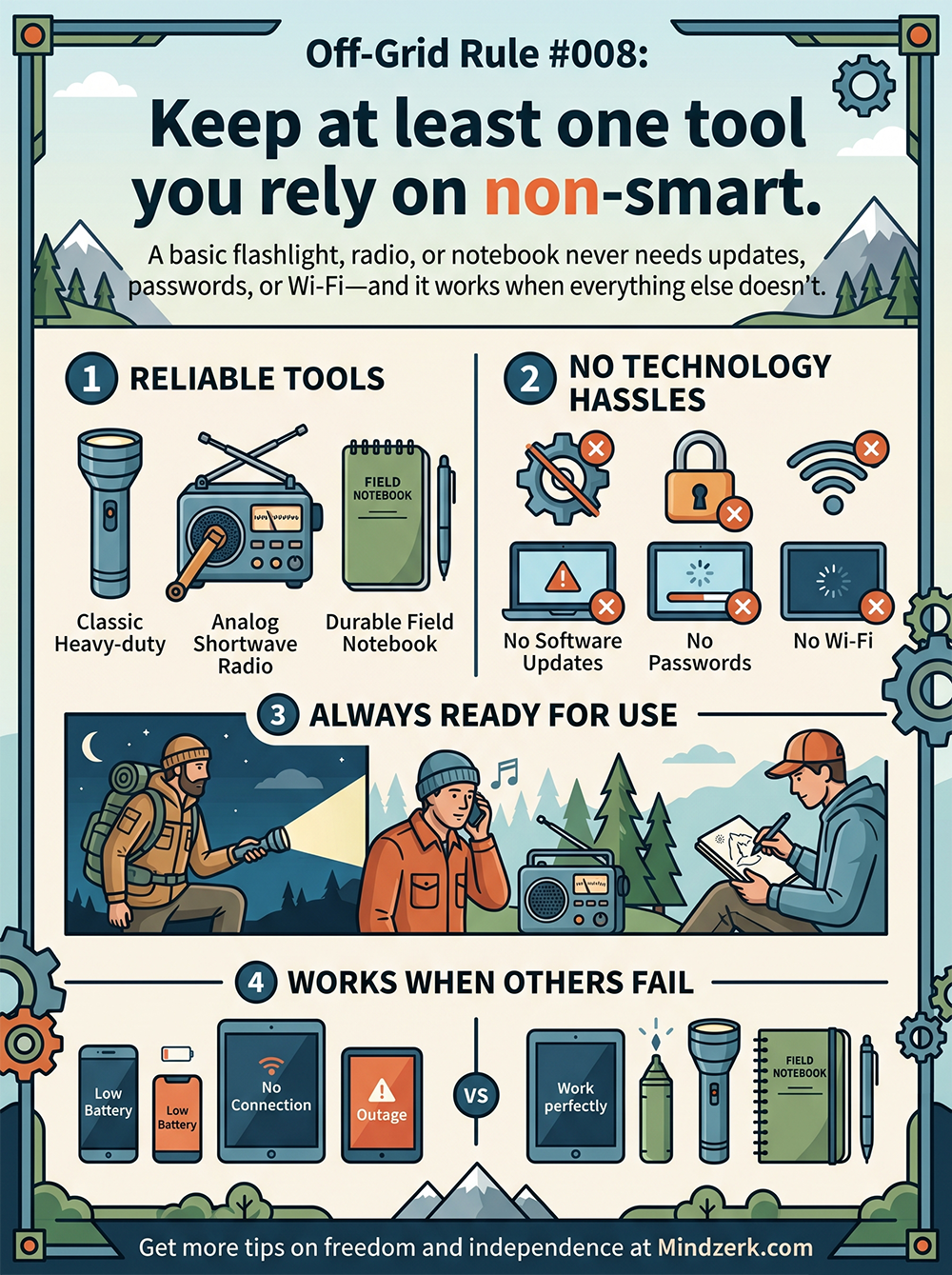
The Rule: Always Have a Non-Smart Backup
At least one tool you rely on should work without power, internet, or updates.
No login.
No syncing.
No waiting.
Just works.
What Counts as “Non-Smart”
Simple. Mechanical. Analog.
Examples:
- A heavy-duty flashlight
- A crank or battery-powered radio
- A durable field notebook
- Basic hand tools
These don’t ask permission to function.
Why This Matters
Because failure doesn’t happen in ideal conditions.
It happens:
- At night
- In bad weather
- During outages
- When systems are already stressed
That’s when you need tools that don’t care about tech.
The Hidden Weakness of Smart Systems
Smart tools fail quietly.
- Battery drains
- Signal drops
- Software glitches
- Updates break things
And suddenly you’re stuck troubleshooting instead of solving the problem.
Non-Smart Tools Remove Friction
No:
- Software updates
- Passwords
- Wi-Fi issues
- App dependencies
They’re always ready.
Always predictable.
Where This Applies
This isn’t just survival gear.
Think wider:
- Communication
- Lighting
- Navigation
- Note-taking
- Basic repairs
If it’s important, it needs a low-tech fallback.
Real-World Example
Your phone handles everything.
Until:
- Battery hits zero
- No signal
- App won’t load
Now what?
A notebook still writes.
A flashlight still lights.
A radio still receives.
The Principle: Reduce Points of Failure
Every layer you add:
- Adds convenience
- Adds risk
Non-smart tools strip it down.
Fewer failure points = higher reliability.
Where People Go Wrong
They over-optimize for convenience.
Everything becomes:
- Connected
- Automated
- Dependent
Then when things break…
They have nothing that works independently.
The Better Setup
Use smart tools for efficiency.
But anchor your system with simple tools that:
- Don’t depend on anything else
- Work instantly
- Keep you moving
The Bottom Line
Technology is great—until it isn’t.
Your most critical tools should work even when everything else fails.
Final Thought
Don’t replace simplicity.
Protect it.
The tool that never needs an update is often the one that saves you.