
Most people use AI like a scratch pad.
They open a new chat.
Type something.
Get an answer.
Close it.
Start over next time.
That’s the slow way.
The real advantage isn’t in generating once.
It’s in reusing what already works.
The Core Idea
Every prompt you write…
Every output you refine…
Every structure that gets results…
Is an asset.
Treat your past work like a library, not a one-time use.
Because the best results don’t come from repetition.
They come from iteration.
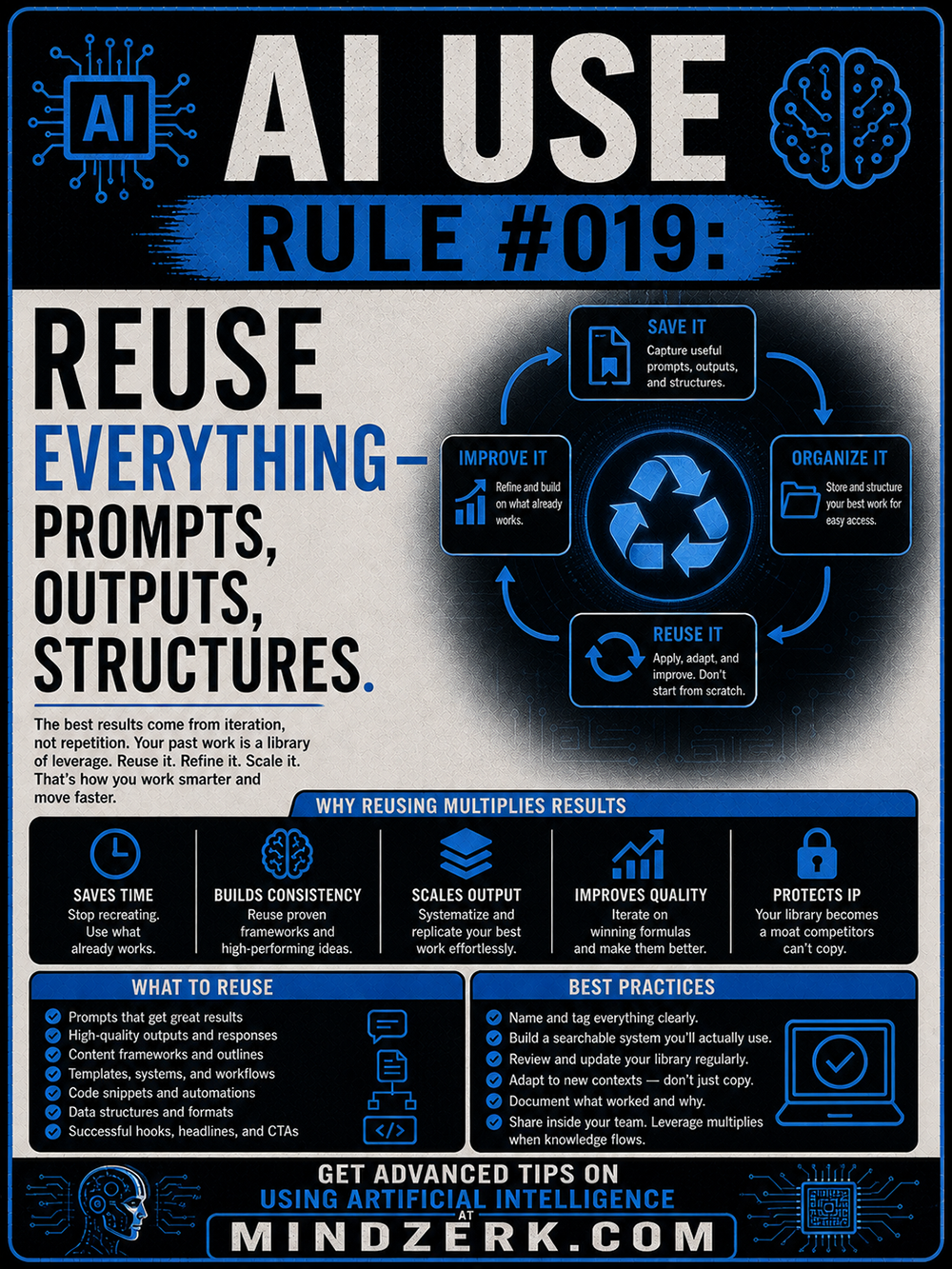
The 4-Step Loop That Wins
This is where things compound.
1. Save It
Capture anything that works:
- Strong prompts
- Clean outputs
- Useful formats
- Winning structures
If it worked once, it can work again.
2. Organize It
If you can’t find it, you won’t use it.
- Tag by purpose (sales, content, research)
- Group by format (emails, outlines, ads)
- Store it where it’s easy to access
A messy library is the same as no library.
3. Reuse It
Don’t start from scratch.
Take what worked and:
- Adapt it
- Apply it
- Build on it
Same structure. New context.
4. Improve It
Every reuse is a chance to upgrade.
- Tighten wording
- Improve clarity
- Increase performance
You’re not just reusing.
You’re refining.
Why Reuse Multiplies Results
You Save Time
No more reinventing the wheel.
You start at 70% instead of 0%.
You Build Consistency
Using proven frameworks means:
- Better quality
- More predictable results
- Less guesswork
You Scale Output
Once something works, you can:
- Replicate it
- Systemize it
- Produce more with less effort
You Improve Quality
Iteration beats inspiration.
Each version gets sharper.
You Protect Your Edge
Your library becomes your advantage.
Others generate.
You compound.
What You Should Be Reusing
Start building your stack:
- Prompts that get strong results
- High-quality outputs you’ve refined
- Content frameworks and outlines
- Templates and workflows
- Data structures and formats
- Code snippets or automations
- Hooks, headlines, and CTAs that convert
If it worked once, it belongs in your system.
Best Practices That Actually Work
Name Everything Clearly
“Prompt 3” means nothing.
Use names like:
- “Sales Page Framework — Short Form”
- “Blog Outline — Authority Style”
Make It Searchable
Use tools you’ll actually use:
- Notes apps
- Docs
- Simple folders
Don’t overcomplicate it.
Review and Update Regularly
Old prompts get stale.
Refine them as you learn.
Adapt — Don’t Copy
Reuse isn’t copy-paste.
It’s:
Structure + context = results
Document What Worked
Don’t just save the prompt.
Save:
- Why it worked
- Where it worked
- What result it got
That’s where the real value is.
Share (If You Have a Team)
When knowledge flows, output multiplies.
One good prompt can power multiple people.
The Biggest Mistake
People chase new prompts.
New ideas.
New tricks.
Meanwhile, they ignore the gold they already have.
The fastest way forward is often behind you.
The Shift That Changes Everything
Stop thinking:
“What should I prompt next?”
Start thinking:
“What have I already proven works?”
That’s how you move faster.
That’s how you scale.
The Bottom Line
AI rewards people who:
- Capture what works
- Organize it
- Reuse it
- Improve it
Not people who start over every time.
Don’t generate more.
Leverage more.
Because the real power of AI isn’t in one output…
It’s in what you do with it next.