
Most people overestimate what they can accomplish in a month and underestimate what they can build over several years.
They expect fast growth.
Fast sales.
Fast recognition.
Fast proof that the idea is working.
When the results take longer than expected, they assume they chose the wrong business, the wrong market, or the wrong strategy.
Often, none of those things are true.
They simply have not stayed in the game long enough for the advantages to compound.
That is why the early stage of almost any business is difficult because you are building everything at once.
You are learning the market.
Developing skills.
Creating products.
Finding customers.
Testing prices.
Building systems.
Establishing a reputation.
Nothing feels easy because nothing has had time to mature.
But every useful action leaves something behind.
Knowledge.
Connections.
Content.
Customers.
Processes.
Confidence.
Those assets begin working together. Eventually, the game that once felt impossible becomes familiar.
Experience Makes Problems Easier to Solve
At the beginning, every problem feels new.
You do not know why a product is not selling.
You cannot tell whether the offer is weak, the audience is wrong, or the message is unclear.
You spend hours solving problems that an experienced operator would recognize immediately.
That changes with time.
After enough launches, customer conversations, failed experiments, and completed projects, patterns become visible.
You stop treating every setback like a mystery.
You know where to look first.
You recognize weak positioning.
You notice vague promises.
You identify unnecessary complexity.
You understand which problems matter and which ones will resolve themselves.
Experience does not eliminate problems.
It helps you solve them faster.
Knowledge Turns Into Intuition
In the beginning, every decision requires research.
What should you charge?
How long should the product be?
Which platform should you use?
What should the headline say?
Should you continue, revise, or abandon the idea?
Over time, knowledge becomes intuition.
You develop a feel for what customers will understand.
You can recognize a good product idea before investing weeks into it.
You notice when something fits your business and when it is only a distraction.
This intuition is not magic.
It is compressed experience.
It comes from seeing similar situations repeatedly and learning what usually happens next.
That is one reason staying in the game creates such a large advantage. New competitors may have better tools, larger budgets, or more energy, but they cannot instantly copy years of accumulated judgment.
Reputation Opens Doors
In the beginning, nobody knows you.
You must explain who you are.
Prove that you can deliver.
Convince people to take a chance.
Every sale requires more effort because trust has not been established.
As your reputation grows, that changes.
People begin recognizing your work.
Customers return.
Readers recommend you.
Partners become easier to find.
Opportunities arrive without being chased.
A strong reputation reduces friction throughout the entire business.
It lowers the amount of persuasion required.
It makes launches easier.
It increases customer confidence.
It helps you recover from mistakes.
Reputation compounds because every good experience makes the next opportunity more likely.
Systems Remove Repeated Work
New businesses constantly reinvent.
Every product gets built differently.
Every launch starts from zero.
Every email requires a new decision.
Every customer problem is handled manually.
That is exhausting.
But repetition reveals structure.
After doing something several times, you begin creating templates, checklists, standard procedures, and automation.
The work that once required constant attention becomes a reliable process.
A product follows an established format.
A launch uses a proven sequence.
Customer onboarding follows a checklist.
Content is repurposed through a repeatable workflow.
Systems do not remove effort entirely.
They prevent you from paying for the same lesson repeatedly.
As systems improve, the business becomes easier to operate and easier to grow.
Momentum Makes Small Wins More Powerful
A single sale does not transform a business.
Neither does one article, one customer, or one partnership.
But small wins accumulate.
One customer leaves a review.
That review helps create another sale.
The new buyer joins your email list.
The list makes the next product launch easier.
The product teaches you something that improves the next offer.
That better offer attracts a potential partner.
Each small result becomes fuel for another.
This is momentum.
The early stage feels slow because every result must be created from nothing.
Later, new actions receive support from everything you have already built.
You are no longer pushing a motionless object.
You are guiding something already moving.
Confidence Grows Through Survival
Confidence is often mistaken for personality.
People think some entrepreneurs are naturally fearless.
Usually, confidence comes from surviving enough uncertainty.
You launch something that fails and discover that you are still standing.
A platform changes and you adapt.
A customer complains and you resolve it.
A product underperforms and you improve the next one.
Each experience proves that setbacks are manageable.
You stop interpreting every problem as a sign that the entire plan is collapsing.
That resilience creates better decisions.
You become less reactive.
Less desperate.
Less tempted by every new opportunity.
You can think long-term because you no longer believe every week must produce a dramatic breakthrough.
Staying in the Game Does Not Mean Staying Stuck
Persistence is valuable, but blind persistence is not.
Staying in the game does not mean repeating the same failed action forever.
It means remaining committed to the larger mission while continuing to adapt.
Keep the goal.
Change the method.
Improve the offer.
Refine the audience.
Replace weak systems.
Learn new tools.
Drop what no longer works.
The people who last are not the ones who refuse to change.
They are the ones who change without quitting.
How to Keep Going Long Enough to Win
Focus on Progress, Not Perfection
Perfect businesses do not exist.
Every product can be improved.
Every system has weaknesses.
Every launch teaches something.
Measure whether you are getting better, not whether everything is flawless.
Be Patient With Results
Some actions have delayed returns.
Content may take months to gain attention.
Reputation may take years to build.
An email list grows one subscriber at a time.
A product catalog becomes powerful after enough products exist.
Do not confuse delayed results with wasted effort.
Stay Consistent When It Feels Ordinary
Most compounding happens during unremarkable days.
Publishing another article.
Improving another product.
Following up with another customer.
Documenting another process.
The work may not feel important in the moment.
Its value becomes visible later.
Keep Learning and Adapting
Markets change.
Customer expectations change.
Technology changes.
Your own goals change.
Long-term survival depends on learning faster than your environment changes.
Stay curious.
Test ideas.
Notice patterns.
Keep what works.
Discard what does not.
Surround Yourself With People Who Think Long-Term
The wrong environment makes patience feel like failure.
People chasing constant novelty will make steady progress look boring.
Spend more time around builders.
Operators.
Creators.
Investors.
People who understand that durable results often take longer than expected.
Their perspective helps you keep moving when immediate rewards are small.
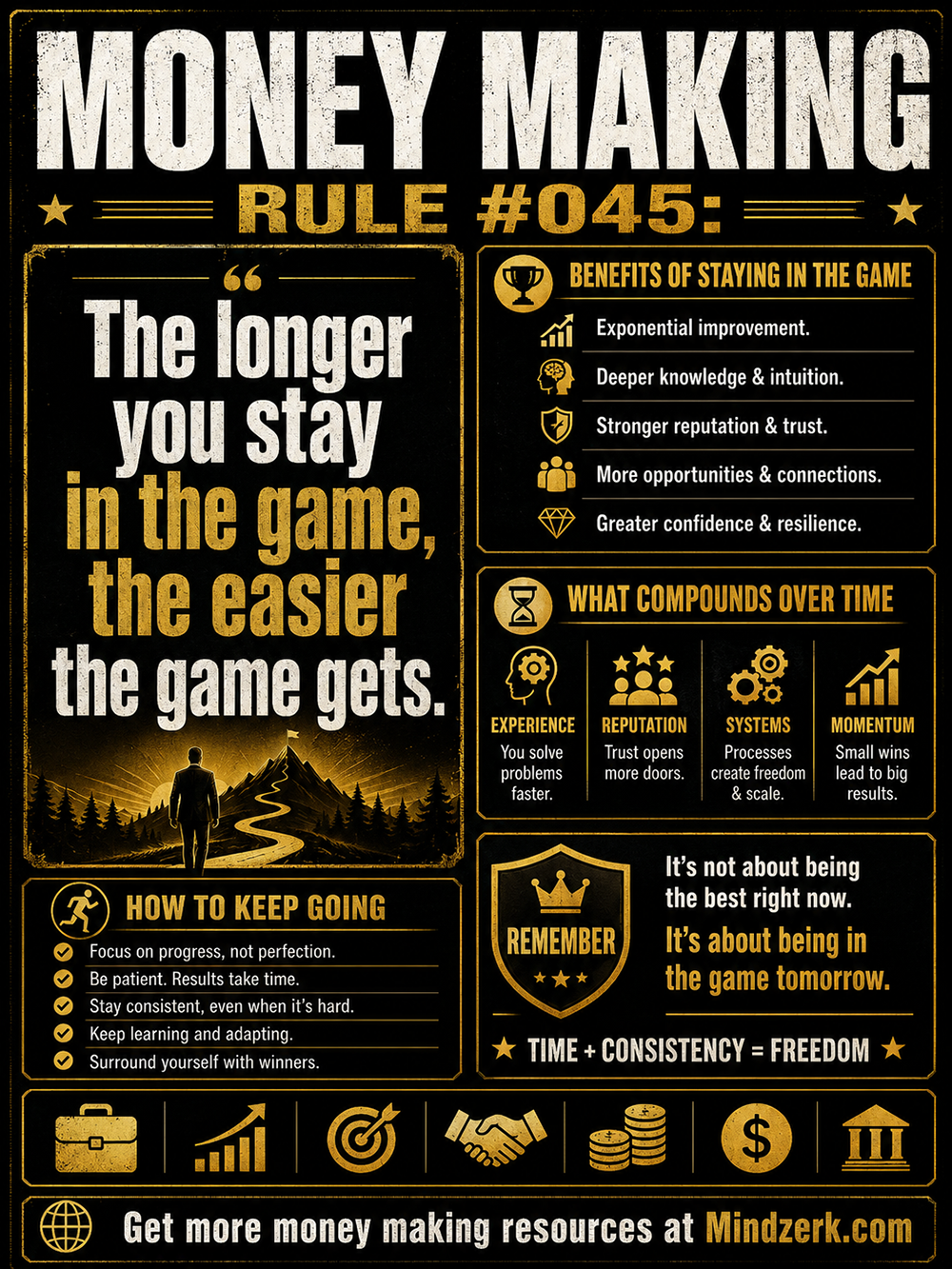
What Compounds Over Time
Experience
You solve problems faster because you have encountered similar ones before.
Reputation
Trust makes customers, partners, and opportunities easier to attract.
Systems
Processes reduce friction, save time, and create scale.
Momentum
Small wins begin supporting larger wins.
Relationships
Connections deepen and create opportunities that cold outreach rarely produces.
Confidence
Repeated survival teaches you that uncertainty is manageable.
These advantages are difficult to see at first.
Later, they become the reason the business feels easier.
The Real Goal Is to Still Be Here Tomorrow
You do not need to be the best person in your market today.
You do not need the biggest audience.
The most advanced tools.
The largest catalog.
Or the perfect business model.
You need to keep building.
Keep learning.
Keep improving.
Keep enough financial and emotional margin to continue.
Many competitors will disappear because they expected immediate rewards.
Others will abandon their work every time a new trend appears.
Some will burn themselves out trying to force five years of progress into six months.
Staying power becomes an advantage because so few people develop it.
Eventually, you are not competing only through talent.
You are competing with the accumulated weight of everything you have learned and built.
The game becomes easier because you are no longer starting from zero.
You have experience behind you.
Systems beneath you.
A reputation ahead of you.
Momentum carrying you.
That is the power of staying in the game.
It is not about being the best right now.
It is about still being in the game tomorrow.
Time plus consistency creates freedom.