
Modern technology sells convenience.
One account.
One login.
One cloud.
Everything synchronized automatically across every device.
Your photos.
Your contacts.
Your messages.
Your documents.
Your calendar.
Your location history.
Your browsing activity.
Your payments.
It sounds efficient.
And it is.
But there’s a cost.
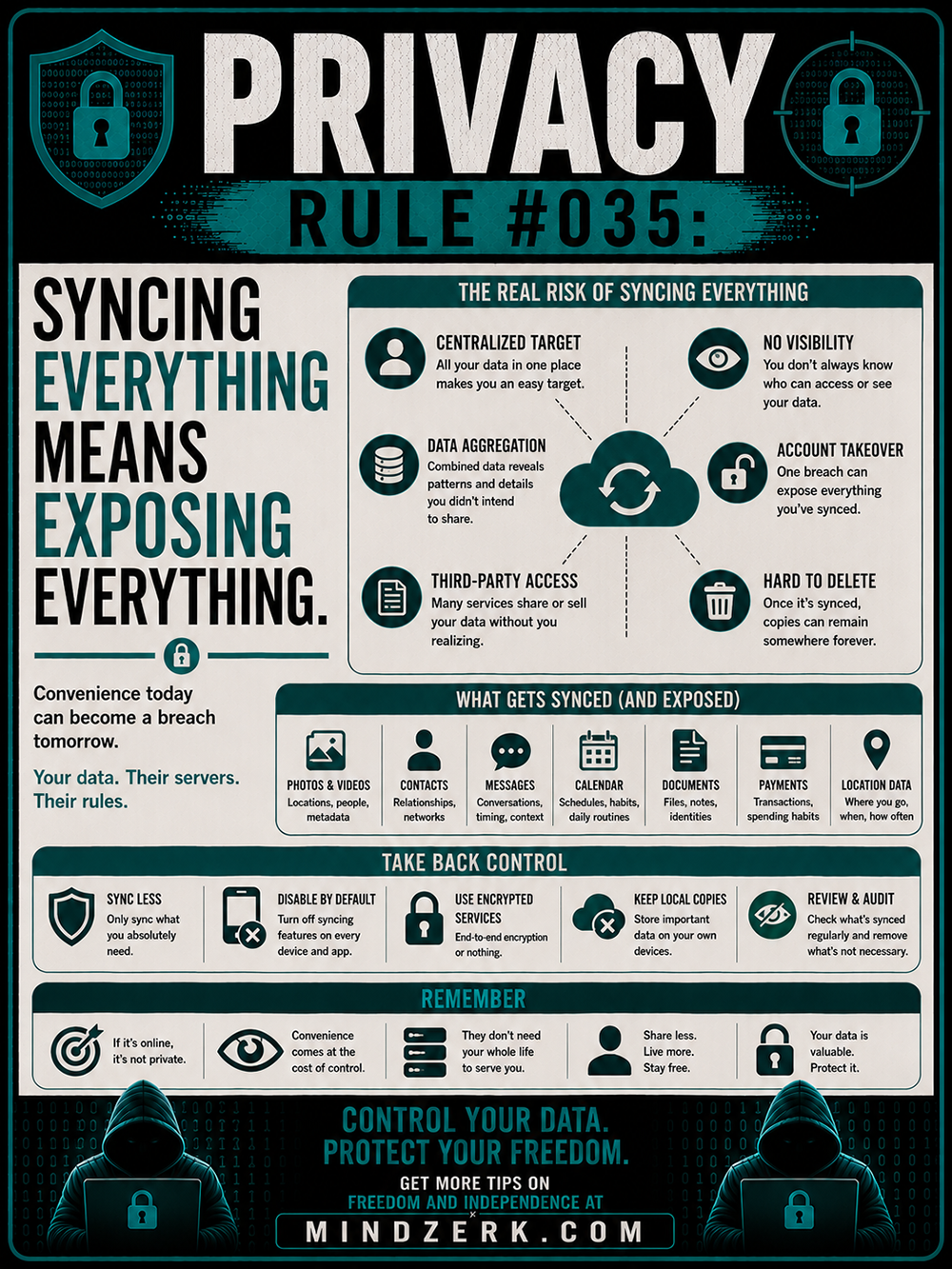
Privacy Rule #035: Syncing Everything Means Exposing Everything.
Every piece of data you centralize creates a larger target.
The more you sync, the more you expose.
Convenience Has a Price
Technology companies love synchronization.
The reason is simple.
The more connected your data becomes, the more valuable it becomes.
When information is isolated, it tells a small story.
When information is combined, it tells your entire story.
A calendar alone reveals little.
A location history alone reveals little.
A contacts list alone reveals little.
Combined together, they reveal:
- Where you go
- Who you know
- What you do
- What you buy
- When you’re home
- When you’re away
- What matters to you
The individual pieces aren’t the real asset.
The complete profile is.
The Aggregation Problem
Most privacy discussions focus on data collection.
The bigger issue is often data aggregation.
Companies don’t just collect information.
They connect it.
Photos become location data.
Location data becomes behavioral data.
Behavioral data becomes advertising profiles.
Advertising profiles become predictive models.
Over time, the picture becomes surprisingly accurate.
Not because one piece of information was dangerous.
Because thousands of small pieces were assembled into a complete map.
One Account Becomes One Target
Centralization creates efficiency.
It also creates vulnerability.
When everything is connected to a single account:
- Photos
- Documents
- Contacts
- Password resets
- Payment information
One compromise can expose everything.
A single successful phishing attack.
A reused password.
A security breach.
Suddenly the attacker doesn’t gain access to one service.
They gain access to your digital life.
The more centralized the system, the larger the consequences of failure.
The Visibility Problem
Many people don’t know what is being synchronized.
Settings are often enabled by default.
Applications quietly connect services together.
Data moves between platforms automatically.
Years later, people discover information they’ve forgotten exists still sitting on servers they haven’t visited in a decade.
The first privacy problem is often simple:
You can’t protect what you don’t know exists.
What Gets Synced?
More than most people realize.
Photos and Videos
Not just images.
Also:
- Locations
- Dates
- Device information
- People
- Patterns
Contacts
Your network reveals relationships.
Who you know can often be as valuable as what you know.
Messages
Even when content is protected, metadata frequently remains useful.
Calendars
Schedules reveal routines.
Routines reveal habits.
Habits reveal predictability.
Documents
Files often contain far more personal information than intended.
Payments
Spending patterns reveal lifestyle choices, priorities, and circumstances.
Location History
Perhaps the most revealing category of all.
Where you go often says more than what you say.
Third Parties Multiply Risk
Many services share data.
Some sell it.
Some analyze it.
Some transfer it to partners.
Some are acquired by other companies.
Every additional party increases exposure.
Even if you trust the original service, you may not know every company that eventually touches your information.
Your data often travels farther than you think.
Taking Back Control
Privacy doesn’t require abandoning technology.
It requires intentional use.
Sync Less
Ask a simple question:
“Do I actually need this synchronized?”
Many people discover the answer is no.
Disable by Default
Turn synchronization on only when necessary.
Not automatically.
Not everywhere.
Keep Local Copies
Important files don’t always need to live in the cloud.
Local storage provides control.
Use Encrypted Services
If data must leave your devices, encryption should be the starting point, not an afterthought.
Audit Regularly
Review:
- Connected accounts
- Cloud storage
- Synced devices
- Application permissions
Most people are surprised by what they’ve forgotten.
The Freedom Trade-Off
Convenience and control often pull in opposite directions.
More convenience usually means:
- More synchronization
- More collection
- More exposure
- Less control
More control usually means:
- Fewer connections
- More intentional decisions
- Better visibility
- Smaller attack surfaces
Neither extreme is required.
The goal is balance.
Use convenience where it serves you.
Avoid it where it creates unnecessary exposure.
Privacy Is About Minimization
The strongest privacy strategy isn’t perfect security.
It’s minimization.
Collect less.
Share less.
Store less.
Sync less.
The less information available, the less information that can be exposed.
Privacy isn’t achieved by hiding everything.
It’s achieved by exposing only what is necessary.
The Bottom Line
Every synchronized service creates another connection.
Every connection creates another pathway.
Every pathway creates another potential point of exposure.
Convenience today can become a breach tomorrow.
That doesn’t mean synchronization is always bad.
It means synchronization should be intentional.
Your data is valuable.
Treat it that way.
Because once everything is connected, everything is at risk.
Control your data. Protect your freedom.