
Most people don’t have an income problem.
They have a systems problem.
They repeat the same tasks every day:
- answering the same emails
- formatting the same posts
- sending the same follow-ups
- organizing the same files
- onboarding the same clients
- rebuilding the same workflows from scratch
Over time, those repeated manual actions quietly drain:
- time
- energy
- focus
- growth potential
That’s the trap.
Manual work scales poorly because you become the bottleneck.
The moment your business depends entirely on your constant attention, growth slows down.
That’s why systemization matters.
Manual Work Creates Invisible Friction
A task might only take:
- 5 minutes
- 10 minutes
- 20 minutes
But repeated hundreds of times, those tasks become operational debt.
People underestimate how much mental energy repetitive decisions consume.
Every manual process creates:
- more opportunities for mistakes
- inconsistent results
- slower execution
- burnout
- limits on scale
Eventually, your business starts managing you instead of the other way around.
Systems Buy Back Time
A system is simply:
a repeatable process that produces consistent results.
Good systems:
- reduce thinking
- reduce errors
- improve consistency
- save time
- increase scalability
The goal is not removing humans entirely.
The goal is removing unnecessary repetition.
Because every repetitive task that becomes systemized frees attention for:
- strategy
- growth
- creativity
- decision-making
- higher-value work
Why Systems Scale Better Than Hustle
Hustle is temporary.
Systems compound.
You can only work so many hours manually.
But systems can:
- run repeatedly
- operate consistently
- continue while you sleep
- be delegated
- be improved over time
That’s the difference between:
- surviving through effort
and - building leverage
Systems create leverage.
The Biggest Mistake Builders Make
Most people wait too long to organize.
They think:
“I’ll systemize later.”
But later rarely comes.
Instead:
- the business becomes messy
- tasks pile up
- knowledge stays trapped in your head
- operations become chaotic
Then growth itself creates stress.
The smartest move is documenting while building.
Even simple systems create huge advantages over time.
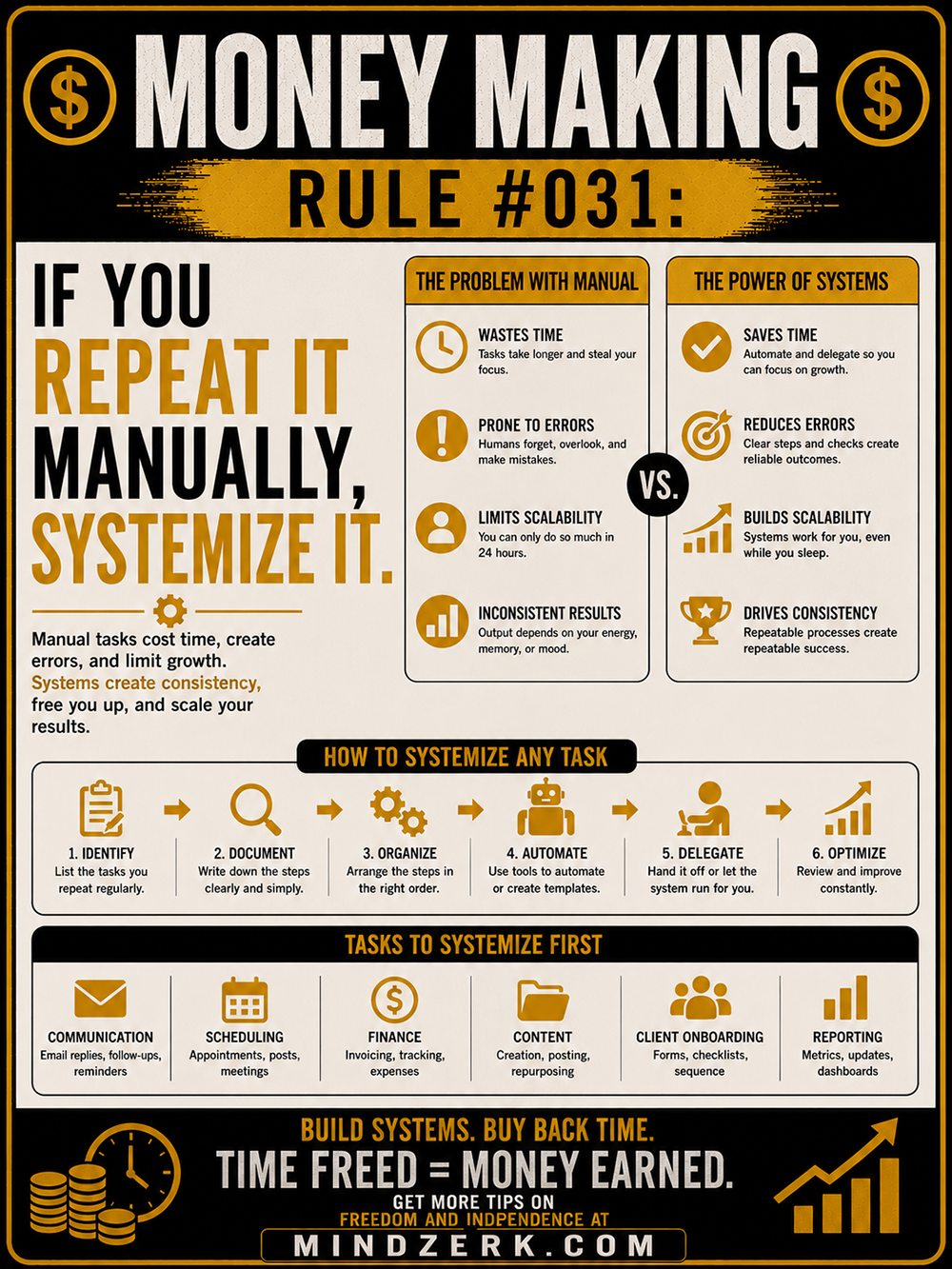
How to Systemize Any Task
Almost every repeated task can follow a simple process.
1. Identify Repetition
Look for:
- tasks repeated weekly
- repetitive communication
- recurring workflows
- frequent decisions
- repeatable outputs
If you do it repeatedly, it’s a candidate for systemization.
2. Document the Process
Write down:
- steps
- tools
- order of operations
- templates
- requirements
Most systems fail because they only exist in memory.
Documented systems survive stress and scale better.
3. Organize the Workflow
Simplify:
- unnecessary steps
- duplicated effort
- confusing sequences
Complex systems break more easily.
Simple systems survive.
4. Automate What Makes Sense
Automation works best for:
- repetitive tasks
- reminders
- notifications
- formatting
- sorting
- content distribution
- follow-up systems
But remember:
automate proven workflows first
Automating chaos only creates faster chaos.
5. Delegate
Once documented:
- others can execute it
- contractors can follow it
- AI can assist it
- teams can scale it
Documentation creates transferability.
Transferability creates leverage.
6. Optimize Over Time
Systems improve through repetition.
Small improvements compound:
- faster execution
- fewer mistakes
- smoother operations
- greater output
The best systems evolve continuously.
The First Things You Should Systemize
Start with the tasks that happen constantly.
Communication
- email templates
- follow-up sequences
- customer replies
- FAQs
Scheduling
- calendars
- posting schedules
- recurring reminders
- publishing timelines
Content
- content templates
- prompt libraries
- asset organization
- repurposing workflows
Finance
- invoicing
- expense tracking
- reporting
- bookkeeping routines
Client Onboarding
- forms
- checklists
- welcome sequences
- instructions
These systems create immediate relief.
Consistency Is Built Through Systems
People think consistency comes from motivation.
It doesn’t.
Consistency comes from reducing friction.
Systems reduce friction by:
- eliminating unnecessary decisions
- simplifying execution
- standardizing processes
- removing chaos
That’s why disciplined businesses usually look “boring” operationally.
Reliable systems often are boring.
But boring systems produce dependable results.
Freedom Comes From Infrastructure
Most people chase:
- viral moments
- lucky breaks
- one-off wins
But long-term freedom usually comes from:
- repeatable operations
- documented workflows
- scalable systems
- organized execution
A business that relies entirely on your constant effort is fragile.
A business with systems becomes durable.
The Bottom Line
If you repeat something manually over and over, it’s costing more than you think.
Manual repetition:
- wastes time
- creates errors
- limits scale
- drains focus
Systemization changes that.
Document the process.
Simplify the workflow.
Automate what makes sense.
Refine continuously.
Because the real goal isn’t just making more money.
It’s building systems that buy back your time.