
One of the fastest ways to create an off-grid disaster is assuming something is full when it is not.
Fuel tanks.
Water tanks.
Propane.
Backup reserves.
Generators.
People trust gauges too much.
That trust becomes dangerous when:
- Sensors fail
- Gauges stick
- Floats jam
- Readings drift
- Electronics glitch
- Tanks leak slowly over time
The system says:
“You’re good.”
Reality says:
“You’re empty.”
And you usually discover the truth at the worst possible moment.
During:
- A storm
- A power outage
- A wildfire evacuation
- A winter freeze
- A long night repair
- An emergency startup
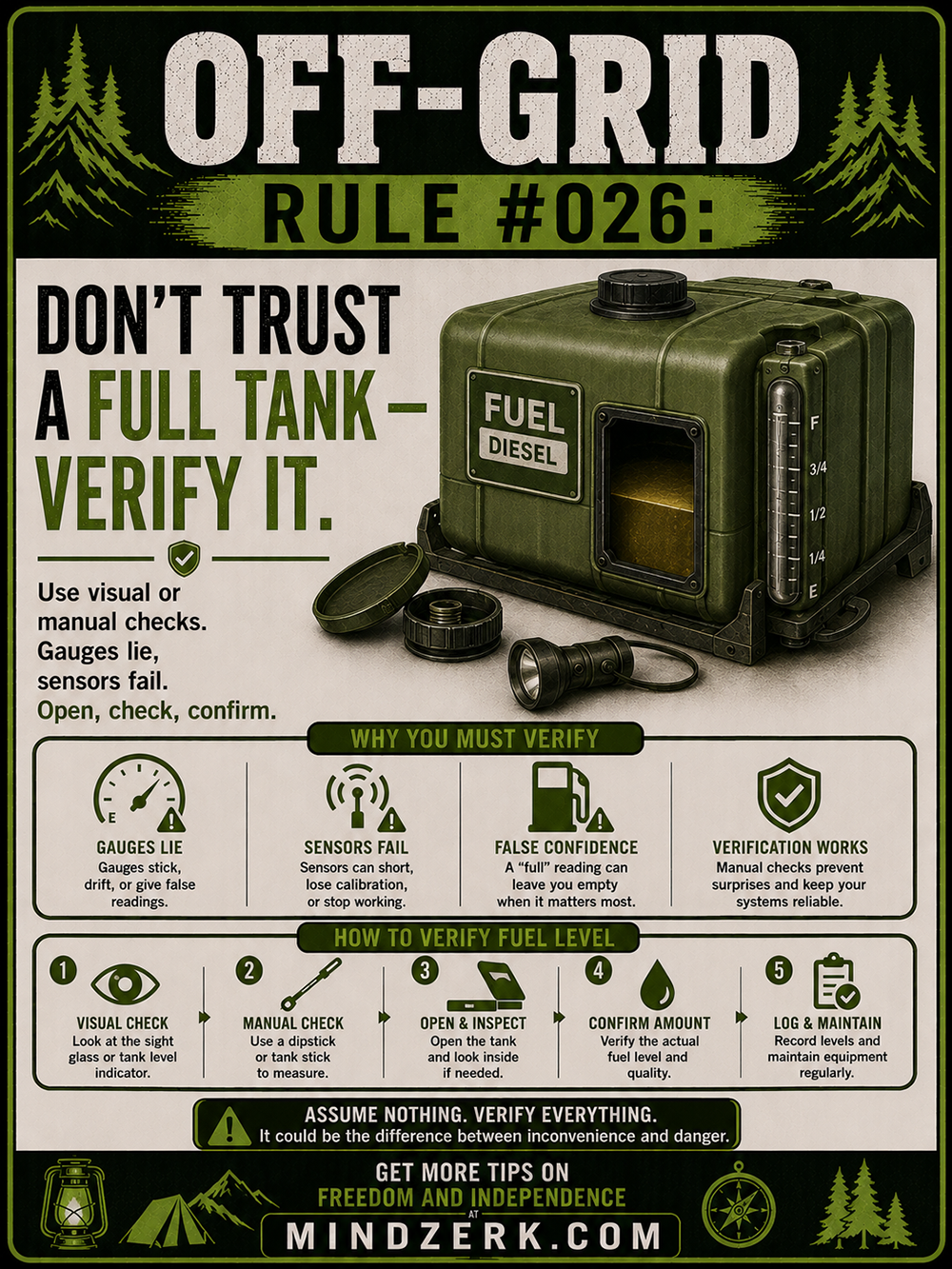
That is why real off-grid systems follow a simple rule:
Open. Check. Confirm.
Assume nothing.
Verify everything.
Gauges Lie More Than People Think
People assume fuel gauges are precise.
Many are not.
Especially on:
- Older tanks
- Portable fuel systems
- Cheap generators
- Off-grid water storage
- Propane systems
- Backup equipment
Common problems include:
- Stuck floats
- Corrosion
- Sensor failure
- Wiring issues
- Condensation damage
- Miscalibration
A gauge reading “full” means nothing if the system behind it is failing.
And off-grid life punishes assumptions fast.
False Confidence Is Dangerous
The real problem is not just empty tanks.
It is false confidence.
Believing:
- You have enough fuel
- Your water reserve is fine
- Your backup system is ready
- Your generator can run all night
…when none of those things are actually true.
False confidence causes:
- Delayed response
- Poor planning
- Risky decisions
- System failures
- Emergency shortages
Verification removes surprises.
Fuel Problems Become Emergency Problems Fast
Fuel is often the backbone of off-grid resilience.
Generators.
Vehicles.
Chainsaws.
Heaters.
Pumps.
If your fuel supply is lower than expected, small mistakes become major problems quickly.
Especially during:
- Extreme weather
- Remote travel
- Emergency evacuations
- Long outages
- Supply disruptions
A “nearly empty” tank pretending to be half full can become a real threat.
Visual Checks Beat Blind Trust
Whenever possible:
Use your eyes.
Sight glasses.
Transparent indicators.
Manual inspection.
Tank opening checks.
Dipsticks.
Physical verification is often more reliable than electronics.
Especially in rugged environments where:
- Dust
- Moisture
- Vibration
- Corrosion
- Heat
- Freezing
…slowly damage systems over time.
Manual Verification Is Old-School for a Reason
There is a reason experienced operators still:
- Use dipsticks
- Tap tanks
- Open lids
- Check flow manually
- Inspect visually
Because physical confirmation works.
Technology helps.
But physical verification prevents surprises.
A simple wooden stick can sometimes outperform a digital sensor during harsh conditions.
Small Leaks Become Big Problems
Another reason to verify:
Slow leaks happen quietly.
Fuel tanks can lose contents through:
- Loose fittings
- Cracked seals
- Temperature expansion
- Corroded lines
- Tiny punctures
Water systems do the same.
By the time a gauge finally reflects reality, you may already be dangerously low.
Routine checks catch problems early.
Off-Grid Systems Drift Over Time
Every system degrades eventually.
Calibration changes.
Equipment ages.
Components wear down.
What worked perfectly last year may now be inaccurate.
That is why verification must become habit.
Not something you do only when trouble starts.
Build Redundancy Into Your Awareness
Good off-grid operators do not rely on one source of information.
They cross-check.
Example:
- Gauge reading
- Visual inspection
- Fuel logs
- Runtime tracking
- Consumption estimates
Multiple verification methods create reliability.
One weak point should never control your entire awareness.
Logs Matter More Than People Think
Tracking usage patterns helps identify:
- Leaks
- Abnormal consumption
- Sensor drift
- Generator inefficiency
- Fuel contamination
Simple records create awareness.
If your generator normally burns:
- 5 gallons every 10 hours
…but suddenly burns:
- 5 gallons in 6 hours
…something changed.
Logs reveal patterns before failures become emergencies.
Fuel Quality Matters Too
Verification is not only about quantity.
You must also confirm:
- Fuel quality
- Water contamination
- Sediment buildup
- Old degraded fuel
- Algae growth in diesel systems
A full tank of bad fuel is still a failed system.
Always inspect:
- Color
- Smell
- Clarity
- Sediment
Especially for long-term stored reserves.
Verify Before You Need It
This is the key lesson.
Do not wait until:
- The storm arrives
- The blackout starts
- The wildfire spreads
- The generator dies
…to discover your reserves were lower than expected.
Preparedness is proactive.
Not reactive.
Practical Ways to Verify Systems
1. Use Manual Checks Regularly
Dipsticks and visual inspection still work extremely well.
2. Open and Inspect Tanks
Sometimes the simplest method is best.
Look directly.
3. Test Backup Systems Under Real Conditions
Run generators.
Use pumps.
Cycle systems fully.
4. Track Consumption
Know your normal usage patterns.
5. Inspect for Leaks Frequently
Small leaks become large failures.
6. Keep Maintenance Logs
Good records reveal hidden problems early.
7. Never Trust One Reading Alone
Cross-check important systems.
Always.
Verification Is an Off-Grid Mindset
Off-grid living is not built on assumptions.
It is built on awareness.
The people who stay functional during emergencies are usually the people who:
- Inspect regularly
- Maintain systems
- Verify supplies
- Test backups
- Question readings
- Stay observant
Preparedness is not gear ownership.
Preparedness is operational discipline.
Assume Nothing. Verify Everything.
That mindset prevents:
- Empty tanks
- Dead generators
- Dry water systems
- Failed backups
- Dangerous surprises
The goal is not paranoia.
The goal is reliability.
Because when systems fail off-grid, inconvenience can become danger fast.
Final Thought
A gauge is a tool.
Not a guarantee.
Sensors fail.
Readings drift.
Systems age.
And assumptions create risk.
The people who avoid emergencies are often the people who:
- Open the tank
- Check manually
- Confirm visually
- Test regularly
- Verify before it matters
Because:
“Probably full” is not the same thing as “confirmed ready.”