
Power failures get attention.
Water problems don’t.
They happen quietly… slowly… and by the time you notice, the damage is already done.
Water doesn’t just vanish.
It moves first—then it’s gone.
And if you’re off-grid, that kind of loss hits hard.
The Core Principle
Leaks don’t announce themselves.
They drain your system in the background:
- A loose fitting
- A hairline crack
- A worn seal
Nothing dramatic. Just steady loss.
Slow loss is worse than sudden failure.
Because you don’t react to it in time.
Why Water Systems Fail Quietly
Unlike power, water doesn’t “shut off.”
It degrades.
- Pressure drops slightly
- Tanks don’t stay as full
- Pumps run more often
It’s subtle.
Easy to ignore.
Until one day—you’re out.
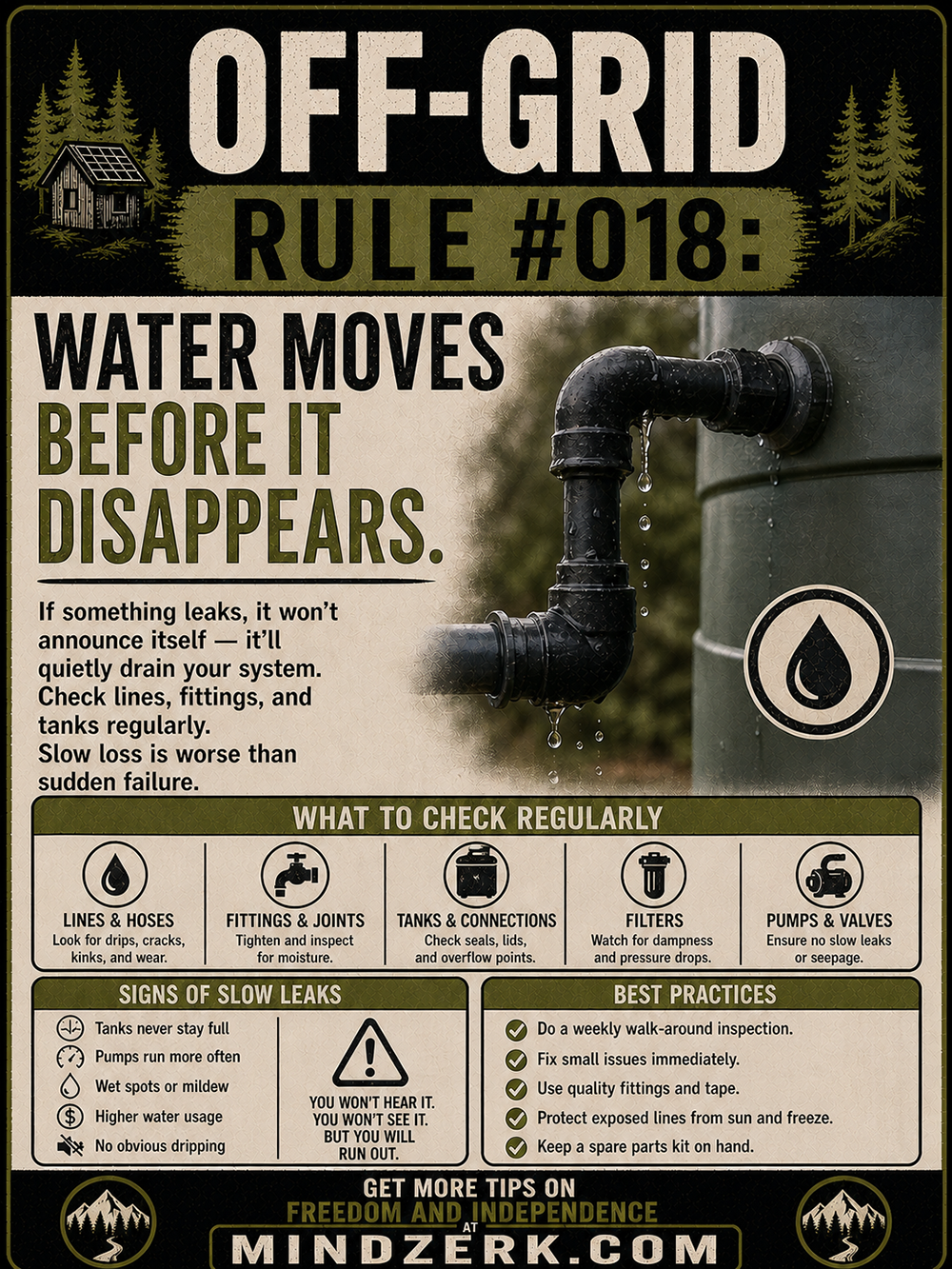
What You Should Be Checking Regularly
Lines & Hoses
These are your weakest links.
Look for:
- Drips
- Cracks
- Kinks
- Sun damage
Even small wear becomes a problem fast.
Fittings & Joints
Where connections meet, problems start.
- Tighten loose fittings
- Check for moisture
- Watch for slow seepage
If it can leak, it will leak—eventually.
Tanks & Connections
Your storage is only as good as its seals.
- Inspect lids and seals
- Check overflow points
- Look for damp areas around the base
Filters
Filters can hide issues.
- Reduced pressure
- Damp housings
- Unexpected buildup
If pressure changes, something’s off.
Pumps & Valves
If your pump is working harder than usual…
There’s a reason.
- More frequent cycling
- Lower pressure output
- Strange sounds
Don’t ignore it.
The Warning Signs of a Slow Leak
This is where most people miss it.
You won’t hear dripping.
You won’t see obvious water loss.
But you will notice patterns:
- Tanks never seem full
- Pump runs more often
- Damp spots or mildew appear
- Water usage feels higher
- No clear source of loss
That’s the danger.
It hides in “normal.”
The Reality
A slow leak can drain:
- Your water supply
- Your battery (from pump overuse)
- Your time and energy
And it usually shows up when you need water most.
Best Practices That Actually Work
Do Regular Walk-Through Inspections
Once a week. No excuses.
Look at everything.
Fix Small Issues Immediately
Don’t wait.
A minor drip becomes a major problem faster than you think.
Use Quality Parts
Cheap fittings fail.
Good materials last longer and leak less.
Protect Your System
Exposure kills systems.
- Sun dries out hoses
- Freezing cracks lines
- Movement loosens joints
Shield what you can.
Keep Spare Parts Ready
When something fails, you don’t want to “figure it out.”
Have:
- Extra fittings
- Hose sections
- Tape and sealant
Preparation turns problems into quick fixes.
The Biggest Mistake
People wait for obvious failure.
But water systems don’t fail loudly.
They fail quietly.
You won’t hear it.
You won’t see it.
But you will feel it when you run out.
The Mindset Shift
Stop thinking:
“Everything looks fine.”
Start thinking:
“Where is water slowly escaping?”
That question changes how you inspect everything.
The Bottom Line
Water loss isn’t dramatic.
It’s silent.
Gradual.
Relentless.
By the time it’s obvious, it’s already too late.
Stay ahead of it.
Check your system.
Fix small issues fast.
Watch for patterns.
Because off-grid…
water doesn’t disappear.
It moves first.