
People love buying security tools.
Encrypted apps.
VPNs.
Firewalls.
Password managers.
Privacy-focused operating systems.
Secure browsers.
All useful.
But most privacy failures do not happen because encryption failed.
They happen because a human made a mistake.
One careless click.
One reused password.
One fake email.
One overshared detail.
One moment of distraction.
That’s usually all it takes.
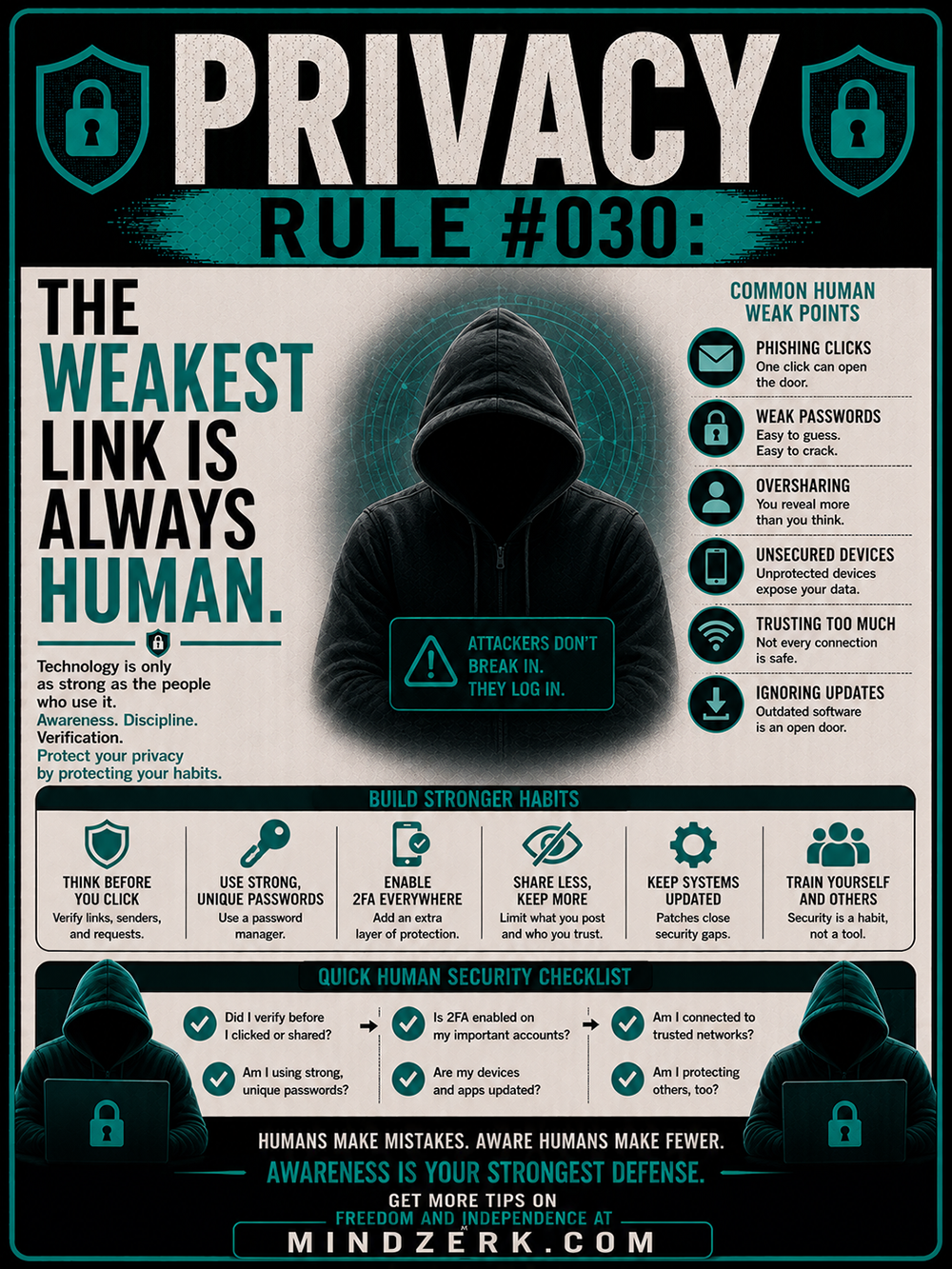
Because the weakest link in almost every security system is not the technology.
It’s the human using it.
Attackers Rarely “Hack In” Anymore
Most modern attacks do not look like movie hacking scenes.
Nobody is dramatically typing green code in a dark room while breaking through firewalls.
Most attacks are far simpler.
Attackers:
- trick people
- manipulate trust
- exploit habits
- abuse convenience
- rely on distraction
They don’t always break in.
Often, they log in.
That distinction matters.
Human Weaknesses Create Open Doors
Technology can only protect you so far.
If a person:
- clicks the phishing link
- installs the malicious app
- reuses passwords
- ignores updates
- trusts the wrong person
- overshares information
…the security system collapses anyway.
The attacker does not need to defeat the vault if someone leaves the door open.
Phishing Works Because Humans React Emotionally
Phishing succeeds because humans respond emotionally before thinking critically.
Attackers use:
- urgency
- fear
- authority
- curiosity
- panic
- greed
- confusion
Examples:
- “Your account has been locked.”
- “Immediate action required.”
- “Click here to avoid suspension.”
- “You missed a package delivery.”
- “Payroll update needed.”
The goal is simple:
make you react before you verify.
That’s why slowing down is a security skill.
Weak Passwords Are Still Everywhere
Despite endless warnings, weak passwords remain one of the biggest security problems online.
People still use:
- reused passwords
- predictable phrases
- birthdays
- pet names
- short passwords
Once one account is breached:
attackers often test those same credentials everywhere else.
That means one weak password can expose:
- banking
- social accounts
- cloud storage
- work systems
- business operations
Strong security starts with strong password habits.
Oversharing Creates Intelligence For Attackers
People constantly publish information they should keep private.
Not because they are stupid.
Because modern platforms reward oversharing.
Every post can reveal:
- routines
- locations
- relationships
- habits
- vulnerabilities
- emotional states
- travel schedules
- financial clues
Attackers collect small details over time.
Then they combine them.
That process is called social engineering.
And it is extremely effective.
Unsecured Devices Become Easy Targets
People secure accounts…
then ignore devices.
Meanwhile:
- outdated phones
- unpatched laptops
- unsecured Wi-Fi
- infected apps
- shared devices
…become entry points.
A compromised device can bypass many other protections entirely.
That’s why updates matter.
Not because companies are annoying.
Because patches close known security holes.
Trust Is Exploitable
Humans naturally trust familiarity.
Attackers know this.
That’s why scams often impersonate:
- coworkers
- banks
- delivery companies
- family members
- customer support
- government agencies
The more convincing the identity,
the easier the manipulation.
Verification matters more than appearance.
Always.
Awareness Is More Powerful Than Paranoia
You do not need to live in fear.
But you do need awareness.
Strong privacy habits are mostly about:
- slowing down
- verifying information
- reducing unnecessary exposure
- questioning convenience
- building disciplined routines
Privacy is not one giant decision.
It is thousands of small habits.
Think Before You Click
This single habit prevents enormous damage.
Before clicking:
- inspect the sender
- check the URL carefully
- question urgency
- verify independently
- avoid emotional reactions
Most successful attacks depend on impulsive behavior.
Pausing breaks the attack chain.
Use Strong, Unique Passwords
Every important account should have:
- a long password
- a unique password
- no reuse across services
Password managers help enormously because humans are bad at remembering dozens of secure passwords consistently.
Strong password habits remove one of the easiest attack paths available.
Enable 2FA Everywhere
Two-factor authentication is one of the highest-value security habits available.
Even if a password leaks:
2FA can stop attackers from accessing the account.
Especially protect:
- banking
- cloud storage
- work accounts
- social platforms
- payment systems
Your email account is particularly important because it often becomes the recovery point for everything else.
Share Less. Keep More.
Oversharing creates exposure.
Not every thought needs posting.
Not every purchase needs documenting.
Not every location needs broadcasting.
The less attackers know:
the harder targeting becomes.
Privacy often improves simply by reducing unnecessary visibility.
Keep Systems Updated
Updates are annoying.
Ignoring them is worse.
Security patches exist because vulnerabilities were discovered.
Outdated systems become easy targets precisely because attackers already know the weaknesses.
Update:
- operating systems
- browsers
- routers
- apps
- plugins
- firmware
Basic maintenance prevents avoidable problems.
Security Is A Habit, Not A Product
Many people buy security tools hoping the tool itself creates safety.
It doesn’t.
Security tools help.
Habits protect.
A careless user with advanced tools is still vulnerable.
A disciplined user with basic tools is often safer.
Because consistency matters more than hype.
Train The People Around You
Your privacy is connected to others.
A careless friend, family member, employee, or coworker can expose information unintentionally.
That means security culture matters.
Teach:
- verification habits
- phishing awareness
- password discipline
- safe sharing practices
- skepticism toward unexpected requests
A chain is only as strong as its weakest link.
The Human Security Checklist
Ask yourself regularly:
- Did I verify before clicking?
- Are my passwords unique?
- Is 2FA enabled?
- Are my systems updated?
- Am I oversharing?
- Do I trust this network?
- Am I protecting the people connected to me too?
Simple awareness catches many problems early.
Most Security Failures Are Preventable
That’s the uncomfortable truth.
Most breaches are not genius-level attacks.
They are:
- rushed decisions
- ignored warnings
- weak habits
- lazy security
- emotional reactions
- convenience over discipline
Small mistakes create massive consequences.
But small protective habits compound too.
Final Thought
Technology matters.
But habits matter more.
Because attackers understand something many people forget:
Humans are predictable.
Distracted.
Emotional.
Trusting.
Impatient.
That is what gets exploited.
So build better habits.
Slow down.
Verify more.
Share less.
Question convenience.
Stay aware.
Humans make mistakes.
Aware humans make fewer.
And in privacy:
awareness is your strongest defense.