
Survival advice is everywhere.
Books. Shows. TikToks. YouTube “experts” with perfect teeth and spotless gear.
Most of it is wrong.
Or worse—it’s half-true, which is far more dangerous. Half-true advice gets people confident enough to make fatal decisions.
Real survival isn’t cinematic.
It’s boring. Uncomfortable. Quiet. And deeply unglamorous.
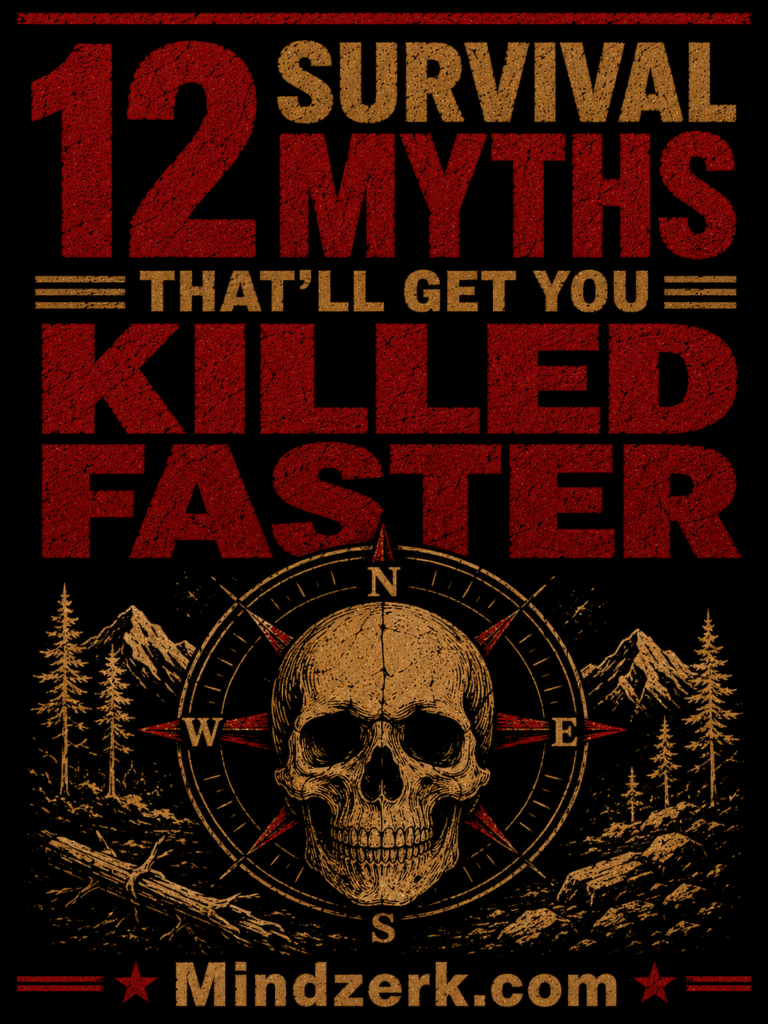
Below are 12 survival myths that sound smart, feel empowering, and routinely get people injured, lost, or dead.
1. “Just Follow the Sun / Moss / Stars”
This one refuses to die.
- Moss does not reliably grow on the north side of trees.
- The sun does not rise and set in clean east-west lines once terrain is involved.
- Stars are useless if it’s cloudy, smoky, or you don’t actually know astronomy.
People who rely on “natural navigation tricks” usually end up walking in circles until exhaustion wins.
Reality:
Navigation comes from tools + discipline:
- Map and compass
- GPS with battery management
- Knowing when to stop moving
Walking confidently in the wrong direction kills faster than staying put.
2. “Fire Is Your Top Priority”
Fire looks important.
Fire feels productive.
Fire is often a distraction.
People waste precious daylight trying to friction-start a fire while:
- Dehydrated
- Hypothermic
- Already disoriented
Reality:
Your priorities are:
- Shelter
- Water
- Heat (fire or insulation)
- Signaling
- Food (way later than you think)
Fire helps—but only after the basics are handled.
3. “You Can Survive Weeks Without Food”
This is technically true.
And practically deadly.
Yes, humans can survive weeks without eating—but that assumes:
- Warmth
- Hydration
- Minimal exertion
- No stress response
In real survival situations, calorie deficits lead to:
- Poor decision-making
- Faster hypothermia
- Muscle failure
- Panic spirals
Reality:
Food matters because it preserves clarity, not because you’ll starve on Day 3.
4. “If You’re Tough Enough, You’ll Make It”
Survival isn’t about toughness.
It’s about energy management.
Tough people:
- Push too far
- Ignore injuries
- “Power through” dehydration
- Refuse to stop before collapse
Reality:
Survivors pace themselves.
They stop early.
They rest often.
They treat minor problems before they become fatal.
Ego kills faster than weakness.
5. “Nature Will Provide”
Nature does not provide.
Nature permits—sometimes.
Wild food myths get people poisoned, sick, or desperate:
- Misidentified plants
- Unsafe water sources
- Parasites
- Bacterial infections
Reality:
Unless you already know the local ecology intimately, foraging is a risk, not a solution.
Water purification matters more than food knowledge.
6. “You Should Keep Moving to Find Help”
This myth has killed countless lost hikers.
Movement feels proactive.
Stillness feels like failure.
But wandering:
- Increases exposure
- Burns calories
- Makes you harder to find
- Compounds navigation errors
Reality:
If you are lost but not injured:
- Stop
- Shelter
- Signal
- Conserve energy
Search teams find stationary people.
They don’t find moving targets.
7. “Gear Is Everything”
Gear obsession is modern survival culture’s biggest lie.
People pack:
- Knives they don’t know how to use
- Gadgets that fail in cold
- Tools they’ve never tested
And forget:
- Fitness
- Familiarity
- Practice under stress
Reality:
The best survival tool is competence.
A cheap kit you’ve practiced with beats expensive gear you panic around.
8. “Urban Survival Is Easier Than Wilderness Survival”
Cities feel safer.
They’re not.
Urban disasters bring:
- Crowds
- Violence
- Resource competition
- Infrastructure failure
- Zero privacy
In wilderness survival, your enemy is environment.
In urban survival, your enemy is other people under stress.
Reality:
Urban survival requires:
- Social awareness
- Mobility planning
- Noise discipline
- Exit routes
It’s a different skillset—and often more dangerous.
9. “Water Is Always the Biggest Threat”
Yes, dehydration kills.
But exposure kills faster.
People obsess over water while:
- Getting soaked
- Losing body heat
- Ignoring wind exposure
- Sleeping on cold ground
Reality:
Hypothermia can kill in hours—even in mild weather.
Stay dry.
Insulate from the ground.
Block wind.
Water matters—but temperature kills quietly.
10. “Signaling Means Big, Dramatic Signals”
People imagine:
- Huge signal fires
- Giant SOS symbols
- Constant shouting
All of which:
- Drain energy
- Expose you unnecessarily
- May never be seen
Reality:
Effective signaling is:
- Consistent
- Repeatable
- Low-energy
Whistles. Mirrors. Controlled signals at known intervals.
Survival is about being found, not being loud.
11. “Survival Is a Solo Skill”
The lone survivor fantasy is seductive.
It’s also statistically worse.
Solo survival means:
- No error correction
- No shared workload
- No morale buffering
- No backup if injured
Reality:
Groups survive better—if they’re disciplined.
Leadership, communication, and task division matter more than individual heroics.
12. “If You’re Smart, Panic Won’t Happen”
This one is deadly.
Panic doesn’t care how smart you are.
Stress hormones:
- Shut down fine motor skills
- Narrow attention
- Distort time perception
- Override logic
Reality:
You don’t eliminate panic.
You train around it.
Simple routines.
Checklists.
Automatic behaviors practiced before you need them.
Survival favors the prepared—not the intelligent.
The Real Survival Truth Nobody Sells
Survival isn’t about:
- Being fearless
- Being extreme
- Being impressive
It’s about:
- Slowing down
- Making boring decisions
- Avoiding mistakes
- Preserving clarity
Most survival deaths don’t come from dramatic moments.
They come from small, confident errors made repeatedly.
The goal isn’t to conquer the situation.
The goal is to not make it worse.
That’s how people actually survive.
Want the Real Urban Survival Playbook?
If this article made one thing clear, it’s this:
urban survival is a different animal.
Most “survival guides” are built for forests you’ll never be lost in, not cities where systems fail, crowds panic, and mistakes compound fast.
That’s exactly why we built Urban Chaos Survival.
https://mindzerk.com/b/urban-survival
This isn’t gear porn or apocalypse fantasy. It’s a clear-headed field guide for real-world breakdowns:
- How to move without drawing attention
- What actually matters when infrastructure fails
- How to think when everyone else is reacting
- Practical strategies for shelter, mobility, and discretion
- Mental frameworks that prevent panic before it starts
No hero myths. No Hollywood nonsense. Just the stuff that keeps you alive when things get quiet—and weird.
If you live in a city, suburb, or anywhere dependent on systems you don’t control, this belongs in your stack.
🔗 Get Urban Chaos Survival → https://mindzerk.com/b/urban-survival
Read it before you need it.