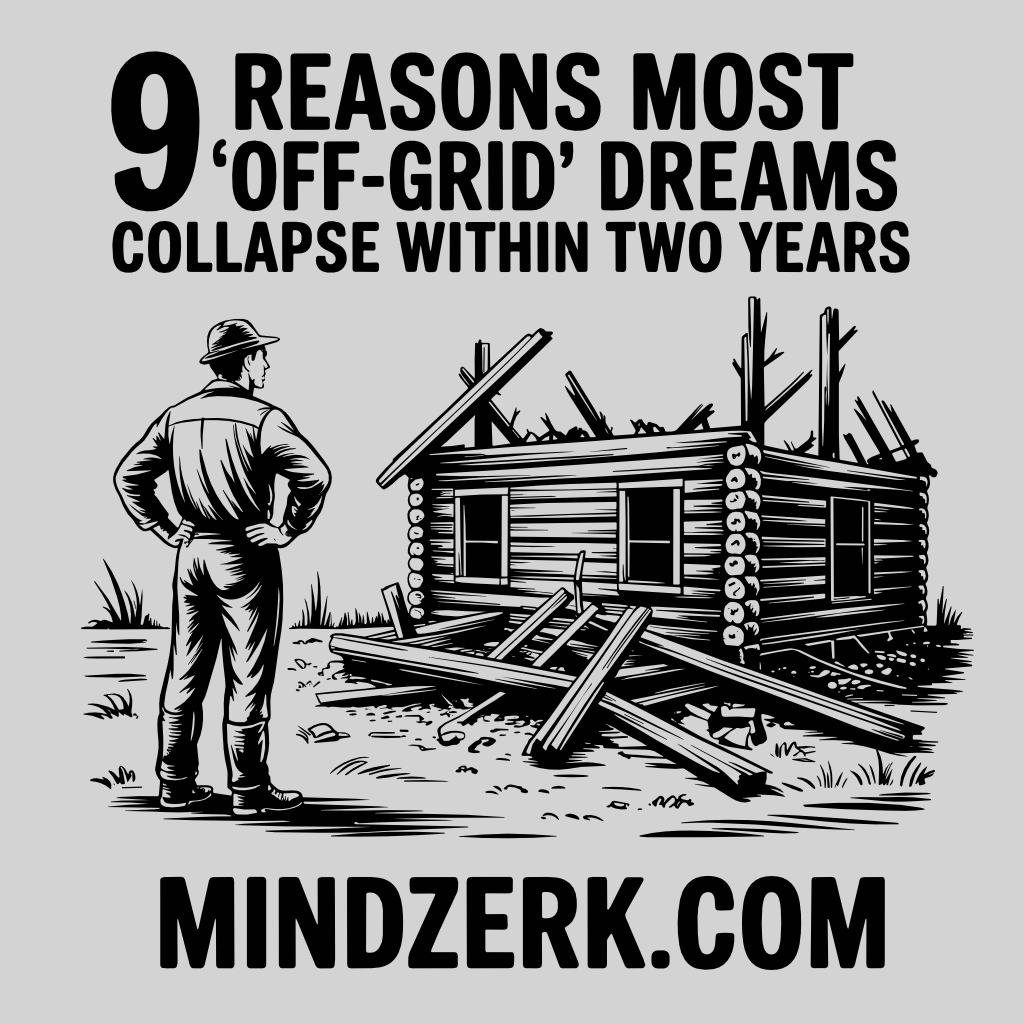

Most off-grid dreams don’t fail dramatically.
There’s no blizzard death scene.
No bear attack.
No heroic last stand.
They fail quietly.
A slow grind of fatigue, paperwork, miscalculations, and loneliness until one day the person packs up, sells cheap, or just… disappears back into the system they swore they were escaping.
If you’ve ever wondered why so many people vanish from the off-grid forums after a year or two, here’s the real answer.
It’s not because the land won.
It’s because reality did.
1. They Confuse Isolation With Independence
Living far away from people doesn’t automatically make you free.
Many off-grid setups are still deeply dependent:
- on fuel deliveries
- on online income
- on nearby towns
- on legal tolerance
When one of those inputs fails, isolation becomes exposure.
Independence isn’t distance.
It’s self-sufficiency across systems.
Most people never build that.
2. They Underestimate Bureaucracy More Than Weather
Cold can be planned for.
Snow can be adapted to.
Animals can be defended against.
Paperwork is different.
Zoning notices.
Permit violations.
Tax issues.
Environmental complaints.
One letter can shut down years of effort.
Most failures happen not because someone couldn’t survive —
but because they didn’t understand how land is actually controlled.
3. They Build Shelters That Slowly Kill Them
Most off-grid shelters fail silently.
Drafts you don’t notice at first.
Moisture trapped behind walls.
Roofs under-engineered for snow load.
Poor ventilation causing mold and CO buildup.
Nothing dramatic — just declining health, higher fuel use, constant repairs.
A shelter isn’t a structure.
It’s a life-support system.
And most are built like weekend projects.
4. They Never Calculate Calories Honestly
This one ends more dreams than bears ever will.
People drastically underestimate:
- how many calories they burn hauling water and wood
- how little food hunting actually provides
- how unreliable foraging is long-term
If you burn 4,000 calories a day and replace 2,000, the math doesn’t care how motivated you are.
Starvation doesn’t announce itself.
It just makes everything harder until you quit.
5. They Rely on Technology Instead of Redundancy
Solar panels.
Batteries.
Internet.
Water pumps.
Technology feels empowering — until it fails.
Batteries die.
Panels ice over.
Electronics corrode.
Replacement parts take weeks.
Survivability comes from redundancy, not gadgets.
Most people build systems that work perfectly — until they don’t.
6. They Ignore Winter Until Winter Arrives
Summer off-grid life is forgiving.
Winter is not.
Everything costs more effort:
- water freezes
- food disappears
- movement slows
- mistakes compound
Many people reach their first winter unprepared, exhausted, and under-supplied — and that’s the beginning of the end.
Winter isn’t a season.
It’s a stress test.
7. They Attract Attention Without Realizing It
Noise.
Smoke.
Light.
Tracks.
Online posts.
People announce themselves constantly without noticing.
Neighbors notice.
Officials notice.
Hunters notice.
Drones notice.
Being off-grid doesn’t mean being invisible.
Visibility is a skill.
Most people never learn it.
8. They Don’t Plan for Injury or Illness
A twisted ankle.
An infected cut.
A broken tooth.
Small problems become major ones when help is far away.
Many off-grid setups have no:
- medical redundancy
- evacuation plan
- self-treatment capability
One untreated injury can end everything.
Survival isn’t about toughness.
It’s about preparing for weakness.
9. They Are Not Psychologically Ready for Silence
This is the one nobody talks about.
The silence is heavy.
The isolation is real.
The days blend together.
Without constant stimulation, unresolved thoughts surface.
Anxiety spikes.
Motivation drops.
Meaning wobbles.
Most people don’t quit because they’re afraid.
They quit because they’re alone with themselves for too long.
The Pattern Nobody Admits
Off-grid dreams don’t collapse because people lack courage.
They collapse because people confuse escape with infrastructure.
Freedom isn’t about leaving.
It’s about replacing everything you leave behind —
legally, physically, psychologically, and logistically.
That replacement takes planning.
Not vibes.
Why This Matters
If you’ve ever felt drawn to autonomy but unsettled by how often others fail, that instinct is correct.
Most people aren’t failing because freedom is impossible.
They’re failing because no one taught them how it actually works.
And by the time they realize that, they’re already too invested to recover.
Understanding the failure points early changes everything.
Most people don’t fail off-grid because they’re weak.
They fail because they never saw the failure points coming.
They moved with hope instead of orientation.
With inspiration instead of infrastructure.
Operation Last Frontier exists to correct that mistake.
It is not a dream.
It is not motivation.
It is a tactical field guide to how autonomy actually works — where it still exists, how land is really controlled, how people survive long-term without attracting attention, and what the cost of holding ground truly is.
If you’re serious about understanding freedom beyond slogans and aesthetics — before committing years, money, or your safety — this is where that understanding begins.
OPERATION LAST FRONTIER
The Tactical Guide to Seizing Territory and Absolute Autonomy