
If your entire setup depends on one thing working perfectly… you don’t have a system.
You have a single point of failure.
And off-grid, failure isn’t an inconvenience.
It’s a problem that shows up fast—at night, in bad weather, or when you need power most.
Real independence comes from layers, not luck.
The Core Principle
One power source = fragile.
Layered power = resilient.
Your goal isn’t just to generate power.
It’s to stay powered no matter what breaks.
Because something will break.
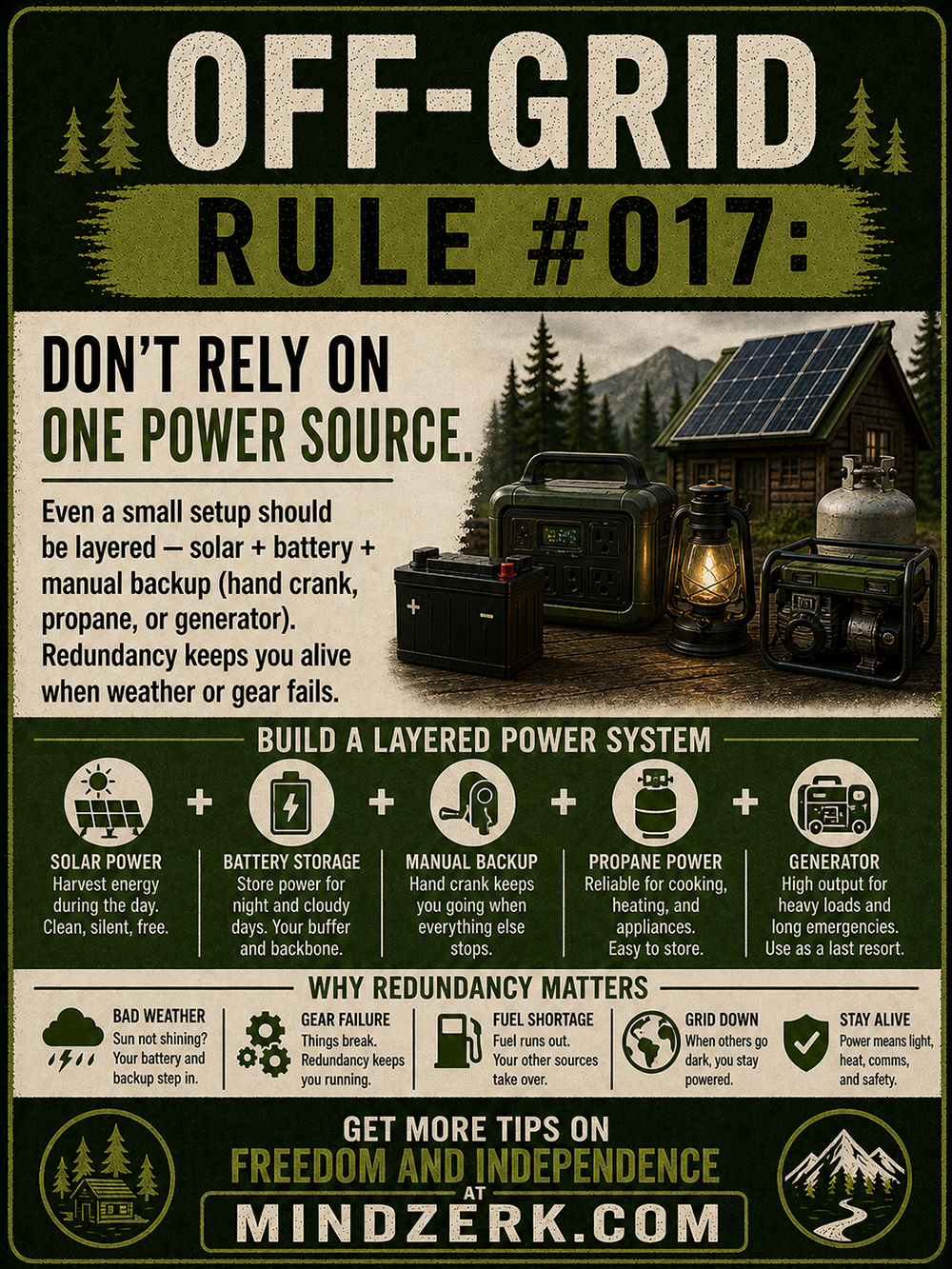
What a Layered Power System Looks Like
Think of your setup like a stack—not a single line.
1. Solar Power (Primary Source)
Your everyday workhorse.
- Charges during the day
- Silent and renewable
- Handles your baseline needs
This is your foundation—not your guarantee.
2. Battery Storage (Your Buffer)
Power doesn’t matter if you can’t hold onto it.
- Runs your system at night
- Covers cloudy days
- Smooths out fluctuations
Batteries turn sunlight into usable, reliable energy.
3. Manual Backup (Last-Resort Lifeline)
This is what keeps you going when everything else fails.
- Hand-crank radios or chargers
- Mechanical tools
- No fuel required
It’s slow. It’s basic. But it works when nothing else does.
4. Propane Power (Reliable Utility Layer)
Simple, dependable, and easy to store.
- Cooking
- Heating
- Basic appliances
Not everything needs electricity. Propane fills the gaps.
5. Generator (Emergency Power)
High output when you need it most.
- Heavy loads
- Long outages
- System recovery
Use it as a backup, not a crutch.
Why Redundancy Matters
Most people don’t plan for failure.
They assume things will just work.
That’s where they lose control.
Bad Weather
No sun? Solar drops.
Your batteries and backups take over.
Gear Failure
Something breaks. It will.
If you’ve got layers, you stay up.
If you don’t, you’re in the dark.
Fuel Shortage
Gas runs out. Deliveries stop.
If you’re diversified, it’s a hiccup.
If not, it’s a shutdown.
Grid Down
When others go dark…
You stay powered.
That’s the difference.
Survival Basics
Power isn’t just convenience.
It’s:
- Light
- Heat
- Communication
- Safety
Take it seriously.
The Biggest Mistake People Make
They build for efficiency, not resilience.
They optimize one system:
- Bigger solar array
- Larger battery
- More powerful generator
But still…
One failure = total failure.
That’s not off-grid thinking.
How to Build It the Right Way
Start Small, But Layered
Even a basic setup can have redundancy:
- Solar panel
- Small battery
- Propane stove
- Flashlights or manual gear
You don’t need massive scale.
You need coverage.
Think in Scenarios
Ask yourself:
- What happens if it’s cloudy for 3 days?
- What if something breaks?
- What if fuel runs out?
If you don’t have an answer, you don’t have a system yet.
Separate Your Dependencies
Don’t let everything rely on the same source.
Example:
- Lights on battery
- Cooking on propane
- Backup with manual tools
Now one failure doesn’t take everything down.
Test Your Setup
Don’t wait for an emergency.
- Turn systems off
- Run backups
- Find weak points
The test is where the truth shows up.
The Mindset Shift
Stop asking:
“What’s the best power source?”
Start asking:
“What happens when this one fails?”
That question changes everything.
The Bottom Line
Off-grid isn’t about having power.
It’s about keeping power.
Through weather.
Through failure.
Through uncertainty.
One source is convenience.
Multiple sources are control.
Build for failure—and you’ll never be caught off guard.