
Most people think privacy is about what they post.
It’s not.
It’s about how people can reach you… and how easily they can watch you move.
Every way in.
Every way out.
Every path you take.
Those are your real exposure points.
If someone can predict where you’ll be, when you’ll be there, and how you got there…
your privacy is already compromised.
The Core Principle
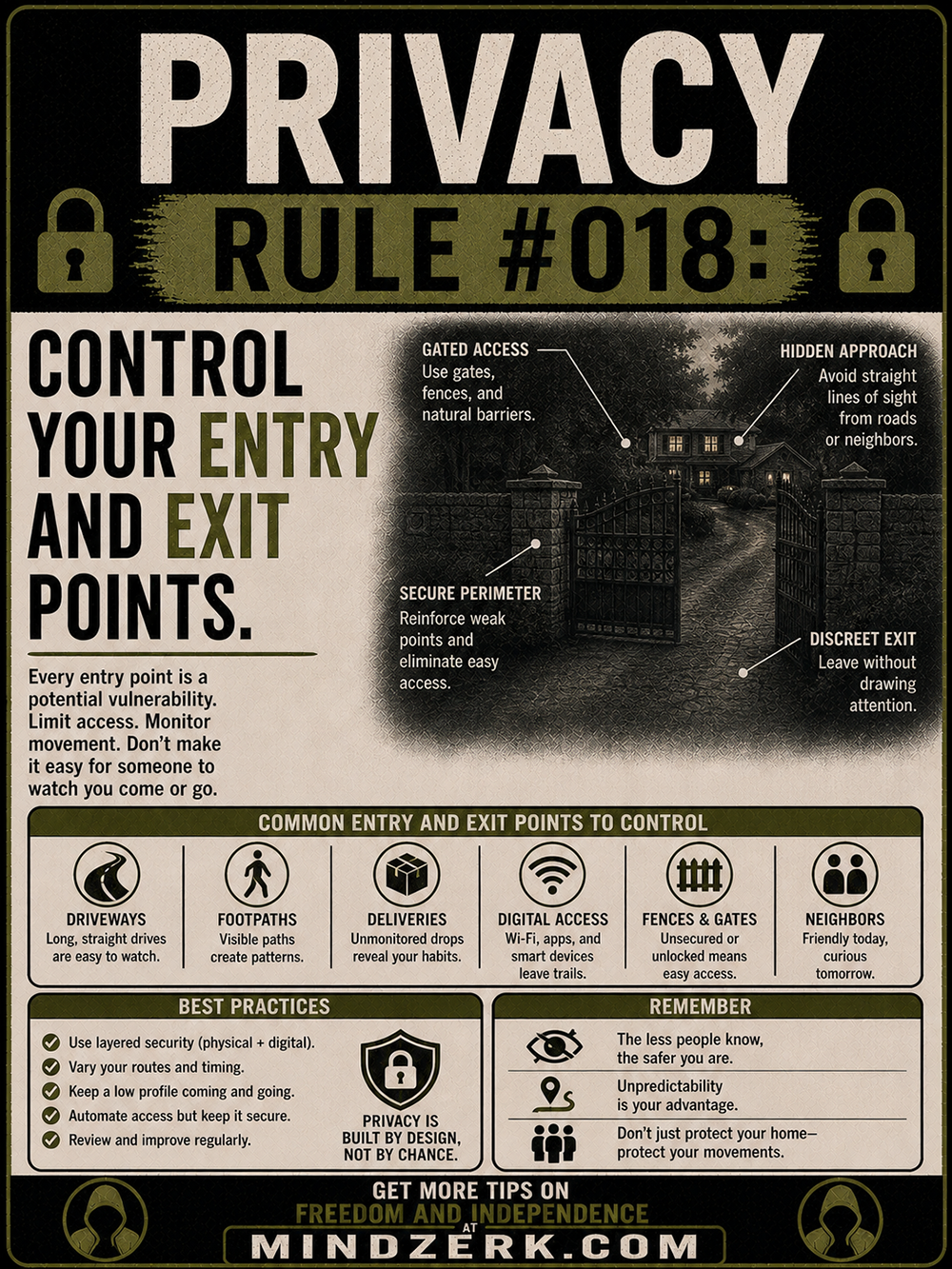
Every entry point is a vulnerability.
Every exit point is a signal.
Control both—and you control your visibility.
Ignore them—and you create a pattern anyone can follow.
What “Entry and Exit Points” Actually Means
This isn’t just about doors and gates.
It’s everything connected to how you move:
- Physical access to your space
- Paths people can see you use
- Digital access to your accounts
- Habits tied to when you arrive and leave
Movement is data.
And most people leak it constantly.
Where You’re Exposed (Without Realizing It)
Driveways
Long, straight approaches are easy to observe.
Anyone can see when you come and go.
Footpaths
Visible routes create predictable movement.
Same path. Same time. Every day.
Deliveries
Packages reveal patterns.
- When you’re home
- What you buy
- How often you order
Digital Access
Wi-Fi, apps, and smart devices log activity.
Your movement isn’t just physical—it’s tracked digitally.
Fences & Gates
Unsecured access points are open invitations.
Even a small weakness becomes the easiest way in.
Neighbors & Observers
Most people aren’t threats.
But curiosity travels.
What feels casual to you may be information to someone else.
How to Take Control
1. Limit Access Points
Not every path needs to exist.
- Close off unused entries
- Funnel access through controlled points
- Make movement intentional
Fewer access points = fewer problems.
2. Add Physical Barriers
Simple works.
- Gates
- Fences
- Natural barriers
These don’t need to be extreme—just enough to slow and control access.
3. Remove Straight Lines of Sight
Visibility is vulnerability.
- Avoid direct views from roads
- Use landscaping or layout changes
- Break visual access where possible
If they can’t see you, they can’t track you.
4. Control Your Exits
Leaving matters just as much as entering.
- Don’t make departures obvious
- Avoid predictable timing
- Keep movements low-profile
5. Layer Physical + Digital Security
Privacy isn’t just outside your door.
- Secure your networks
- Limit app permissions
- Control device access
Physical security without digital awareness is incomplete.
6. Vary Your Patterns
Routine creates predictability.
Predictability creates exposure.
- Change routes
- Change timing
- Break habits
Unpredictable movement is harder to track.
The Biggest Mistake
People protect their home…
…but ignore their movement.
They lock doors, install cameras, set alarms—
Then:
- Leave at the same time every day
- Use the same path
- Broadcast their habits online
You don’t just need to protect where you are.
You need to protect how you move.
The Mindset Shift
Stop thinking:
“Is my place secure?”
Start thinking:
“Can someone map my movement?”
That’s the real question.
The Reality
Privacy isn’t built by accident.
It’s built by design.
- Fewer access points
- Controlled visibility
- Unpredictable patterns
That’s how you reduce exposure.
The Bottom Line
Every entry point you leave open…
Every exit you make predictable…
…adds to the trail you leave behind.
The less people know about how you move,
the harder it is to track you.
Control the paths.
Control the access.
Control the visibility.
That’s how you stay private—even when the world is watching.