
Most people searching for AI productivity are chasing excitement.
They want:
- New tools
- Viral prompts
- Secret hacks
- Magic automations
- Revolutionary systems
But the workflows that actually produce long-term results are usually… boring.
Not flashy.
Not complicated.
Not constantly changing.
Just reliable.
That’s the part people miss.
Boring workflows win because:
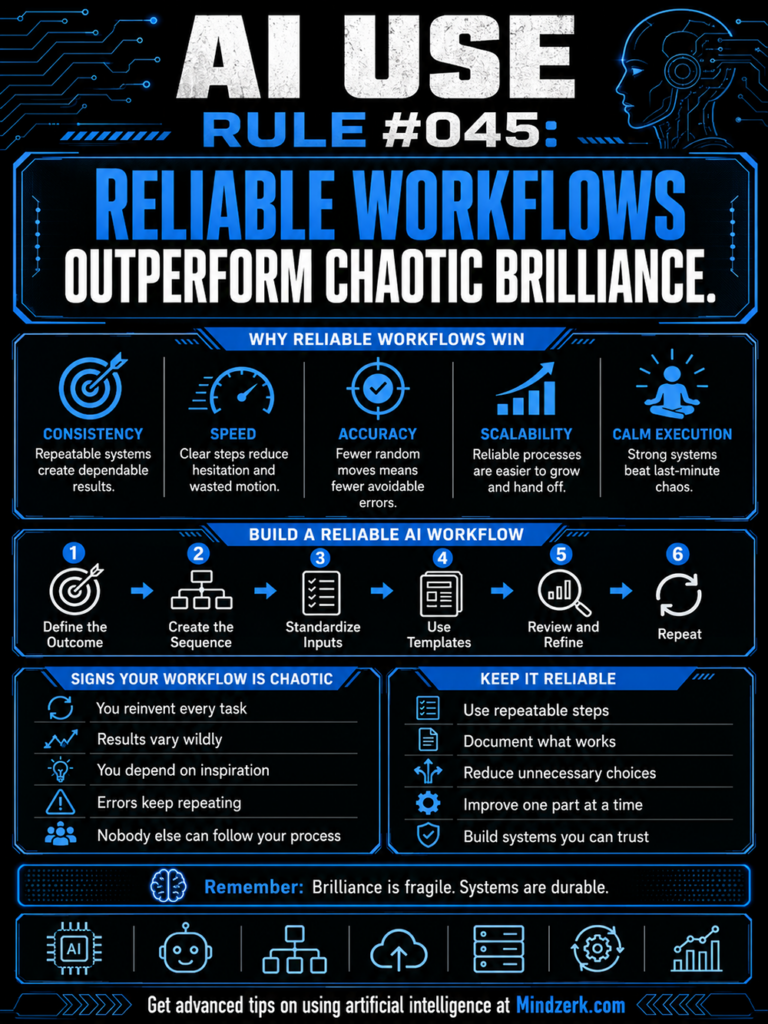
Repeatable systems outperform random bursts of inspiration.
Boring Means Repeatable
When people hear “boring,” they think:
- Uncreative
- Rigid
- Limited
- Basic
But in business and AI systems:
Boring often means dependable.
A boring workflow:
- Produces predictable output
- Saves time
- Reduces mental friction
- Requires fewer decisions
- Can be repeated consistently
- Gets refined over time
And consistency compounds.
Most People Never Build Systems
Instead, they stay trapped in experimentation forever.
They:
- Constantly switch tools
- Rewrite workflows every week
- Chase new AI apps daily
- Overcomplicate simple tasks
- Rebuild from scratch repeatedly
This feels productive.
It usually isn’t.
Tool-hopping destroys momentum.
Reliable Beats Exciting
A simple workflow you actually use is worth more than:
- A perfect workflow you abandon
- A giant automation you never finish
- A complicated setup nobody understands
The goal is not maximum complexity.
The goal is:
Reliable execution.
That means:
- Fewer moving parts
- Clear steps
- Repeatable inputs
- Predictable outcomes
- Easy improvements
Systems Beat Spikes
A lot of creators and entrepreneurs rely on random bursts of energy.
One productive day.
Then chaos.
Then burnout.
Then restarting from zero.
A workflow changes that.
Instead of reinventing the process every day, you create:
- Structure
- Rhythm
- Momentum
- Scalability
That frees up mental energy for higher-level thinking.
The Real AI Advantage
AI is not magic.
Its real power is:
- Speed
- Repetition
- Scaling
- Assistance
- Automation
- Pattern handling
Which means AI works best inside systems.
Not chaos.
Without a workflow:
- AI creates clutter
- Outputs become inconsistent
- Quality drifts
- Work becomes fragmented
But inside a structured process:
AI becomes leverage.
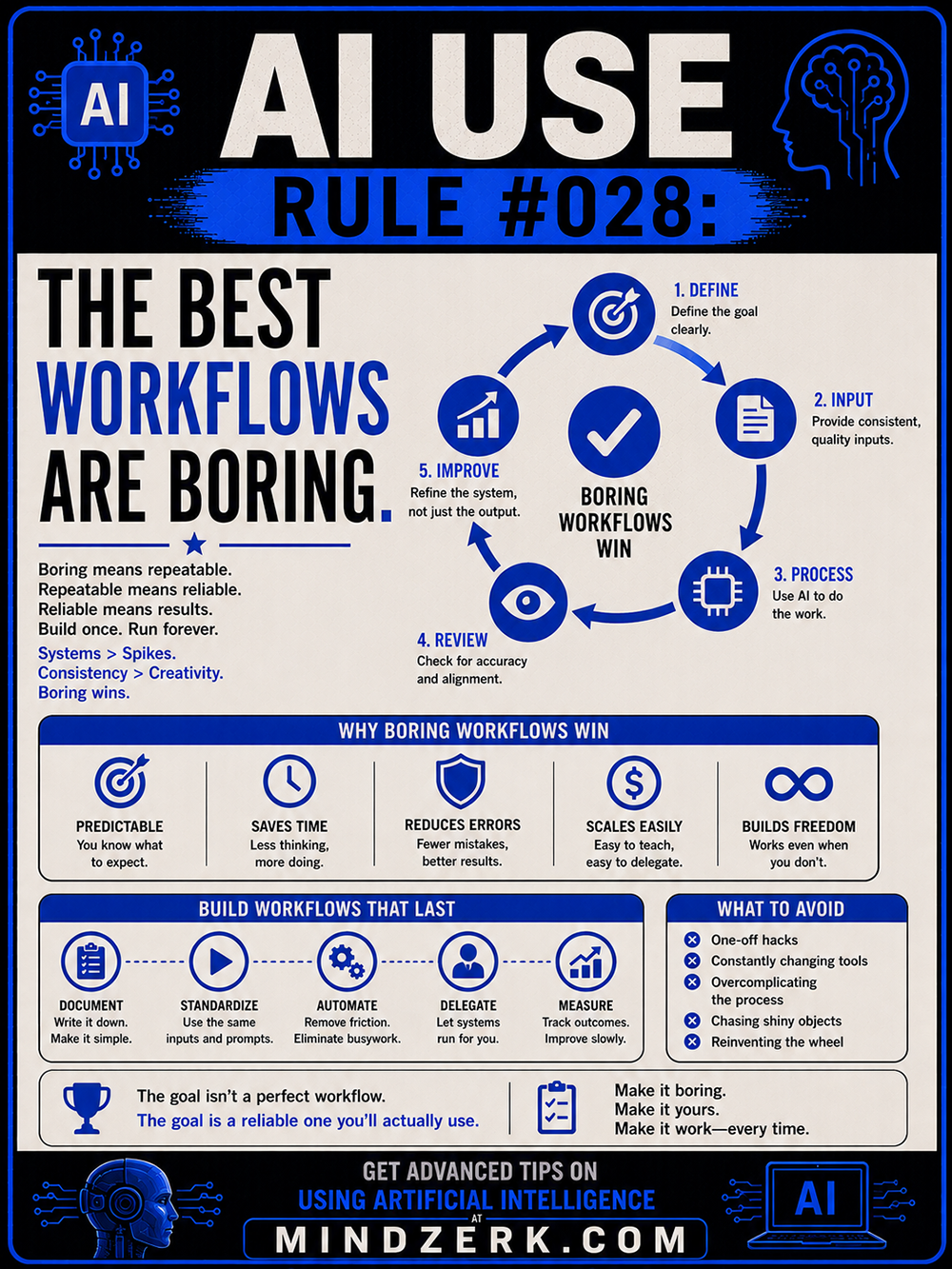
The 5-Part Boring Workflow Loop
The strongest AI workflows are usually simple loops repeated consistently.
1. Define
Know the goal clearly.
What are you trying to create?
- Article?
- Product?
- Video?
- Research?
- Design?
- Email campaign?
Most workflow problems start with vague goals.
Specific goals create cleaner outputs.
2. Input
Garbage in.
Garbage out.
Strong workflows use:
- Consistent prompts
- Clear formatting
- Quality reference material
- Structured information
Good input dramatically improves AI performance.
3. Process
Now let AI do the heavy lifting.
Examples:
- Drafting
- Summarizing
- Brainstorming
- Organizing
- Expanding
- Reformatting
- Data processing
AI handles repetition well.
Humans handle direction well.
4. Review
This is where most people fail.
They copy raw AI output directly without:
- Fact-checking
- Editing
- Refining
- Rewriting
- Improving clarity
- Adding human judgment
Reviewing is what transforms AI-generated content into useful content.
5. Improve
The workflow itself should evolve.
Not just the output.
Ask:
- Where are delays happening?
- What keeps breaking?
- What feels repetitive?
- What can be simplified?
- What can be automated?
Good workflows slowly become smoother over time.
Why Boring Workflows Win
Predictable
You know what to expect.
That reduces chaos.
Saves Time
Less thinking.
More execution.
Reduces Errors
Simple systems fail less often.
Scales Easily
You can:
- Delegate
- Teach others
- Automate parts
- Increase output
Builds Freedom
A reliable system keeps working even when:
- You’re tired
- Busy
- Distracted
- Unmotivated
That matters.
Creativity Still Matters
This does NOT mean creativity disappears.
It means creativity works better inside structure.
Think of it this way:
- Workflow handles repetition
- Creativity handles direction
You need both.
Without creativity:
- Output becomes generic
Without systems:
- Output becomes inconsistent
What To Avoid
One-Off Hacks
Random tricks rarely scale.
Constant Tool Switching
New tools are not always better tools.
Overcomplication
Complexity creates friction.
Shiny Object Syndrome
Research can become avoidance disguised as productivity.
Reinventing Everything
Most people do not need a revolutionary system.
They need:
A functioning one.
Build Workflows That Last
Document Everything
Write the process down.
This creates consistency.
Standardize Inputs
Use reusable prompts, templates, and structures.
Automate Friction
Remove repetitive manual steps where possible.
Delegate
Simple systems are teachable.
Measure Results
Track:
- Time saved
- Output quality
- Conversion rates
- Engagement
- Revenue
- Efficiency
Then improve gradually.
Simple Systems Compound
A boring workflow used every day becomes extremely powerful over time.
That’s because:
- Reliability compounds
- Speed compounds
- Skill compounds
- Efficiency compounds
- Output compounds
The people producing the most are often NOT the people using the fanciest systems.
They are the people:
Consistently running functional ones.
AI Should Reduce Friction, Not Create More
A lot of people accidentally make AI harder than the original task.
They:
- Use too many tools
- Build giant automations
- Create confusing pipelines
- Spend more time tweaking than producing
That defeats the purpose.
The best workflows feel:
- Clear
- Smooth
- Understandable
- Sustainable
Make It Boring
That’s the secret.
Make it:
- Repeatable
- Reliable
- Understandable
- Sustainable
- Easy to run consistently
Because exciting systems often collapse.
Boring systems survive.
And survival compounds into results.
Final Thought
The goal is not building the most impressive workflow on the internet.
The goal is building one:
- You actually use
- That consistently works
- That saves time
- That improves output
- That reduces friction
- That scales over time
Boring workflows win because:
Reliability beats novelty.
Every single time.